



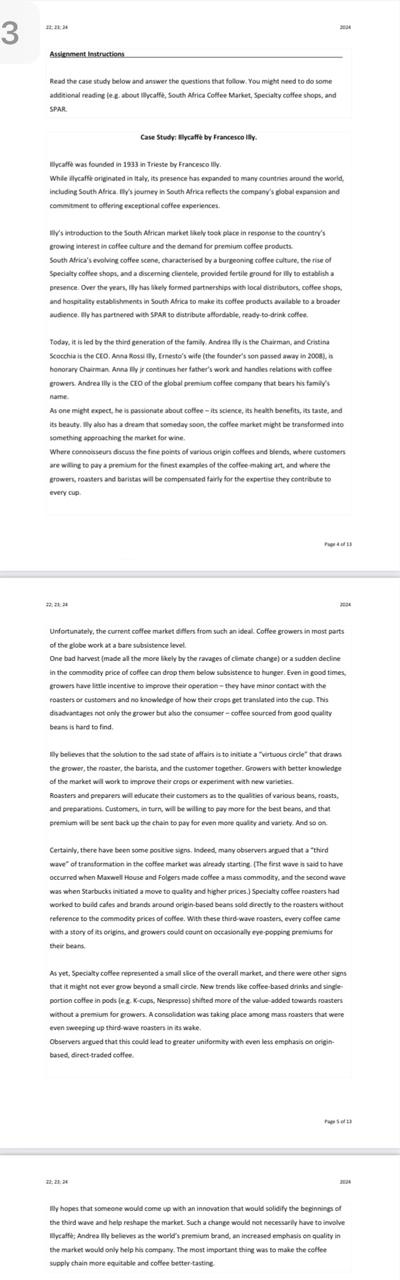
Question: Read the case study below and anawer the questions that folow. You mient need to do some Spar. Cave Study Bryaffe by Franceico illy. Brcafe
Read the case study below and anawer the questions that folow. You mient need to do some
Spar.
Cave Study Bryaffe by Franceico illy.
Brcafe was founded in in Trieste by Francelico lity.
commtment to eftering exceptional coffec experiences.
growing interest in coffee culure and the demand for premium coffee products.
South Africa's evolving coffee scene, characterised by a burgeoning coffec culture, the rise of
and hosptality entablithments in South Atrica to make its coffee products walable to a brouder
Today, it is led by the third generation of the famiay. Addres illy is the Charman, und Cratina
growen. Andrea lily is the cio of the global premium coffee company that bears has famary:
nume.
its beasty. IIy alo has a dream that someday soon, the coffee mariet misht be transtormed into
something appeosehing the market for wine.
are willine to pay a premium for the finest examples of the coffee making art, and where the
erowers, roanters and barital will be compensated farly for the expertise ther comeribute to
every cup.
Unfortunately, the curnent colfee market difles from such an ideal. Coffee growers in most parts
of the globe work at a bare subustence livel.
One bad havest made all the more likely by the ravages of climate change or a sudden decline
in the commodity price of colfee can drop them below subsistence to hunger. Even in good times.
growes have litle incentive to impeove their operation they have minor contact wah the
rounters of customens and no knowledee of how their erops get tranluted into the cup. This
disadvantagei not only the grower but also the conumer colfee sources from good quality
beams is hard to find.
Dy believes that the solution to the sad state of affains is to initiate a "vertuows ciecle" that draws
the crower, the roaster, the barista, and the cuatomer together. Growers with better inowledge
of the makkt will work to improve their orops or esperiment wath new varieties.
Roosters and preparen will educate their customers as to the qualities of various beans, roasts,
and preparasemt. Cuatomen, is turn, will be willing to poy more for the beit beans, and that
premium will be sert back up the chain to pay for even moee quality and variety. And so on
Certainly, there have been some positive signs. Indeed, many observen argued that a "third wave" of tranaformation in the coffee market was already tartine. The this wave in suid to have ocurred when Maxnell House and Folgers made colfee a mass commodity, and the second wave was when Starbucks invianed a move to quality and hieher prices. I Specialty coffee roasters had worked to build cafes and brands around orieinbased beafts sold directly to the roasters without reference to the commedity prices of colfe. What these thirdwave roasten, every colfec came whth a sory of is origins, and erowers could count on octationally eve popping premiums for Beir beans. As yet, Specialy collee represented a smal slice of the overall market, and there were other segs that it might not ever arow beyond a small circle. New trends like coffeebased drinks and singleportion coffee in pods e Kcups, Nespresso shifted more of the value added towards roasters.without a premium for gowers. A consolidation was taking place amons mass roasters that were
even sweping up thirs wave rasters in is wake.
Observers argued that this could load to greater uniformity with even less emphasis on origin. buted, diekttraded solfee.
In Learning Unit to Learning Unit you examined the concept of business analysis; in doing so you encountered the concept of business analysis origins, the scope of the business analysis, and the role and responsibility of a business analyst as a strategy analyst in an organisation. Using the above scenario, the guidance of the prescribed book, as well as at least two other credible sources, you have been asked as a business analyst to establish an innovation strategy that would solidify the beginnings of the third wave and help reshape the market.
Q Using the Mission, Objectives, Strategies, and Tactics MOST analysis framework, identify the factors that illycaff needs to take into consideration when establishing illycaffe. Apply the MOST Analysis to explain how Andrea Illy and illycaff align their mission and strategies to foster the transformation of the coffee market.
Q In addition to the case study above, illycaff has further identified potential strategies to meet his goals for the thirdwave transformation.
Strategy : Partner with coffee growers to provide training in sustainable
and qualityfocused farming practices.
Strategy : Develop marketing and education campaigns to raise
consumer awareness about coffee origins and quality.
Strategy : Strengthen relationships with thirdwave speciality coffee roasters.
Strategy : Innovate in coffee processing and packaging for sustainability & quality.
Illycaff has the budget to meet and implement one strategy in this current financial year.
Step by Step Solution
There are 3 Steps involved in it
1 Expert Approved Answer
Step: 1 Unlock

Question Has Been Solved by an Expert!
Get step-by-step solutions from verified subject matter experts
Step: 2 Unlock
Step: 3 Unlock