







Question: Read the case study From Peanuts to Prison: Applying Ethical Theories of Decision Making. Explain how Mary should have handled the situation when pressured by
Read the case study From Peanuts to Prison: Applying Ethical Theories of Decision Making.
Explain how Mary should have handled the situation when pressured by Parnell. Apply the decision-making model and explain which ethical philosophy (utilitarianism, human rights and duties, or ethical relativism) guided your approach to the decision-making model. Cite sources that support/provide evidence for what you write.
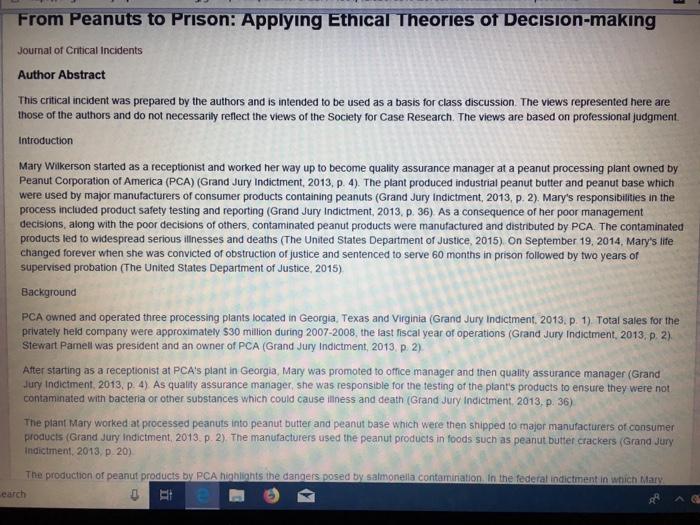

From Peanuts to Prison: Applying Ethical Theories of Decision-making Journal of Critical Incidents Author Abstract This critical incident was prepared by the authors and is intended to be used as a basis for class discussion. The views represented here are those of the authors and do not necessarily reflect the views of the Society for Case Research. The views are based on professional judgment. Introduction Mary Wilkerson started as a receptionist and worked her way up to become quality assurance manager at a peanut processing plant owned by Peanut Corporation of America (PCA) (Grand Jury Indictment, 2013, p. 4). The plant produced industrial peanut butter and peanut base which were used by major manufacturers of consumer products containing peanuts (Grand Jury Indictment, 2013, p. 2). Mary's responsibilities in the process included product safety testing and reporting (Grand Jury Indictment, 2013, p. 36). As a consequence of her poor management decisions, along with the poor decisions of others, contaminated peanut products were manufactured and distributed by PCA. The contaminated products led to widespread serious illnesses and deaths (The United States Department of Justice, 2015). On September 19, 2014, Mary's life changed forever when she was convicted of obstruction of justice and sentenced to serve 60 months in prison followed by two years of supervised probation (The United States Department of Justice, 2015) Background PCA owned and operated three processing plants located in Georgia, Texas and Virginia (Grand Jury Indictment, 2013, p. 1). Total sales for the privately held company were approximately $30 million during 2007-2008, the last fiscal year of operations (Grand Jury Indictment, 2013, p. 2). Stewart Parnell was president and an owner of PCA (Grand Jury Indictment, 2013, p. 2). After starting as a receptionist at PCA's plant in Georgia, Mary was promoted to office manager and then quality assurance manager (Grand Jury Indictment, 2013, p. 4) As quality assurance manager, she was responsible for the testing of the plant's products to ensure they were not contaminated with bacteria or other substances which could cause illness and death (Grand Jury Indictment, 2013, p. 36) The plant Mary worked at processed peanuts into peanut butter and peanut base which were then shipped to major manufacturers of consumer products (Grand Jury Indictment, 2013. p. 2). The manufacturers used the peanut products in foods such as peanut butter crackers (Grand Jury Indictment, 2013, p. 20) The production of peanut products by PCA highlights the dangers posed by salmonella contamination. In the federal indictment in which Mary earch e ii
Step by Step Solution
3.43 Rating (159 Votes )
There are 3 Steps involved in it
Introduction In the view of the case study the example reflects the businesss ethical values that show how the moral practices and principles must be ... View full answer

Get step-by-step solutions from verified subject matter experts
 Study Help