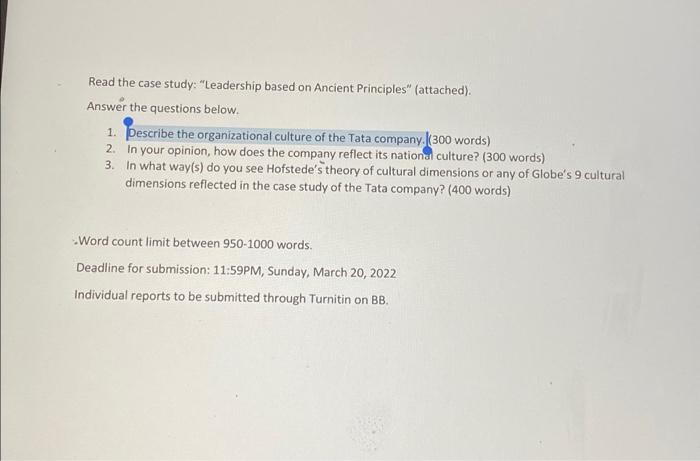
Question: Read the case study: Leadership based on Ancient Principles (attached). Answer the questions below. 1. Describe the organizational culture of the Tata company. ((300 words)
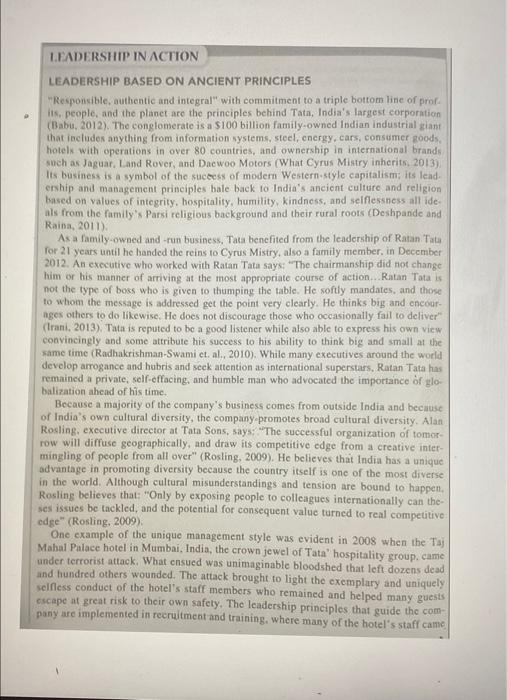
Read the case study: "Leadership based on Ancient Principles" (attached). Answer the questions below. 1. Describe the organizational culture of the Tata company. ((300 words) 2. In your opinion, how does the company reflect its national culture? ( 300 words) 3. In what way(s) do you see Hofstede's theory of cultural dimensions or any of Globe's 9 cultural dimensions reflected in the case study of the Tata company? (400 words) Word count limit between 950-1000 words. Deadline for submission: 11:59PM, Sunday, March 20,2022 Individual reports to be submitted through Turnitin on BB. LEADERSHIP BASED ON ANCIENT PRINCIPLES "Resporisible, authentic and integral" with commitment to a triple bottom line of profits, people, and the planet are the principles behind Tata, India's largest eorporation (Babu, 2012). The conglomerate is a $100 billion family-owned Indian industrial giant that iacludes anything from information systems, steel, cnergy, cars, consumer goods. hotelk with operations in over 80 countries, and ownership in international brands such as Jaguar. Land Rover, and Daewoo Motors (What Cyrus Miatry inherits, 2013) Its business is a symbol of the suceess of modern Western-style capitalism; its lead. ership and management principles bale back to India's ancient culture and religion based on values of integrity, hospitality, humility, kindness, and selflessness all ide. als from the family's Parsi religious background and their rural roots (Deshpande and Raina, 2011). As a family-owned and -run business. Tata benefited from the leadership of Ratan. Tata for 21 years until he handed the reins to Cyrus Mistry, also a family member. in December 2012. An executive who worked with Ratan Tata says: Th The chairmanship did not change him or his manner of arriving at the most appropriate course of action...Ratan Tata is not the type of boss who is given to thumping the table. He softly mandates, and those to whom the message is addressed get the point very clearly. He thinks big and encoarages others to do likewise. He does not discourage those who occasionally fail to deliver" (Trani. 2013). Tata is reputed to be a good listener while also able to express his own view convincingly and some attribute his success to his ability to think big and small at the same time (Radhakrishman-Swami et. al., 2010). While many executives around the world develop arrogance and hubris and seek attention as international superstars, Ratan Tata has remained a private, self-effacing, and humble man who advocated the importance of globalization ahend of his time. Because a majority of the company's business comes from outside India and because of India's own cultural diversity, the company promotes broad cultural diversity. Alan Rosling, executive director at Tata Sons, says: "The successful organization of tomerrow will diffuse geographically, and draw its competitive edge from a creative intermingling of people from all over" (Rosling, 2009). He believes that India has a unique advantage in promoting diversity because the country itself is one of the most diverse in the world. Although cultural misunderstandings and tension are bound to happen. Rosling believes that: "Only by exposing people to colleagues internationally can theses issucs be tackled, and the potential for consequent value turned to real competitive cdge" (Rosling, 2009). One example of the unique management style was evident in 2008 when the Taj Mahal Palace hotel in Mumbai, India, the crown jewel of Tata' hospitality group. came under terrorist attack. What ensued was unimaginable bloodshed that left dozens dead and hundred others wounded. The attack brought to light the exemplary and uniquely seifless conduct of the hotel's staff members who remained and helped many guests escape at great risk to thcir own safety. The leadership principles that guide the company are implemented in recruitment and training, where many of the hotel's staff came from villages and were brought up with traditional cultural values, which are further reinforced through training and reward systems (Deshpande and Raina, 2011)










 Study Help