Read the case study Sham Cancer Charities and answer the following questions:
- Describe the ethical dilemma/concern/issue to be solved
- What organizational policies and professional guidelines should be considered? What is the best way for these charities to approach this dilemma/concern/issue?
- What kind of responsibility do these charities have to its different stakeholders?
- What alternatives are available to these charities for a solution? What are the advantages and disadvantages of each alternative (if chosen)?
- Discuss the decision that these charities should make. What are the short - and long-term consequences of the decision chosen?
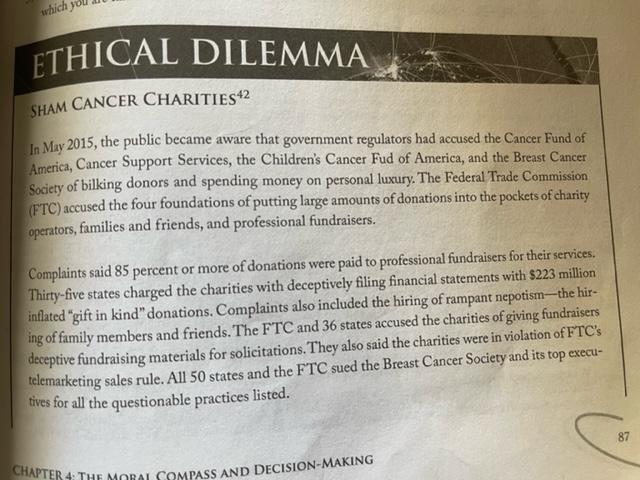
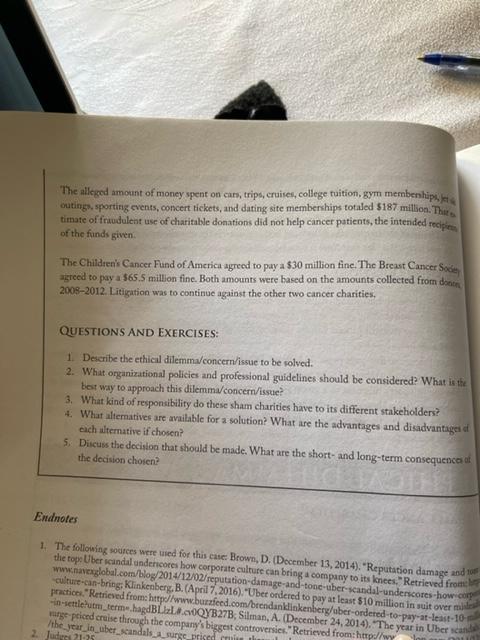
which ETHICAL DILEMMA SHAM CANCER CHARITIES42 In May 2015, the public became aware that government regulators had accused the Cancer Fund of America, Cancer Support Services, the Children's Cancer Fud of America, and the Breast Cancer Society of bilking donors and spending money on personal luxury. The Federal Trade Commission (FTC) accused the four foundations of putting large amounts of donations into the pockets of charity operators, families and friends, and professional fundraisers. Complaints said 85 percent or more of donations were paid to professional fundraisers for their services. Thirty-five states charged the charities with deceptively filing financial statements with $223 million inflated "gift in kind" donations. Complaints also included the hiring of rampant nepotism--the hir- ing of family members and friends. The FTC and 36 states accused the charities of giving fundraisers deceptive fundraising materials for solicitations. They also said the charities were in violation of FTC's telemarketing sales rule. All 50 states and the FTC sued the Breast Cancer Society and its top execu- tives for all the questionable practices listed. 87 CHAPTER 4: THE MORAL COMPASS AND DECISION-MAKING "The alleged amount of money spent on cars, trips, cruises, college tuition, gym memberships, bet cutinga, sporting events, concert tickets, and dating site memberships totaled $187 million. There timate of fraudulent use of charitable donations did not help cancer patients, the intended recipien of the funds given The Children's Cancer Fund of America agreed to pay a $30 million fine. The Breast Cancer Socie agreed to pay a $65.5 million fine. Both amounts were based on the amounts collected from dont 2008-2012. Litigation was to continue against the other two cancer charities, QUESTIONS AND EXERCISES: 1 Describe the ethical dilemma/concern/issue to be solved. 2. What organizational policies and professional guidelines should be considered? What is the best way to approach this dilemma/concern/issue? 3. What kind of responsibility do these sham charities have to its different stakeholders? 4. What alternatives are available for a solution? What are the advantages and disadvantagead each alternative if chosen? 5. Discuss the decision that should be made. What are the short and long-term consequenced the decision chosen Endnotes 1. The following sources were used for this case: Brown, D. (December 13, 2014). "Reputation damage and to the top: Uber scandal underscores how corporate culture can bring a company to its crites. Retrieved from www.navesglobal.com/blog/2014/12/02/ reputation-damage-and-tone-uber-scandal-underscores-how.com culture can bringKlinkenberg, B.(April 7, 2016). "Ubet ordered to pay at least 510 million in suit over milo practices. "Retrieved from http://www.burzfeed.com/brendan dinkenberg/uber-ordered-to-pay-at-least-10 -in-settlePutm_term-hagdBLOQYB27B, Silman, A. (December 24, 2014). "The year in Uber cande espeiced cruise through the company's biggest controversies." Retrieved from: http//wy the year_in_ube_scandals surge prisca cu 2. Judesi 21:35 which ETHICAL DILEMMA SHAM CANCER CHARITIES42 In May 2015, the public became aware that government regulators had accused the Cancer Fund of America, Cancer Support Services, the Children's Cancer Fud of America, and the Breast Cancer Society of bilking donors and spending money on personal luxury. The Federal Trade Commission (FTC) accused the four foundations of putting large amounts of donations into the pockets of charity operators, families and friends, and professional fundraisers. Complaints said 85 percent or more of donations were paid to professional fundraisers for their services. Thirty-five states charged the charities with deceptively filing financial statements with $223 million inflated "gift in kind" donations. Complaints also included the hiring of rampant nepotism--the hir- ing of family members and friends. The FTC and 36 states accused the charities of giving fundraisers deceptive fundraising materials for solicitations. They also said the charities were in violation of FTC's telemarketing sales rule. All 50 states and the FTC sued the Breast Cancer Society and its top execu- tives for all the questionable practices listed. 87 CHAPTER 4: THE MORAL COMPASS AND DECISION-MAKING "The alleged amount of money spent on cars, trips, cruises, college tuition, gym memberships, bet cutinga, sporting events, concert tickets, and dating site memberships totaled $187 million. There timate of fraudulent use of charitable donations did not help cancer patients, the intended recipien of the funds given The Children's Cancer Fund of America agreed to pay a $30 million fine. The Breast Cancer Socie agreed to pay a $65.5 million fine. Both amounts were based on the amounts collected from dont 2008-2012. Litigation was to continue against the other two cancer charities, QUESTIONS AND EXERCISES: 1 Describe the ethical dilemma/concern/issue to be solved. 2. What organizational policies and professional guidelines should be considered? What is the best way to approach this dilemma/concern/issue? 3. What kind of responsibility do these sham charities have to its different stakeholders? 4. What alternatives are available for a solution? What are the advantages and disadvantagead each alternative if chosen? 5. Discuss the decision that should be made. What are the short and long-term consequenced the decision chosen Endnotes 1. The following sources were used for this case: Brown, D. (December 13, 2014). "Reputation damage and to the top: Uber scandal underscores how corporate culture can bring a company to its crites. Retrieved from www.navesglobal.com/blog/2014/12/02/ reputation-damage-and-tone-uber-scandal-underscores-how.com culture can bringKlinkenberg, B.(April 7, 2016). "Ubet ordered to pay at least 510 million in suit over milo practices. "Retrieved from http://www.burzfeed.com/brendan dinkenberg/uber-ordered-to-pay-at-least-10 -in-settlePutm_term-hagdBLOQYB27B, Silman, A. (December 24, 2014). "The year in Uber cande espeiced cruise through the company's biggest controversies." Retrieved from: http//wy the year_in_ube_scandals surge prisca cu 2. Judesi 21:35




