







Question: Read the complete problem description and then determine what the expected output should be if given the following input: Prelab input: Prelab output: 2 CBALLMMACZBDDZ
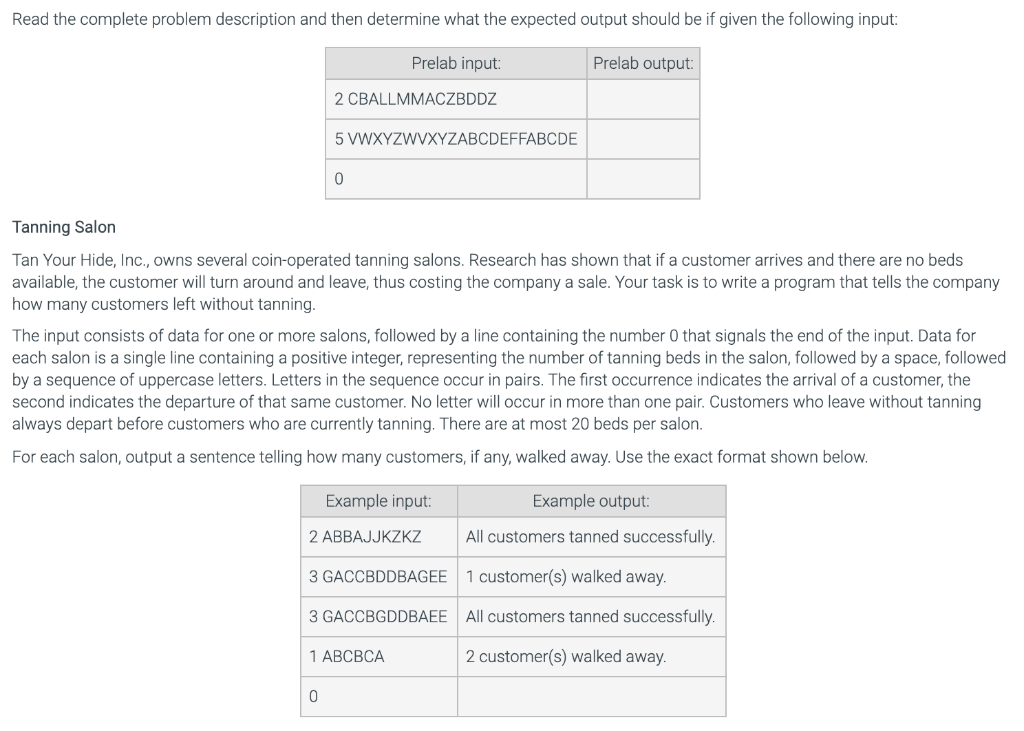
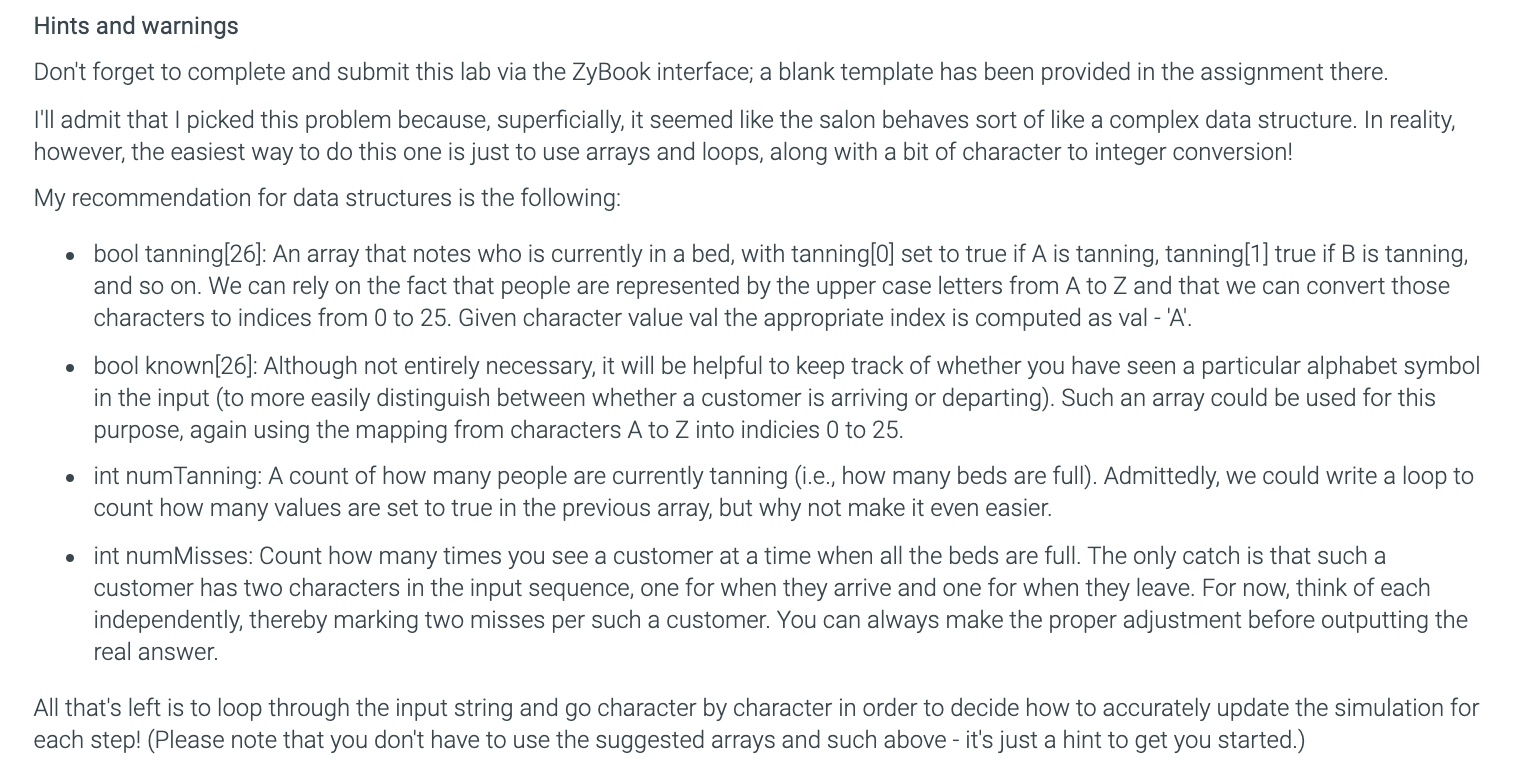
Read the complete problem description and then determine what the expected output should be if given the following input: Prelab input: Prelab output: 2 CBALLMMACZBDDZ 5 VWXYZWVXYZABCDEFFABCDE Tanning Salon Tan Your Hide, Inc., owns several coin-operated tanning salons. Research has shown that if a customer arrives and there are no beds available, the customer will turn around and leave, thus costing the company a sale. Your task is to write a program that tells the company how many customers left without tanning. The input consists of data for one or more salons, followed by a line containing the number 0 that signals the end of the input. Data for each salon is a single line containing a positive integer, representing the number of tanning beds in the salon, followed by a space, followed by a sequence of uppercase letters. Letters in the sequence occur in pairs. The first occurrence indicates the arrival of a customer, the second indicates the departure of that same customer. No letter will occur in more than one pair. Customers who leave without tanning always depart before customers who are currently tanning. There are at most 20 beds per salon. For each salon, output a sentence telling how many customers, if any, walked away. Use the exact format shown below. Example input: Example output: 2 ABBAJJKZKZ All customers tanned successfully. 3 GACCBDDBAGEE 1 customer(s) walked away. 3 GACCBGDDBAEE All customers tanned successfully. 1 ABCBCA 2 customer(s) walked away. Hints and warnings Don't forget to complete and submit this lab via the ZyBook interface; a blank template has been provided in the assignment there. I'll admit that I picked this problem because, superficially, it seemed like the salon behaves sort of like a complex data structure. In reality, however, the easiest way to do this one is just to use arrays and loops, along with a bit of character to integer conversion! My recommendation for data structures is the following: bool tanning[26]: An array that notes who is currently in a bed, with tanning[0] set to true if A is tanning, tanning(1) true if B is tanning, and so on. We can rely on the fact that people are represented by the upper case letters from A to Z and that we can convert those characters to indices from 0 to 25. Given character value val the appropriate index is computed as val - 'A'. bool known[26]: Although not entirely necessary, it will be helpful to keep track of whether you have seen a particular alphabet symbol in the input (to more easily distinguish between whether a customer is arriving or departing). Such an array could be used for this purpose, again using the mapping from characters A to Z into indicies 0 to 25. int numTanning: A count of how many people are currently tanning (i.e., how many beds are full). Admittedly, we could write a loop to count how many values are set to true in the previous array, but why not make it even easier. int numMisses: Count how many times you see a customer at a time when all the beds are full. The only catch is that such a customer has two characters in the input sequence, one for when they arrive and one for when they leave. For now, think of each independently, thereby marking two misses per such a customer. You can always make the proper adjustment before outputting the real answer. All that's left is to loop through the input string and go character by character in order to decide how to accurately update the simulation for each step! (Please note that you don't have to use the suggested arrays and such above - it's just a hint to get you started.) Read the complete problem description and then determine what the expected output should be if given the following input: Prelab input: Prelab output: 2 CBALLMMACZBDDZ 5 VWXYZWVXYZABCDEFFABCDE Tanning Salon Tan Your Hide, Inc., owns several coin-operated tanning salons. Research has shown that if a customer arrives and there are no beds available, the customer will turn around and leave, thus costing the company a sale. Your task is to write a program that tells the company how many customers left without tanning. The input consists of data for one or more salons, followed by a line containing the number 0 that signals the end of the input. Data for each salon is a single line containing a positive integer, representing the number of tanning beds in the salon, followed by a space, followed by a sequence of uppercase letters. Letters in the sequence occur in pairs. The first occurrence indicates the arrival of a customer, the second indicates the departure of that same customer. No letter will occur in more than one pair. Customers who leave without tanning always depart before customers who are currently tanning. There are at most 20 beds per salon. For each salon, output a sentence telling how many customers, if any, walked away. Use the exact format shown below. Example input: Example output: 2 ABBAJJKZKZ All customers tanned successfully. 3 GACCBDDBAGEE 1 customer(s) walked away. 3 GACCBGDDBAEE All customers tanned successfully. 1 ABCBCA 2 customer(s) walked away. Hints and warnings Don't forget to complete and submit this lab via the ZyBook interface; a blank template has been provided in the assignment there. I'll admit that I picked this problem because, superficially, it seemed like the salon behaves sort of like a complex data structure. In reality, however, the easiest way to do this one is just to use arrays and loops, along with a bit of character to integer conversion! My recommendation for data structures is the following: bool tanning[26]: An array that notes who is currently in a bed, with tanning[0] set to true if A is tanning, tanning(1) true if B is tanning, and so on. We can rely on the fact that people are represented by the upper case letters from A to Z and that we can convert those characters to indices from 0 to 25. Given character value val the appropriate index is computed as val - 'A'. bool known[26]: Although not entirely necessary, it will be helpful to keep track of whether you have seen a particular alphabet symbol in the input (to more easily distinguish between whether a customer is arriving or departing). Such an array could be used for this purpose, again using the mapping from characters A to Z into indicies 0 to 25. int numTanning: A count of how many people are currently tanning (i.e., how many beds are full). Admittedly, we could write a loop to count how many values are set to true in the previous array, but why not make it even easier. int numMisses: Count how many times you see a customer at a time when all the beds are full. The only catch is that such a customer has two characters in the input sequence, one for when they arrive and one for when they leave. For now, think of each independently, thereby marking two misses per such a customer. You can always make the proper adjustment before outputting the real answer. All that's left is to loop through the input string and go character by character in order to decide how to accurately update the simulation for each step! (Please note that you don't have to use the suggested arrays and such above - it's just a hint to get you started.)
Step by Step Solution
There are 3 Steps involved in it

Get step-by-step solutions from verified subject matter experts
 Study Help