







Question: Read the following case study: A case study analysis is a very useful and important skill in understanding and applying the theories and tools of
Read the following case study:
A case study analysis is a very useful and important skill in understanding and applying the theories and tools of management. It helps not only in academic settings, but also in real-world business practice. As such, you should pay particular attention to learning effective case study skills that you can utilize through the entire cohort program and beyond. Learning these skills helps managers quickly and efficiently identify problems, their causes, potential solution alternatives (including the pros and cons), and how to effectively implement a selected alternative. In general, every case analysis should cover the following in sufficient detail to cover the objective:
(1) Background and Problem Statement - 1 or 2 paragraphs on the issues/situation as you see it - what are the facts? Do not recite the entire case. Length of your analysis is not the important objective; being able to clearly and quickly identify the issues is.
(2) Key Protagonists and Analysis - Who are the key players in the case? Identify them and the issues that surround them. Why are the issues important? What elements of the issues frame or influence your decision-making?
(3) Alternatives and Conclusions - What are the various potential alternatives to solve the problem/issue? List the pros and cons of each.
(4) Your Recommendation and Plan for Implementation - Based on your alternatives, put forth your recommendation and how you would implement it. How do you measure and track success?
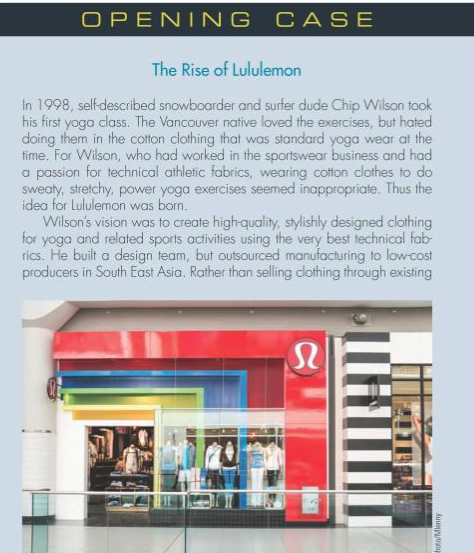
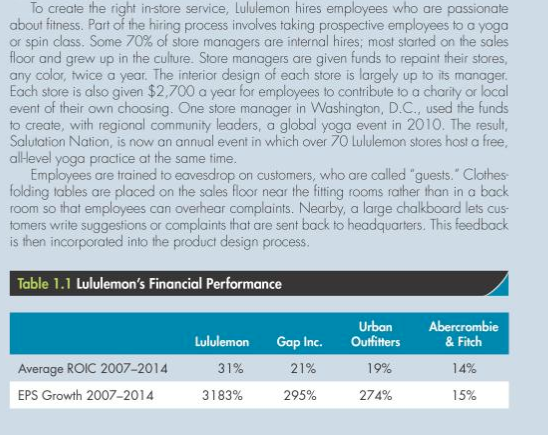
OPENING CASE The Rise of Lululemon In 1998, selfdescribed snowboarder and surfer dude Chip Wilson took his first yoga class. The Vancouver native loved the exercises, but hated doing them in the cotton clothing that was standard yoga wear at the time. For Wilson, who had worked in the sportswear business and had a passion for technical athletic fabrics, wearing cotton clothes to do sweaty, stretchy, power yoga exercises seemed inappropriate. Thus the idea for Lululemon was born Wilson's vision was to create high-quality, stylishly designed clothing for yoga and related sports activities using the very best technical fab- rics. He built a design team, but outsourced manufacturing to low cost producers in South East Asia. Rather than selling clothing through existing retailers, Wilson elected to open his own stores. The idea was to staff the stores with employees who were themselves passionate about exercise, and could act as ambas sadors for healthy living through yoga and related sports such as running and cycling The first store, opened in Vancouver, Canada, in 2000, quickly become a runaway success, and other stores followed. In 2007, the company went public, using the capital raised to accelerate its expansion plans. By late 2014, Lululemon had over 290 stores mostly in North America, and sales in excess of $1.7 billion. Sales per square foot were estimated to be around $1,800-more than four times that of an average specialty re tailer. lululemon's financial performance was stellar. Behween 2007 and 2104, average return on invested capital-an important measure of profitability was 3 1%, far outpacing that of other wellknown specialty retailers, while earnings per share grew by a stagger- ing 3,183% (see Table 1,1]. How did Lululemon achieve this? It started with a focus on an unmet consumer need: the latent desire among yoga enthusiasts for highquality, stylish, technical athletic wear. Getting the product offering right was a central part of the company's strategy. An equally important part of the strategy was to stock a limited supply of an item. New colors and seasonal items, for example, get a 3- to 12 week lifecycle, which keeps the product offerings feeling fresh. The goal is to sell gear at full price, and to condition customers to buy it when they see it, rather than wait, becouse if they do it may soon be "out of stock. The company only allows product returns if the clothes have not been worn and still have the price tags attached. The scarcity strategy has worked. Lululemon never holds sales, and its clothing sells for a premium price. For example, its yoga pants are priced from $78 to $128 a pair, whereas low priced competitors like Gap Inc.s Athleta sell yoga pants on their websites for $25 to $50 To create the right in-store service, Lululemon hires employees who are passionate about fitness. Part of the hiring process involves taking prospective employees to a yoga or spin class. Some 70% of store managers are internal hires, most started on the sales floor and grew up in the culture. Store managers are given funds to repaint their stores any color, twice a year. The interior design of each store is largely up to its manager Each store is also given $2,700 a year for employees to contribute to a charity or local event of their own choosing. One store manager in Washington, D.C., used the funds to create, with regional community leaders, a global yoga event in 2010. The result, Salutation Nation, is now an annual event in which over 70 lululemon stores host a free, al-level yoga practice at the same time Employees are trained to eavesdrop on customers, who are called "guests. Clothes folding tables are placed on the sales floor near the fitting rooms rather than in a back room so that employees can overhear complaints. Nearby, a large chalkboard lets cus tomers write suggestions or complaints that are sent back to headquarters. This feedback is then incorporated into the product design process. Table 1.1 Lululemon's Financial Performance UrbanAbercrombie Average ROIC 2007-2014 EPS Growth 2007-2014 31% 21% 19% 14% 3183% 295% 274% I 5% Despite the company's focus on providing a quality product, it has not all been clear sailing. In 2010, Wilson caused a stir when he emblazoned the company's tote bags with the phrase "Who is John Galt2" the opening line from Ayn Rand's 1957 novel, Alas Shrugged. Atlas Shrugged has become a libertarian bible, and the underlying message that Lululemon supported Rand's brand of unregulated capitalism did not sit well with many of the stores' customers. After negative feedback, the bags were quickly pulled from stores. Wilson himself stepped down from day-to-day involvement in the company in January 2012 and resigned his chairman position in 2014 In early 2013, Lululemon found itself dealing with another controversy when it de- cided to recall black yoga pants that were too sheer, and effectively "see through,"when stretched due to the lack of "rearend coverage." In addition to the negative fallout from the product itself, some customers report being mistreated by employees who demanded hat customers put the pants on and bend over to determine whether the clothing wos seethrough enough to warrant a refund. One consequence of this PR disaster was the resignation of then CEO Christine Day. The company is also facing increasing competi- tion from rivals such as Gap's Athleta Urban Outfitters' Without Walls, and Nike Stores. Notwithstanding these challenges, most observers in the media and financial community believe that the company can handle these issues and should be able to continue on its growth trajectory. OPENING CASE The Rise of Lululemon In 1998, selfdescribed snowboarder and surfer dude Chip Wilson took his first yoga class. The Vancouver native loved the exercises, but hated doing them in the cotton clothing that was standard yoga wear at the time. For Wilson, who had worked in the sportswear business and had a passion for technical athletic fabrics, wearing cotton clothes to do sweaty, stretchy, power yoga exercises seemed inappropriate. Thus the idea for Lululemon was born Wilson's vision was to create high-quality, stylishly designed clothing for yoga and related sports activities using the very best technical fab- rics. He built a design team, but outsourced manufacturing to low cost producers in South East Asia. Rather than selling clothing through existing retailers, Wilson elected to open his own stores. The idea was to staff the stores with employees who were themselves passionate about exercise, and could act as ambas sadors for healthy living through yoga and related sports such as running and cycling The first store, opened in Vancouver, Canada, in 2000, quickly become a runaway success, and other stores followed. In 2007, the company went public, using the capital raised to accelerate its expansion plans. By late 2014, Lululemon had over 290 stores mostly in North America, and sales in excess of $1.7 billion. Sales per square foot were estimated to be around $1,800-more than four times that of an average specialty re tailer. lululemon's financial performance was stellar. Behween 2007 and 2104, average return on invested capital-an important measure of profitability was 3 1%, far outpacing that of other wellknown specialty retailers, while earnings per share grew by a stagger- ing 3,183% (see Table 1,1]. How did Lululemon achieve this? It started with a focus on an unmet consumer need: the latent desire among yoga enthusiasts for highquality, stylish, technical athletic wear. Getting the product offering right was a central part of the company's strategy. An equally important part of the strategy was to stock a limited supply of an item. New colors and seasonal items, for example, get a 3- to 12 week lifecycle, which keeps the product offerings feeling fresh. The goal is to sell gear at full price, and to condition customers to buy it when they see it, rather than wait, becouse if they do it may soon be "out of stock. The company only allows product returns if the clothes have not been worn and still have the price tags attached. The scarcity strategy has worked. Lululemon never holds sales, and its clothing sells for a premium price. For example, its yoga pants are priced from $78 to $128 a pair, whereas low priced competitors like Gap Inc.s Athleta sell yoga pants on their websites for $25 to $50 To create the right in-store service, Lululemon hires employees who are passionate about fitness. Part of the hiring process involves taking prospective employees to a yoga or spin class. Some 70% of store managers are internal hires, most started on the sales floor and grew up in the culture. Store managers are given funds to repaint their stores any color, twice a year. The interior design of each store is largely up to its manager Each store is also given $2,700 a year for employees to contribute to a charity or local event of their own choosing. One store manager in Washington, D.C., used the funds to create, with regional community leaders, a global yoga event in 2010. The result, Salutation Nation, is now an annual event in which over 70 lululemon stores host a free, al-level yoga practice at the same time Employees are trained to eavesdrop on customers, who are called "guests. Clothes folding tables are placed on the sales floor near the fitting rooms rather than in a back room so that employees can overhear complaints. Nearby, a large chalkboard lets cus tomers write suggestions or complaints that are sent back to headquarters. This feedback is then incorporated into the product design process. Table 1.1 Lululemon's Financial Performance UrbanAbercrombie Average ROIC 2007-2014 EPS Growth 2007-2014 31% 21% 19% 14% 3183% 295% 274% I 5% Despite the company's focus on providing a quality product, it has not all been clear sailing. In 2010, Wilson caused a stir when he emblazoned the company's tote bags with the phrase "Who is John Galt2" the opening line from Ayn Rand's 1957 novel, Alas Shrugged. Atlas Shrugged has become a libertarian bible, and the underlying message that Lululemon supported Rand's brand of unregulated capitalism did not sit well with many of the stores' customers. After negative feedback, the bags were quickly pulled from stores. Wilson himself stepped down from day-to-day involvement in the company in January 2012 and resigned his chairman position in 2014 In early 2013, Lululemon found itself dealing with another controversy when it de- cided to recall black yoga pants that were too sheer, and effectively "see through,"when stretched due to the lack of "rearend coverage." In addition to the negative fallout from the product itself, some customers report being mistreated by employees who demanded hat customers put the pants on and bend over to determine whether the clothing wos seethrough enough to warrant a refund. One consequence of this PR disaster was the resignation of then CEO Christine Day. The company is also facing increasing competi- tion from rivals such as Gap's Athleta Urban Outfitters' Without Walls, and Nike Stores. Notwithstanding these challenges, most observers in the media and financial community believe that the company can handle these issues and should be able to continue on its growth trajectory
Step by Step Solution
There are 3 Steps involved in it

Get step-by-step solutions from verified subject matter experts
 Study Help