Question: Read the following case study Web P**n at Work and identify the main characters in the case. Once this is done, in a detailed paragraph,
- Read the following case study "Web P**n at Work" and identify the main characters in the case. Once this is done, in a detailed paragraph, assess the morality of what the main characters did or should do from the point of view of utilitarianism, deontology, or virtue ethics (choose ONE theory or offer a BRIEF comparison between two or more).
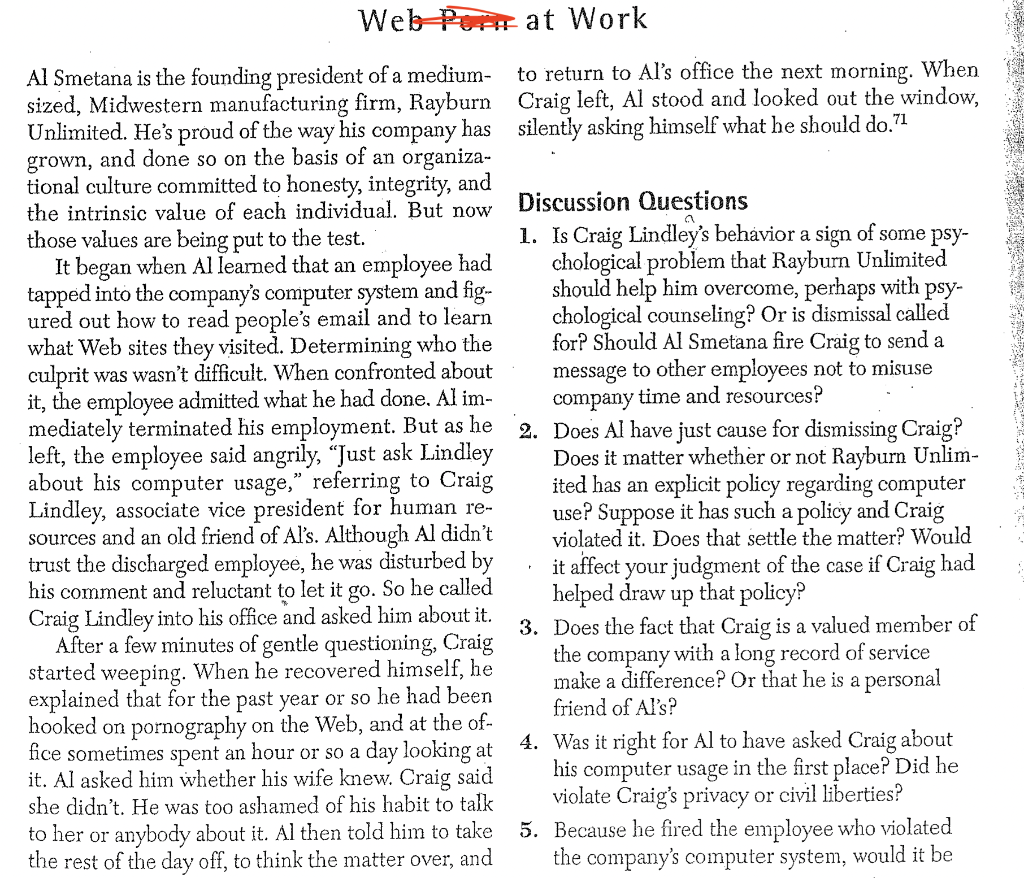
Web Porn at Work to return to Al's office the next morning. When Craig left, Al stood and looked out the window, silently asking himself what he should do.7 Al Smetana is the founding president of a medium- sized, Midwestern manufacturing firm, Rayburn Unlimited. He's proud of the way his company has grown, and done so on the basis of an organiza- tional culture committed to honesty, integrity, and the intrinsic value of each individual. But now those values are being put to the test. Discussion Questions a 1. Is Craig Lindley's behavior a sign of some psy- chological problem that Rayburn Unlimited should help him overcome, perhaps with psy- chological counseling? Or is dismissal called for? Should Al Smetana fire Craig to send a message to other employees not to misuse company time and resources? It began when Al learned that an employee had tapped into the company's computer system and fig- ured out how to read people's email and to learn what Web sites they visited. Determining who the culprit was wasn't difficult. When confronted about it, the employee admitted what he had done. Al im- mediately terminated his employment. But as he left, the employee said angrily, "Just ask Lindley about his computer usage," referring to Craig Lindley, associate vice president for human re- sources and an old friend of Al's. Although Al didn't trust the discharged employee, he was disturbed by his comment and reluctant to let it go. So he called Craig Lindley into his office and asked him about it. 2. Does Al have just cause for dismissing Craig? Does it matter whether or not Rayburn Unlim- ited has an explicit policy regarding computer use? Suppose it has such a policy and Craig violated it. Does that settle the matter? Would it affect your judgment of the case if Craig had helped drawi up that policy? 3. Does the fact that Craig is a valued member of the company with a long record of service make a difference? Or that he is a personal friend of Al's? After a few minutes of gentle questioning, Craig started weeping. When he recovered himself, he explained that for the past year or so he had been hooked on pornography on the Web, and at the of- fice sometimes spent an hour or so a day looking at it. Al asked him whether his wife knew. Craig said she didn't. He was too ashamed of his habit to talk to her or anybody about it. Al then told him to take the rest of the day off, to think the matter over, and 4. Was it right for Al to have asked Craig about his computer usage in the first place? Did he violate Craig's privacy or civil liberties? 5. Because he fired the employee who violated the company's computer system, would it be









 Study Help