







Question: Read the following statements and answer whether TRUE or FALSE. Provide a reason for your answer. Q.1.1 Q.1.2 Q.1.3 Q.1.4 Q.1.5 Q.1.6 Q.1.7 Q.1.8
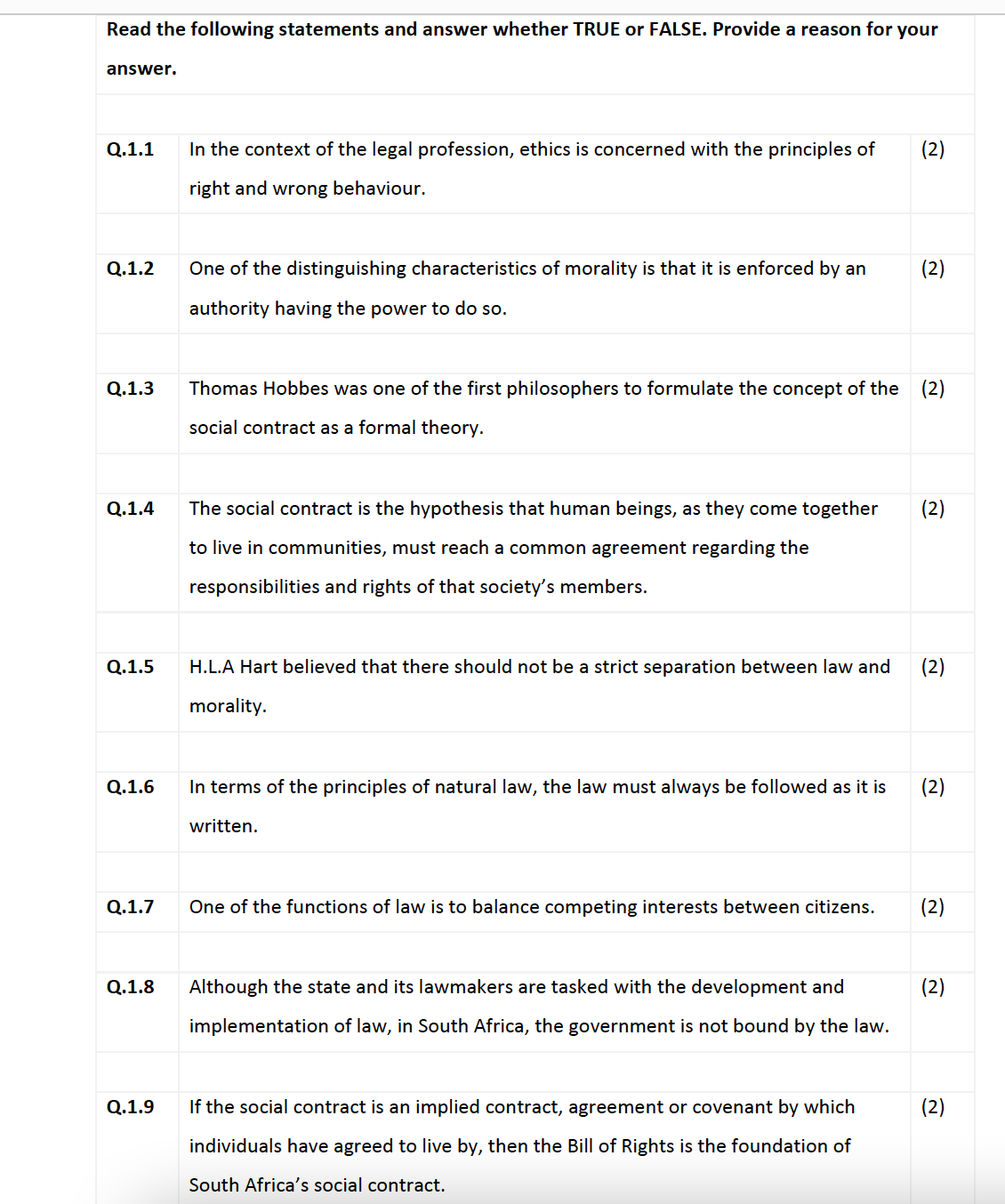
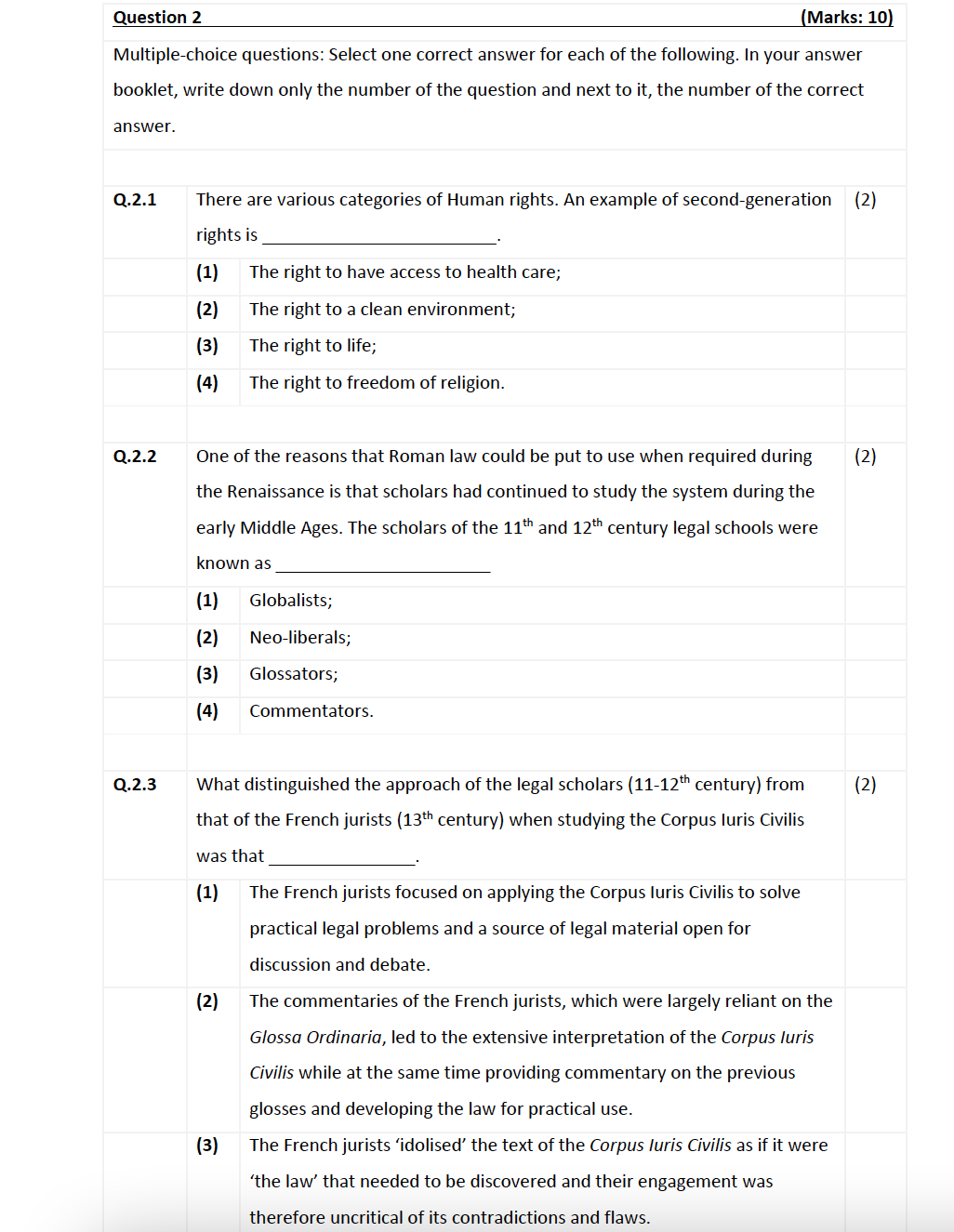
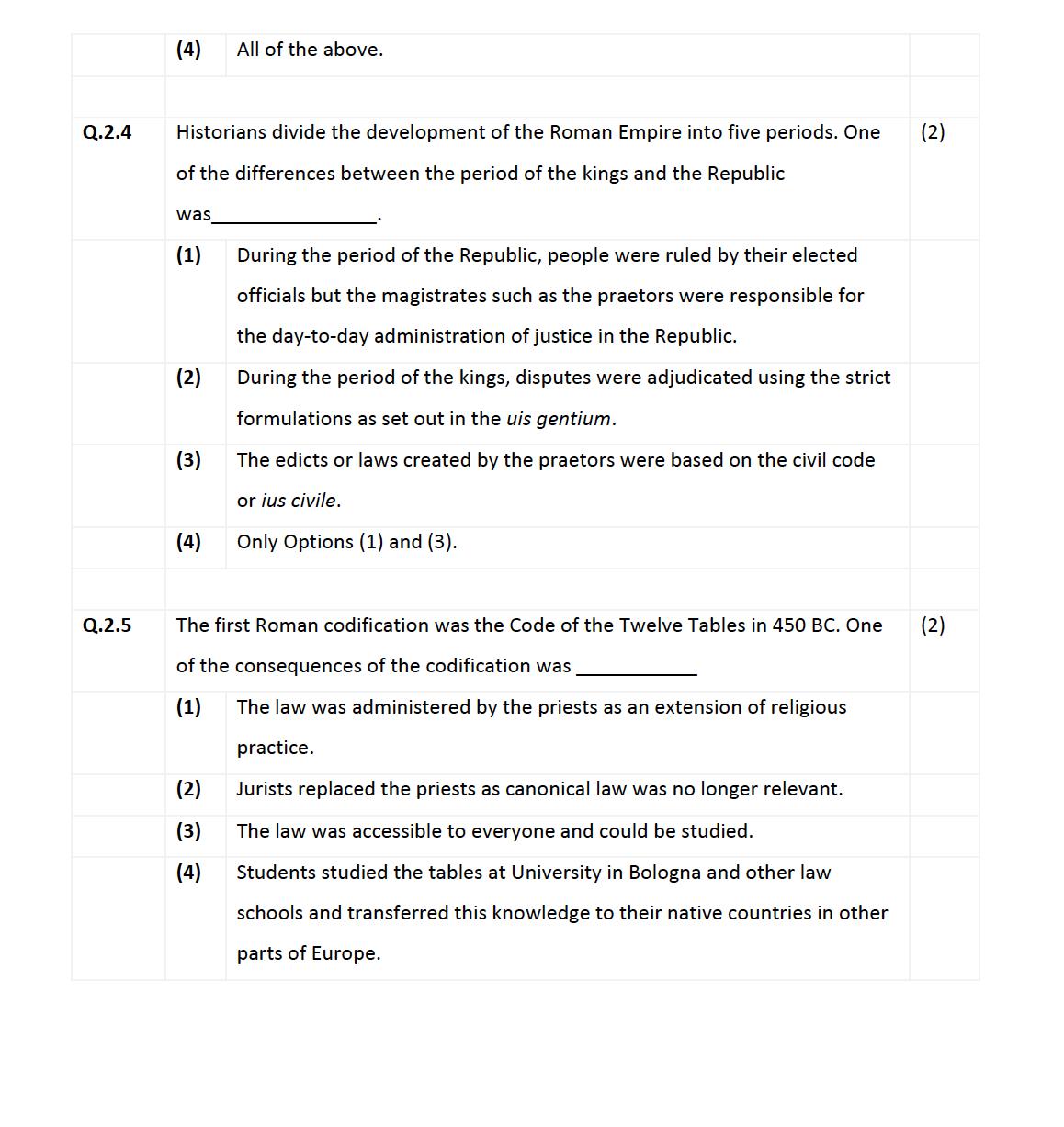
Read the following statements and answer whether TRUE or FALSE. Provide a reason for your answer. Q.1.1 Q.1.2 Q.1.3 Q.1.4 Q.1.5 Q.1.6 Q.1.7 Q.1.8 Q.1.9 In the context of the legal profession, ethics is concerned with the principles of right and wrong behaviour. One of the distinguishing characteristics of morality is that it is enforced by an authority having the power to do so. The social contract is the hypothesis that human beings, as they come together to live in communities, must reach a common agreement regarding the responsibilities and rights of that society's members. Thomas Hobbes was one of the first philosophers to formulate the concept of the (2) social contract as a formal theory. H.L.A Hart believed that there should not be a strict separation between law and morality. In terms of the principles of natural law, the law must always be followed as it is written. One of the functions of law is to balance competing interests between citizens. Although the state and its lawmakers are tasked with the development and implementation of law, in South Africa, the government is not bound by the law. (2) If the social contract is an implied contract, agreement or covenant by which individuals have agreed to live by, then the Bill of Rights is the foundation of South Africa's social contract. (2) (2) (2) (2) (2) (2) (2) (Marks: 10) Multiple-choice questions: Select one correct answer for each of the following. In your answer booklet, write down only the number of the question and next to it, the number of the correct Question 2 answer. Q.2.1 Q.2.2 Q.2.3 There are various categories of Human rights. An example of second-generation (2) rights is (1) The right to have access to health care; (2) The right to a clean environment; (3) The right to life; (4) The right to freedom of religion. One of the reasons that Roman law could be put to use when required during (2) the Renaissance is that scholars had continued to study the system during the early Middle Ages. The scholars of the 11th and 12th century legal schools were known as (1) Globalists; (2) Neo-liberals; (3) Glossators; (4) What distinguished the approach of the legal scholars (11-12th century) from that of the French jurists (13th century) when studying the Corpus luris Civilis was that Commentators. (1) The French jurists focused on applying the Corpus luris Civilis to solve practical legal problems and a source of legal material open for discussion and debate. (2) (3) The commentaries of the French jurists, which were largely reliant on the Glossa Ordinaria, led to the extensive interpretation of the Corpus luris Civilis while at the same time providing commentary on the previous glosses and developing the law for practical use. The French jurists 'idolised' the text of the Corpus luris Civilis as if it were 'the law' that needed to be discovered and their engagement was therefore uncritical of its contradictions and flaws. (2) Q.2.4 Q.2.5 (4) All of the above. Historians divide the development of the Roman Empire into five periods. One of the differences between the period of the kings and the Republic was (1) (2) (3) (4) During the period of the Republic, people were ruled by their elected officials but the magistrates such as the praetors were responsible for the day-to-day administration of justice in the Republic. During the period of the kings, disputes were adjudicated using the strict formulations as set out in the uis gentium. The edicts or laws created by the praetors were based on the civil code or ius civile. Only Options (1) and (3). The first Roman codification was the Code of the Twelve Tables in 450 BC. One of the consequences of the codification was (1) The law was administered by the priests as an extension of religious practice. Jurists replaced the priests as canonical law was no longer relevant. The law was accessible to everyone and could be studied. Students studied the tables at University in Bologna and other law schools and transferred this knowledge to their native countries in other parts of Europe. (2) (3) (4) (2) (2)
Step by Step Solution
3.33 Rating (153 Votes )
There are 3 Steps involved in it
The questions are tackled based on commonly accepted legal principles and historical facts Question 1 Q11 True In the legal profession ethics is indee... View full answer

Get step-by-step solutions from verified subject matter experts
 Study Help