







Question: Read the Netflix Case Study found in the link below and discuss with your team, what you would do if you were Netflix leadership. Feel
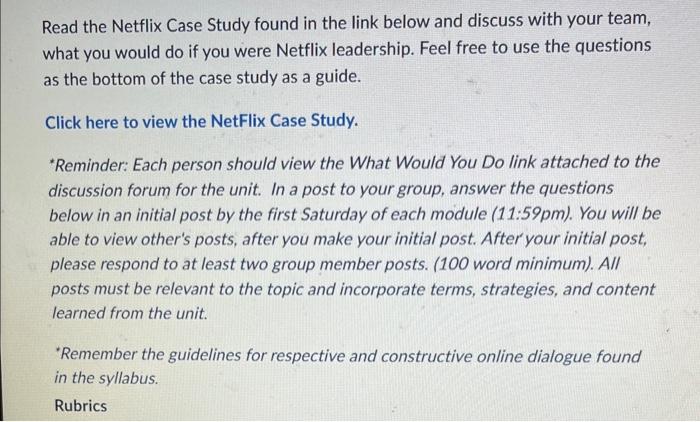
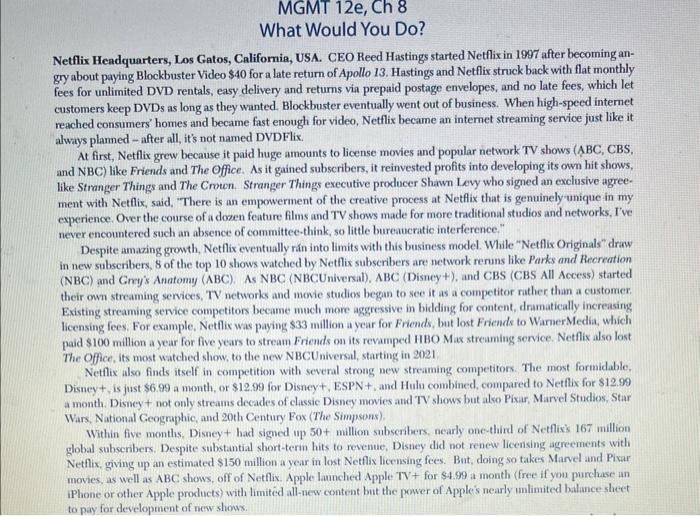
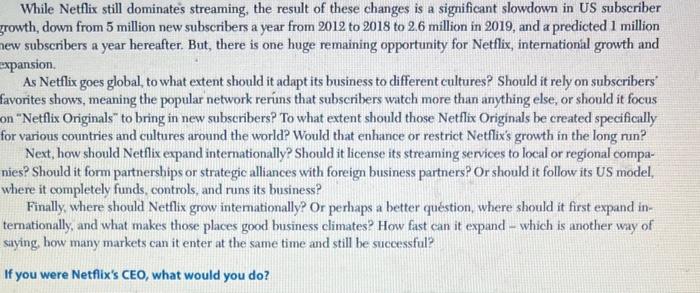
Read the Netflix Case Study found in the link below and discuss with your team, what you would do if you were Netflix leadership. Feel free to use the questions as the bottom of the case study as a guide. Click here to view the NetFlix Case Study. "Reminder: Each person should view the What Would You Do link attached to the discussion forum for the unit. In a post to your group, answer the questions below in an initial post by the first Saturday of each module (11:59pm). You will be able to view other's posts, after you make your initial post. After your initial post, please respond to at least two group member posts. (100 word minimum). All posts must be relevant to the topic and incorporate terms, strategies, and content learned from the unit. "Remember the guidelines for respective and constructive online dialogue found in the syllabus. Rubrics Netflix Hendquarters, Los Gatos, Califormia, USA. CEO Reed Hastings started Netflix in 1997 after becoming angry about paying Blockbuster Video $40 for a late return of Apollo 13. Hastings and Netflix struck back with flat monthly fees for unlimited DVD rentals, easy delivery and returns via prepaid postage envelopes, and no late fees, which let customers keep DVDs as long as they wanted. Blockbuster eventually went out of business. When high-speed internet reached consumers' homes and became fast enough for video, Netflix became an internet streaming service just like it always planned - after all, it's not named DVDFlix. At first, Netflix grew because it paid huge amounts to license movies and popular network TV shows (ABC, CBS, and NBC) like Friends and The Office. As it guined subscribers, it reinvested profits into developing its own hit shows, like Stranger Things and The Crown. Stranger Things executive producer Shawn Levy who signed an exclusive agreement with Netflix, said. "There is an empowerment of the creative process at Netflix that is genuinely unique in my experience. Over the course of a dozen feature films and TV shows made for more traditional studios and networks, Ive never encountered such an absence of committee-think, so little bureaucratic interference." Despite amazing growth, Netflix eventually rin into limits with this business model. While "Netflix Originals" draw in new subscribers, 8 of the top 10 shows watched by Netflix subseribers are network reruns like Parks and Recreation (NBC) and Gry's Anatomy (ABC). As NBC (NBCUniversal), ABC (Disney+), and CBS (CBS All Access) started their own streaming services. TV networks and move studios begin to see it as a competitor ruther tham a customer. Existing streaming service competitors became much more aggressive in bidding for content, dramatically increasing licensing fees. For example. Netflix was paying $33 million a year for Friends, bat lost Friends to WarnerMedia, which paid $100 million a yeur for five years to stream Friends on its revamped HBO Max streaming service. Netflix also lost The Office, its most watched show, to the new NBCUniversal, starting in 2021 Netflix also finds itself in competition with several strong new streaming competitors. The most formidable, Disney+, is just $6.99 a month, or $12.99 for Disney+, ESPN+, and Hulu combined, compared to Netflix for $12.99 a month. Disney+ not only streams decades of elassie Disney movies and TV shows but also Pixar, Marvel Studios, Star Wars, National Geographic, and 20th Century Fox (The Simpsons) Within five months, Disney+ had signed up 50+ million subseribers, nearly one-third of Netflixs 167 million global subseribers. Despite substantial short-term hits to revenue, Disney did not renew licensing agreements with Netflix, giving up an estimated \$150 million a year in lost Netflix licensing fees. But, doing so takes Marvel and Pixar movies, as well as ABC shows, off of Netflix. Apple launched Apple TV+ for $4.99 a month (free if you purchase an iPhone or other Apple products) with limited all-new content but the power of Apple's nearly umlimited balince sheet While Netflix still dominates streaming, the result of these changes is a significant slowdown in US subscriber rowth, down from 5 million new subscribers a year from 2012 to 2018 to 2.6 million in 2019 , and a predicted 1 million ew subseribers a year hereafter. But, there is one huge remaining opportunity for Netflix, international growth and xpansion. As Netflix goes global, to what extent should it adapt its business to different cultures? Should it rely on subscribers cavorites shows, meaning the popular network reruns that subscribers watch more than anything else, or should it focus on "Netflix Originals" to bring in new subscribers? To what extent should those Netflix Originals be created specifically for various countries and cultures around the world? Would that enhance or restrict Netflix's growth in the long run? Next, how should Netflix expand internationally? Should it license its streaming services to local or regional companies? Should it form partnerships or strategic alliances with foreign business partners? Or should it follow its US model, where it completely funds, controls, and runs its business? Finally, where should Netflix grow intemationally? Or perhaps a better question, where should it first expand internationally, and what makes those places good business climates? How fast can it expand - which is another way of saying, how many markets can it enter at the same time and still be successful? If you were Netflix's CEO, what would you do? Read the Netflix Case Study found in the link below and discuss with your team, what you would do if you were Netflix leadership. Feel free to use the questions as the bottom of the case study as a guide. Click here to view the NetFlix Case Study. "Reminder: Each person should view the What Would You Do link attached to the discussion forum for the unit. In a post to your group, answer the questions below in an initial post by the first Saturday of each module (11:59pm). You will be able to view other's posts, after you make your initial post. After your initial post, please respond to at least two group member posts. (100 word minimum). All posts must be relevant to the topic and incorporate terms, strategies, and content learned from the unit. "Remember the guidelines for respective and constructive online dialogue found in the syllabus. Rubrics Netflix Hendquarters, Los Gatos, Califormia, USA. CEO Reed Hastings started Netflix in 1997 after becoming angry about paying Blockbuster Video $40 for a late return of Apollo 13. Hastings and Netflix struck back with flat monthly fees for unlimited DVD rentals, easy delivery and returns via prepaid postage envelopes, and no late fees, which let customers keep DVDs as long as they wanted. Blockbuster eventually went out of business. When high-speed internet reached consumers' homes and became fast enough for video, Netflix became an internet streaming service just like it always planned - after all, it's not named DVDFlix. At first, Netflix grew because it paid huge amounts to license movies and popular network TV shows (ABC, CBS, and NBC) like Friends and The Office. As it guined subscribers, it reinvested profits into developing its own hit shows, like Stranger Things and The Crown. Stranger Things executive producer Shawn Levy who signed an exclusive agreement with Netflix, said. "There is an empowerment of the creative process at Netflix that is genuinely unique in my experience. Over the course of a dozen feature films and TV shows made for more traditional studios and networks, Ive never encountered such an absence of committee-think, so little bureaucratic interference." Despite amazing growth, Netflix eventually rin into limits with this business model. While "Netflix Originals" draw in new subscribers, 8 of the top 10 shows watched by Netflix subseribers are network reruns like Parks and Recreation (NBC) and Gry's Anatomy (ABC). As NBC (NBCUniversal), ABC (Disney+), and CBS (CBS All Access) started their own streaming services. TV networks and move studios begin to see it as a competitor ruther tham a customer. Existing streaming service competitors became much more aggressive in bidding for content, dramatically increasing licensing fees. For example. Netflix was paying $33 million a year for Friends, bat lost Friends to WarnerMedia, which paid $100 million a yeur for five years to stream Friends on its revamped HBO Max streaming service. Netflix also lost The Office, its most watched show, to the new NBCUniversal, starting in 2021 Netflix also finds itself in competition with several strong new streaming competitors. The most formidable, Disney+, is just $6.99 a month, or $12.99 for Disney+, ESPN+, and Hulu combined, compared to Netflix for $12.99 a month. Disney+ not only streams decades of elassie Disney movies and TV shows but also Pixar, Marvel Studios, Star Wars, National Geographic, and 20th Century Fox (The Simpsons) Within five months, Disney+ had signed up 50+ million subseribers, nearly one-third of Netflixs 167 million global subseribers. Despite substantial short-term hits to revenue, Disney did not renew licensing agreements with Netflix, giving up an estimated \$150 million a year in lost Netflix licensing fees. But, doing so takes Marvel and Pixar movies, as well as ABC shows, off of Netflix. Apple launched Apple TV+ for $4.99 a month (free if you purchase an iPhone or other Apple products) with limited all-new content but the power of Apple's nearly umlimited balince sheet While Netflix still dominates streaming, the result of these changes is a significant slowdown in US subscriber rowth, down from 5 million new subscribers a year from 2012 to 2018 to 2.6 million in 2019 , and a predicted 1 million ew subseribers a year hereafter. But, there is one huge remaining opportunity for Netflix, international growth and xpansion. As Netflix goes global, to what extent should it adapt its business to different cultures? Should it rely on subscribers cavorites shows, meaning the popular network reruns that subscribers watch more than anything else, or should it focus on "Netflix Originals" to bring in new subscribers? To what extent should those Netflix Originals be created specifically for various countries and cultures around the world? Would that enhance or restrict Netflix's growth in the long run? Next, how should Netflix expand internationally? Should it license its streaming services to local or regional companies? Should it form partnerships or strategic alliances with foreign business partners? Or should it follow its US model, where it completely funds, controls, and runs its business? Finally, where should Netflix grow intemationally? Or perhaps a better question, where should it first expand internationally, and what makes those places good business climates? How fast can it expand - which is another way of saying, how many markets can it enter at the same time and still be successful? If you were Netflix's CEO, what would you do
Step by Step Solution
There are 3 Steps involved in it

Get step-by-step solutions from verified subject matter experts
 Study Help