







Question: Read the scenario first. The critical thinking topic for this memorandum is: Conflict Management SCENARIO : You and a teammate are working on a presentation
Read the scenario first.
The critical thinking topic for this memorandum is: Conflict Management
SCENARIO: You and a teammate are working on a presentation that will be given at a budget meeting on Monday. On Thursday night, you think the project is far from complete. You'd like the presentation to be as polished as possible, so you suggest to your teammate that you get together over the weekend to finish it. He says that he wants to finish the presentation by Friday because he wants to relax over the weekend. You begin to argue. You know you won't be able to complete the presentation in one day. What is the cause of this conflict and how would you respond?
In memorandum to your instructor, explain how you could use each of the following conflict management techniques.
ACCOMMODATE: What would you do to accommodate your teammate?
COMPETE: What would a competitive approach look like?
COMPROMISE: What would a compromise look like?
COLLABORATE: What would you do to try to collaborate?
Also, identify the approach you would recommend and explain your selection.
And read below to understand each techniques.
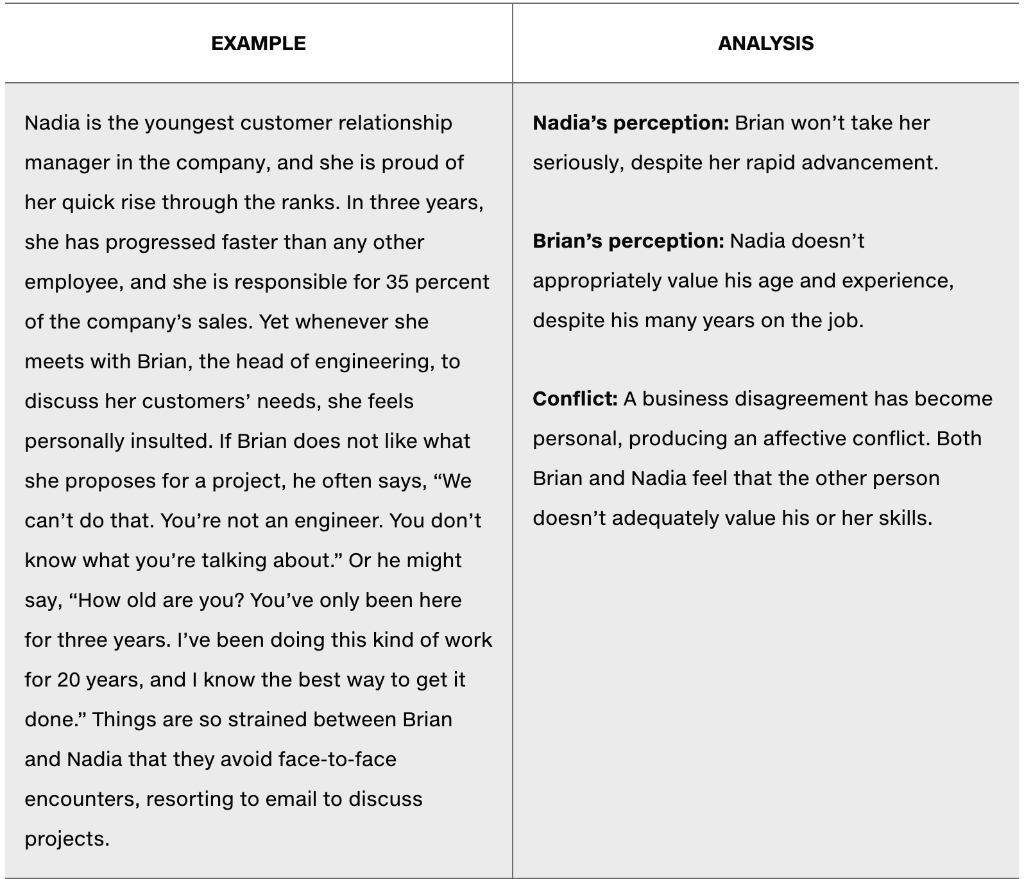
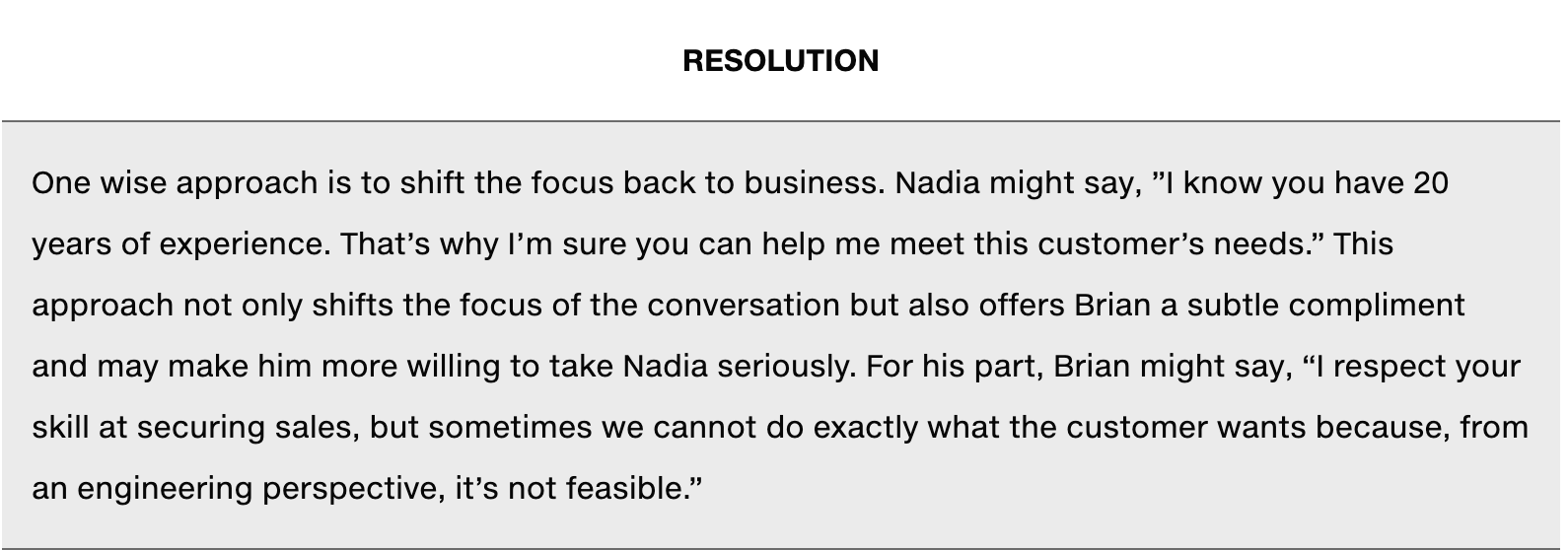
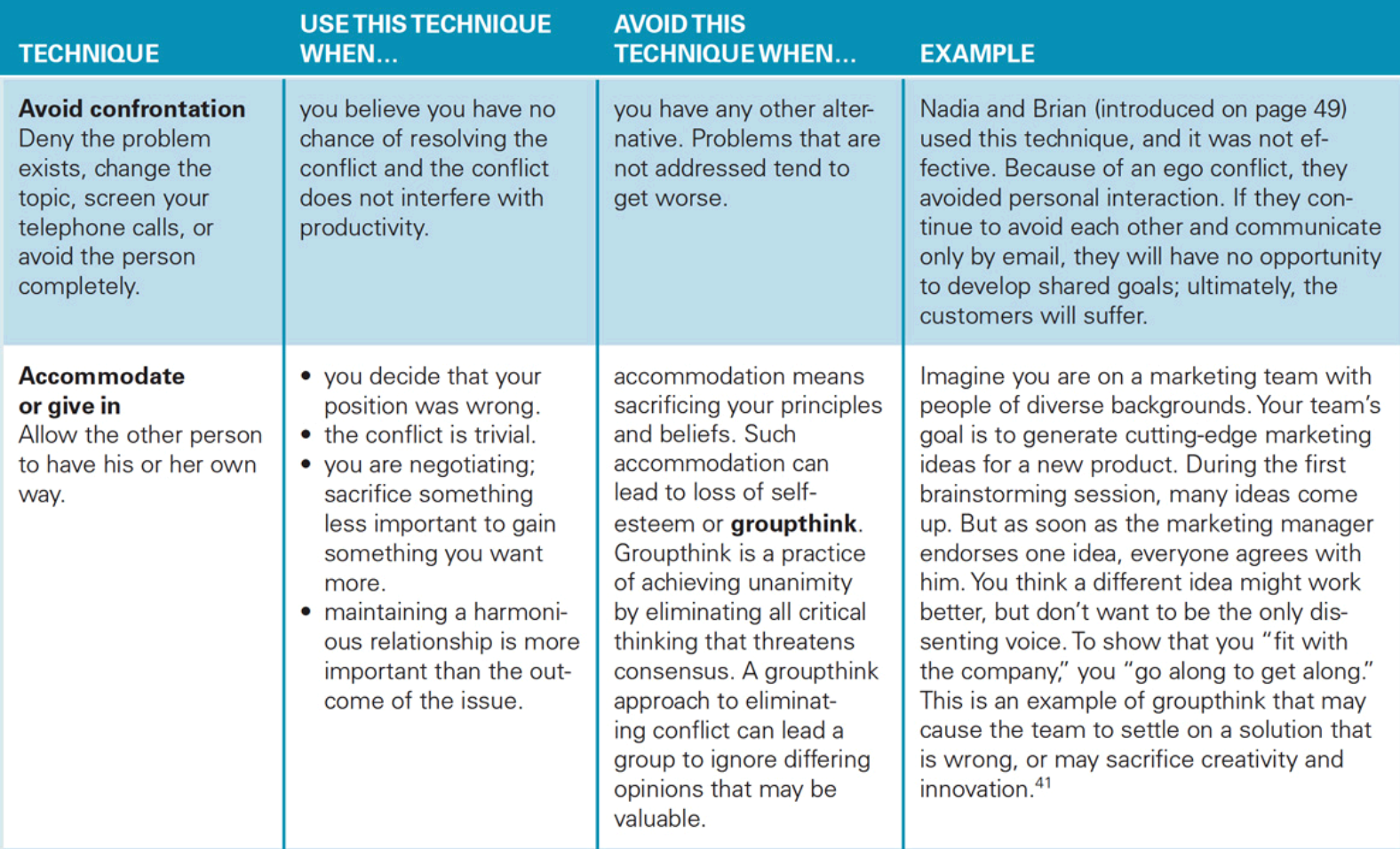
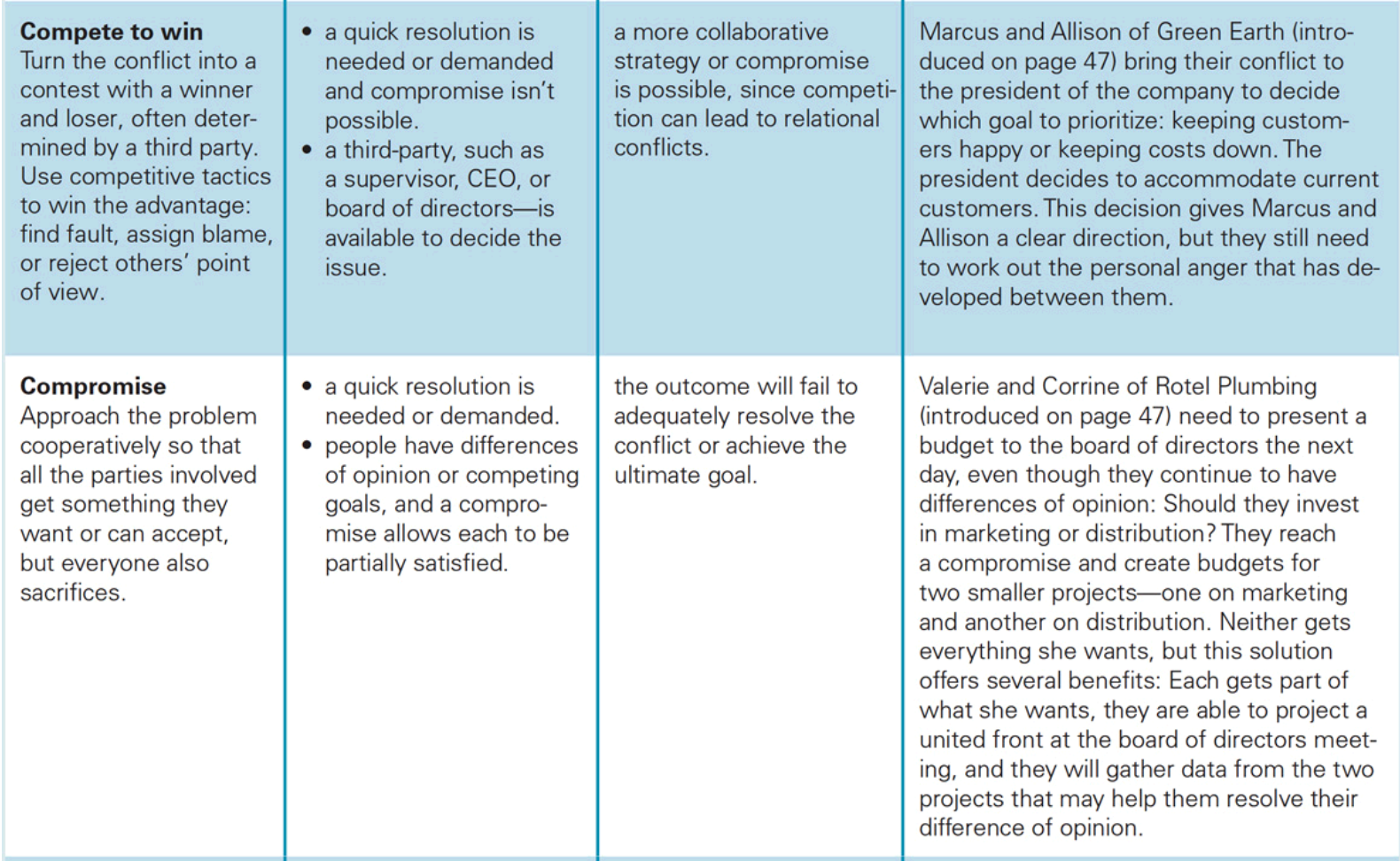
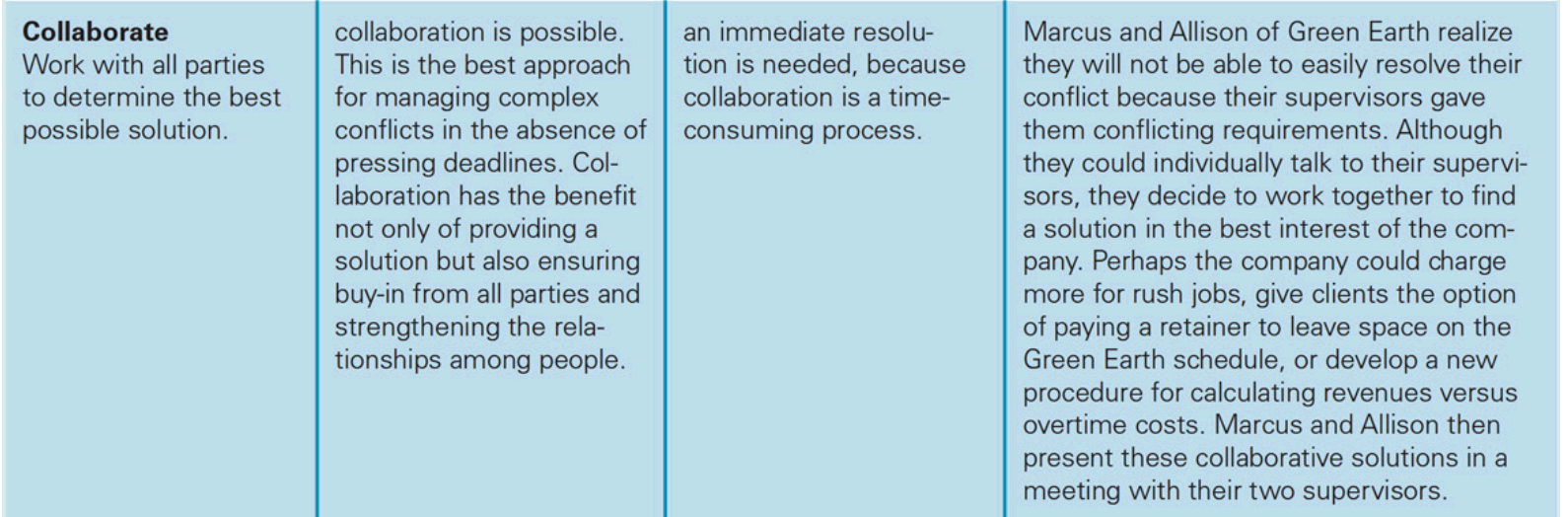
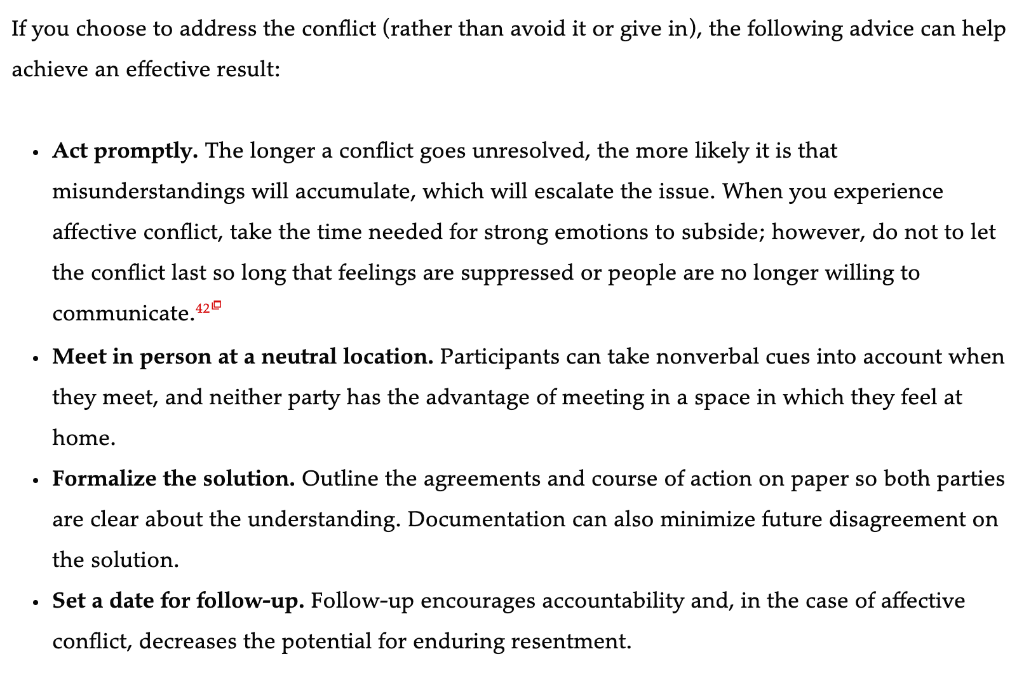
EXAMPLE ANALYSIS Nadia's perception: Brian won't take her seriously, despite her rapid advancement. Brian's perception: Nadia doesn't appropriately value his age and experience, despite his many years on the job. Nadia is the youngest customer relationship manager in the company, and she is proud of her quick rise through the ranks. In three years, she has progressed faster than any other employee, and she is responsible for 35 percent of the company's sales. Yet whenever she meets with Brian, the head of engineering, to discuss her customers' needs, she feels personally insulted. If Brian does not like what she proposes for a project, he often says, We can't do that. You're not an engineer. You don't know what you're talking about." Or he might say, How old are you? You've only been here for three years. I've been doing this kind of work Conflict: A business disagreement has become personal, producing an affective conflict. Both Brian and Nadia feel that the other person doesn't adequately value his or her skills. for 20 years, and I know the best way to get it done." Things are so strained between Brian and Nadia that they avoid face-to-face encounters, resorting to email to discuss projects. RESOLUTION One wise approach is to shift the focus back to business. Nadia might say, "I know you have 20 years of experience. That's why I'm sure you can help me meet this customer's needs. This approach not only shifts the focus of the conversation but also offers Brian a subtle compliment and may make him more willing to take Nadia seriously. For his part, Brian might say, I respect your skill at securing sales, but sometimes we cannot do exactly what the customer wants because, from an engineering perspective, it's not feasible. USE THIS TECHNIQUE WHEN... AVOID THIS TECHNIQUE WHEN... TECHNIQUE EXAMPLE Avoid confrontation Deny the problem exists, change the topic, screen your telephone calls, or avoid the person completely you believe you have no chance of resolving the conflict and the conflict does not interfere with productivity you have any other alter- native. Problems that are not addressed tend to get worse. Nadia and Brian (introduced on page 49) used this technique, and it was not ef- fective. Because of an ego conflict, they avoided personal interaction. If they con- tinue to avoid each other and communicate only by email, they will have no opportunity to develop shared goals; ultimately, the customers will suffer. Accommodate or give in Allow the other person to have his or her own way. you decide that your position was wrong. the conflict is trivial. you are negotiating; sacrifice something less important to gain something you want more. maintaining a harmoni- ous relationship is more important than the out- come of the issue. accommodation means sacrificing your principles and beliefs. Such accommodation can lead to loss of self- esteem or groupthink. Groupthink is a practice of achieving unanimity by eliminating all critical thinking that threatens consensus. A groupthink approach to eliminat- ing conflict can lead a group to ignore differing opinions that may be valuable. Imagine you are on a marketing team with people of diverse backgrounds. Your team's goal is to generate cutting-edge marketing ideas for a new product. During the first brainstorming session, many ideas come up. But as soon as the marketing manager endorses one idea, everyone agrees with him. You think a different idea might work better, but don't want to be the only dis- senting voice. To show that you "fit with the company, you "go along to get along." This is an example of groupthink that may cause the team to settle on a solution that is wrong, or may sacrifice creativity and innovation.41 Compete to win Turn the conflict into a contest with a winner and loser, often deter- mined by a third party. Use competitive tactics to win the advantage: find fault, assign blame, or reject others' point of view. a quick resolution is needed or demanded and compromise isn't possible. a third-party, such as a supervisor, CEO, or board of directors-is available to decide the issue. a more collaborative Marcus and Allison of Green Earth (intro- strategy or compromise duced on page 47) bring their conflict to is possible, since competi- the president of the company to decide tion can lead to relational which goal to prioritize: keeping custom- conflicts. ers happy or keeping costs down. The president decides to accommodate current customers. This decision gives Marcus and Allison a clear direction, but they still need to work out the personal anger that has de- veloped between them. Compromise Approach the problem cooperatively so that all the parties involved get something they want or can accept, but everyone also sacrifices. a quick resolution is needed or demanded. people have differences of opinion or competing goals, and a compro- mise allows each to be partially satisfied. the outcome will fail to adequately resolve the conflict or achieve the ultimate goal. Valerie and Corrine of Rotel Plumbing (introduced on page 47) need to present a budget to the board of directors the next day, even though they continue to have differences of opinion: Should they invest in marketing or distribution? They reach a compromise and create budgets for two smaller projectsone on marketing and another on distribution. Neither gets everything she wants, but this solution offers several benefits: Each gets part of what she wants, they are able to project a united front at the board of directors meet- ing, and they will gather data from the two projects that may help them resolve their difference of opinion. Collaborate Work with all parties to determine the best possible solution. collaboration is possible. an immediate resolu- This is the best approach tion is needed, because for managing complex collaboration is a time- conflicts in the absence of consuming process. pressing deadlines. Col- laboration has the benefit not only of providing a solution but also ensuring buy-in from all parties and strengthening the rela- tionships among people. Marcus and Allison of Green Earth realize they will not be able to easily resolve their conflict because their supervisors gave them conflicting requirements. Although they could individually talk to their supervi- sors, they decide to work together to find a solution in the best interest of the com- pany. Perhaps the company could charge more for rush jobs, give clients the option of paying a retainer to leave space on the Green Earth schedule, or develop a new procedure for calculating revenues versus overtime costs. Marcus and Allison then present these collaborative solutions in a meeting with their two supervisors. If you choose to address the conflict (rather than avoid it or give in), the following advice can help achieve an effective result: 420 Act promptly. The longer a conflict goes unresolved, the more likely it is that misunderstandings will accumulate, which will escalate the issue. When you experience affective conflict, take the time needed for strong emotions to subside; however, do not to let the conflict last so long that feelings are suppressed or people are no longer willing to communicate. Meet in person at a neutral location. Participants can take nonverbal cues into account when they meet, and neither party has the advantage of meeting in a space in which they feel at home. Formalize the solution. Outline the agreements and course of action on paper so both parties are clear about the understanding. Documentation can also minimize future disagreement on the solution. Set a date for follow-up. Follow-up encourages accountability and, in the case of affective conflict, decreases the potential for enduring resentment
Step by Step Solution
There are 3 Steps involved in it

Get step-by-step solutions from verified subject matter experts
 Study Help