Read the story (Box 3.6 / Page 75) about Manville, NJ
In two brief and concise paragraphs: A) Discuss the issues that occurred as a result of the production of asbestos? B) Can this be related to a type of White Collar Crime that is discussed in Chapter 3 in the e-text? Explain and include a relative example!
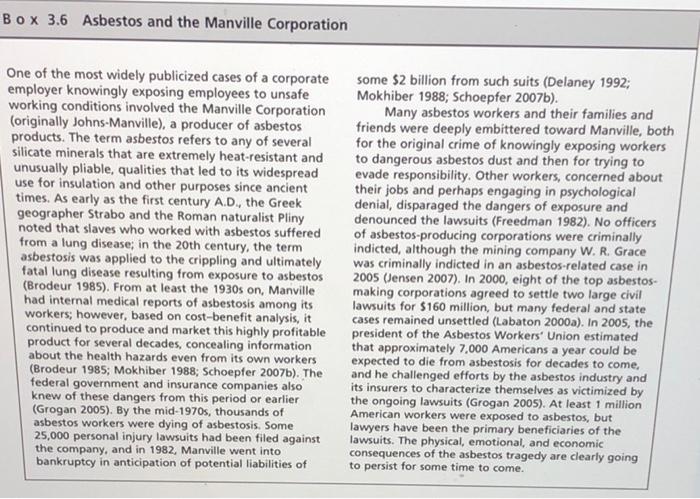
Box 3.6 Asbestos and the Manville Corporation One of the most widely publicized cases of a corporate employer knowingly exposing employees to unsafe working conditions involved the Manville Corporation (originally Johns-Manville), a producer of asbestos products. The term asbestos refers to any of several silicate minerals that are extremely heat-resistant and unusually pliable, qualities that led to its widespread use for insulation and other purposes since ancient times. As early as the first century A.D., the Greek geographer Strabo and the Roman naturalist Pliny noted that slaves who worked with asbestos suffered from a lung disease; in the 20th century, the term asbestosis was applied to the crippling and ultimately fatal lung disease resulting from exposure to asbestos (Brodeur 1985). From at least the 1930s on, Manville had internal medical reports of asbestosis among its workers; however, based on cost-benefit analysis, it continued to produce and market this highly profitable product for several decades, concealing information about the health hazards even from its own workers (Brodeur 1985; Mokhiber 1988; Schoepfer 2007b). The federal government and insurance companies also knew of these dangers from this period or earlier (Grogan 2005). By the mid-1970s, thousands of asbestos workers were dying of asbestosis. Some 25,000 personal injury lawsuits had been filed against the company, and in 1982, Manville went into bankruptcy in anticipation of potential liabilities of some $2 billion from such suits (Delaney 1992; Mokhiber 1988; Schoepfer 2007b). Many asbestos workers and their families and friends were deeply embittered toward Manville, both for the original crime of knowingly exposing workers to dangerous asbestos dust and then for trying to evade responsibility. Other workers, concerned about their jobs and perhaps engaging in psychological denial, disparaged the dangers of exposure and denounced the lawsuits (Freedman 1982). No officers of asbestos-producing corporations were criminally indicted, although the mining company W. R. Grace was criminally indicted in an asbestos-related case in 2005 (Jensen 2007). In 2000, eight of the top asbestos- making corporations agreed to settle two large civil lawsuits for $160 million, but many federal and state cases remained unsettled (Labaton 2000a). In 2005, the president of the Asbestos Workers' Union estimated that approximately 7,000 Americans a year could be expected to die from asbestosis for decades to come, and he challenged efforts by the asbestos industry and its insurers to characterize themselves as victimized by the ongoing lawsuits (Grogan 2005). At least 1 million American workers were exposed to asbestos, but lawyers have been the primary beneficiaries of the lawsuits. The physical, emotional, and economic consequences of the asbestos tragedy are clearly going to persist for some time to come