Question: Read this Case study and answer question: Project Name Cost ($) Revenues Pay Back (Break Even) NPV ROI Year 0 Year 1 Year 2 Year
Read this Case study and answer question:
| Project Name | Cost ($) | Revenues | Pay Back (Break Even) | NPV | ROI |
| | Year 0 | Year 1 | Year 2 | Year 3 | Total cost of Ownership | Year 1 | Year 2 | Year 3 | Total Benifits of Ownership |
| New Large Press | Press 6 (old press) | 0 | 80,000 | 110,000 | 150,000 | 340,000 | 75,000 | 78,750 | 82,688 | 236,438 | NA | -103,563 | -30% |
| New Press | 500,000 | 8,000 | 15,000 | 20,000 | 543,000 | 280,000 | 294,000 | 308,700 | 882,700 | Y2 | 339,700 | 63% |
| Build new HQ | Old HQ | 0 | 150,000 | 180,000 | 200,000 | 530,000 | 350,000 | 367,500 | 385,875 | 1,103,375 | | 573,375 | 108% |
| New HQ | 4,000,000 | 20,000 | 25,000 | 30,000 | 4,075,000 | 800,000 | 840,000 | 882,000 | 2,522,000 | | -1,553,000 | -38% |
| | | | | | | 0 | | 0 | 0 | 0 | | 0 | #DIV/0! |
| | | | | | | 0 | | 0 | 0 | 0 | | 0 | #DIV/0! |
| | | | | | | 0 | | 0 | 0 | 0 | | 0 | #DIV/0! |
| | | 0 | 0 | 0 | 0 | 0 | | 0 | 0 | 0 | | 0 | #DIV/0! |
tion 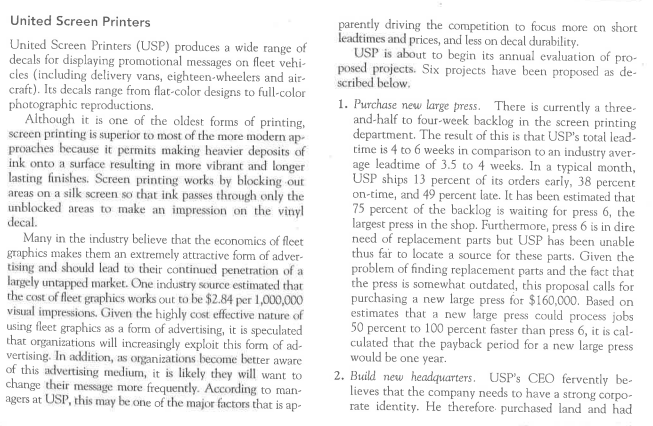
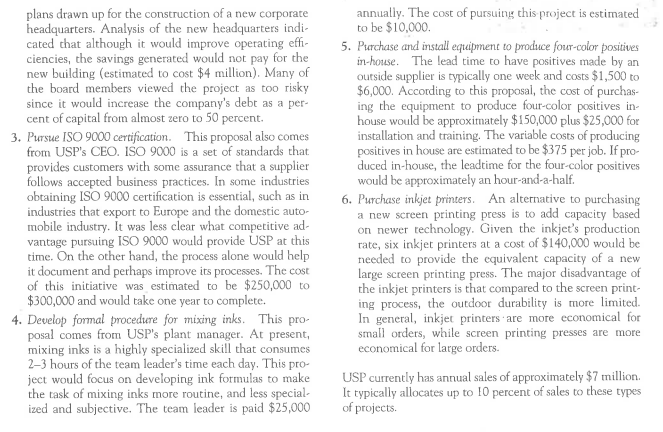
a United Screen Printers United Screen Printers (USP) produces a wide range of decals for displaying promotional messages on fleet vehi- cles (including delivery vans, eighteen-wheelers and air- craft). Its decals range from flat-color designs to full-color photographic reproductions. Although it is one of the oldest forms of printing, screen printing is superior to most of the more modern ap proaches because it permits making heavier deposits of ink onto a surface resulting in more vibrant and longer lasting finishes. Screen printing works by blocking out areas on a silk screen so that ink passes through only the unblocked areas to make an impression on the vinyl decal. Many in the industry believe that the economics of fleet graphics makes them an extremely attractive form of adver- tising and should lead to their continued penetration of a largely untapped market. One industry source estimated that the cost of fleet graphics works out to be $2.84 per 1,000,000 visual impressions. Given the highly cost effective nature of using fleet graphics as a form of advertising, it is speculated that organizations will increasingly exploit this form of ad- vertising. In addition, as organizations become better aware of this advertising medium, it is likely they will want to change their message more frequently. According to man agers at USP, this may be one of the major factors that is parently driving the competition to focus more on short leadtimes and prices, and less on decal durability, USP is about to begin its annual evaluation of pro- posed projects. Six projects have been proposed as de- scribed below. 1. Purchase new large press. There is currently a three- and-half to four-week backlog in the screen printing department. The result of this is that USP's total lead- time is 4 to 6 weeks in comparison to an industry aver- age leadtime of 3.5 to 4 weeks. In a typical month, USP ships 13 percent of its orders early, 38 percent on-time, and 49 percent late. It has been estimated that 75 percent of the backlog is waiting for press 6, the largest press in the shop. Furthermore, press 6 is in dire need of replacement parts but USP has been unable thus far to locate a source for these parts. Given the problem of finding replacement parts and the fact that the press is somewhat outdated, this proposal calls for purchasing a new large press for $160,000. Based on estimates that a new large press could process jobs 50 percent to 100 percent faster than press 6, it is cal- culated that the payback period for a new large press would be one year. 2. Build new headquarters. USP's CEO fervently be lieves that the company needs to have a strong corpo rate identity. He therefore purchased land and had ap- plans drawn up for the construction of a new corporate headquarters. Analysis of the new headquarters indi- cated that although it would improve operating effi- ciencies, the savings generated would not pay for the new building (estimated to cost $4 million). Many of the board members viewed the project as too risky since it would increase the company's debt as a per- cent of capital from almost zero to 50 percent. 3. Pursue ISO 9000 certification. This proposal also comes from USP's CEO. ISO 9000 is a set of standards that provides customers with some assurance that a supplier follows accepted business practices. In some industries obtaining ISO 9000 certification is essential, such as in industries that export to Europe and the domestic auto mobile industry. It was less clear what competitive ad- vantage pursuing ISO 9000 would provide USP at this time. On the other hand, the process alone would help it document and perhaps improve its processes. The cost of this initiative was estimated to be $250,000 to $300,000 and would take one year to complete. 4. Develop formal procedure for mixing inks. This pro- posal comes from USP's plant manager. At present, mixing inks is a highly specialized skill that consumes 2-3 hours of the team leader's time each day. This pro- ject would focus on developing ink formulas to make the task of mixing inks more routine, and less special ized and subjective. The team leader is paid $25,000 annually. The cost of pursuing this project is estimated to be $10,000 5. Purchase and install equipment to produce four-color positives in-house. The lead time to have positives made by an outside supplier is typically one week and costs $1,500 to $6,000. According to this proposal, the cost of purchas- ing the equipment to produce four-color positives in house would be approximately $150,000 plus $25,000 for installation and training. The variable costs of producing positives in house are estimated to be $375 per job. If pro- duced in-house, the leadtime for the four-color positives would be approximately an hour-and-a-half. 6. Purchase inkjet printers. An alternative to purchasing a new screen printing press is to add capacity based on newer technology. Given the inkjet's production rate, six inkjet printers at a cost of $140,000 would be needed to provide the equivalent capacity of a new large screen printing press. The major disadvantage of the inkjet printers is that compared to the screen print- ing process, the outdoor durability is more limited. In general, inkjet printers are more economical for small orders, while screen printing presses are more economical for large orders. USP currently has annual sales of approximately $ 7 million. It typically allocates up to 10 percent of sales to these types of projects. a United Screen Printers United Screen Printers (USP) produces a wide range of decals for displaying promotional messages on fleet vehi- cles (including delivery vans, eighteen-wheelers and air- craft). Its decals range from flat-color designs to full-color photographic reproductions. Although it is one of the oldest forms of printing, screen printing is superior to most of the more modern ap proaches because it permits making heavier deposits of ink onto a surface resulting in more vibrant and longer lasting finishes. Screen printing works by blocking out areas on a silk screen so that ink passes through only the unblocked areas to make an impression on the vinyl decal. Many in the industry believe that the economics of fleet graphics makes them an extremely attractive form of adver- tising and should lead to their continued penetration of a largely untapped market. One industry source estimated that the cost of fleet graphics works out to be $2.84 per 1,000,000 visual impressions. Given the highly cost effective nature of using fleet graphics as a form of advertising, it is speculated that organizations will increasingly exploit this form of ad- vertising. In addition, as organizations become better aware of this advertising medium, it is likely they will want to change their message more frequently. According to man agers at USP, this may be one of the major factors that is parently driving the competition to focus more on short leadtimes and prices, and less on decal durability, USP is about to begin its annual evaluation of pro- posed projects. Six projects have been proposed as de- scribed below. 1. Purchase new large press. There is currently a three- and-half to four-week backlog in the screen printing department. The result of this is that USP's total lead- time is 4 to 6 weeks in comparison to an industry aver- age leadtime of 3.5 to 4 weeks. In a typical month, USP ships 13 percent of its orders early, 38 percent on-time, and 49 percent late. It has been estimated that 75 percent of the backlog is waiting for press 6, the largest press in the shop. Furthermore, press 6 is in dire need of replacement parts but USP has been unable thus far to locate a source for these parts. Given the problem of finding replacement parts and the fact that the press is somewhat outdated, this proposal calls for purchasing a new large press for $160,000. Based on estimates that a new large press could process jobs 50 percent to 100 percent faster than press 6, it is cal- culated that the payback period for a new large press would be one year. 2. Build new headquarters. USP's CEO fervently be lieves that the company needs to have a strong corpo rate identity. He therefore purchased land and had ap- plans drawn up for the construction of a new corporate headquarters. Analysis of the new headquarters indi- cated that although it would improve operating effi- ciencies, the savings generated would not pay for the new building (estimated to cost $4 million). Many of the board members viewed the project as too risky since it would increase the company's debt as a per- cent of capital from almost zero to 50 percent. 3. Pursue ISO 9000 certification. This proposal also comes from USP's CEO. ISO 9000 is a set of standards that provides customers with some assurance that a supplier follows accepted business practices. In some industries obtaining ISO 9000 certification is essential, such as in industries that export to Europe and the domestic auto mobile industry. It was less clear what competitive ad- vantage pursuing ISO 9000 would provide USP at this time. On the other hand, the process alone would help it document and perhaps improve its processes. The cost of this initiative was estimated to be $250,000 to $300,000 and would take one year to complete. 4. Develop formal procedure for mixing inks. This pro- posal comes from USP's plant manager. At present, mixing inks is a highly specialized skill that consumes 2-3 hours of the team leader's time each day. This pro- ject would focus on developing ink formulas to make the task of mixing inks more routine, and less special ized and subjective. The team leader is paid $25,000 annually. The cost of pursuing this project is estimated to be $10,000 5. Purchase and install equipment to produce four-color positives in-house. The lead time to have positives made by an outside supplier is typically one week and costs $1,500 to $6,000. According to this proposal, the cost of purchas- ing the equipment to produce four-color positives in house would be approximately $150,000 plus $25,000 for installation and training. The variable costs of producing positives in house are estimated to be $375 per job. If pro- duced in-house, the leadtime for the four-color positives would be approximately an hour-and-a-half. 6. Purchase inkjet printers. An alternative to purchasing a new screen printing press is to add capacity based on newer technology. Given the inkjet's production rate, six inkjet printers at a cost of $140,000 would be needed to provide the equivalent capacity of a new large screen printing press. The major disadvantage of the inkjet printers is that compared to the screen print- ing process, the outdoor durability is more limited. In general, inkjet printers are more economical for small orders, while screen printing presses are more economical for large orders. USP currently has annual sales of approximately $ 7 million. It typically allocates up to 10 percent of sales to these types of projects









 Study Help