







Question: READ THIS CASE STUDY THEN answer the following Question: Perform a SWOT analysis for Starbucks and Dunkin Donuts. Based on your analysis, in which company
READ THIS CASE STUDY THEN answer the following Question:
Perform a SWOT analysis for Starbucks and Dunkin Donuts. Based on your analysis, in which company would you invest? Justify your answer
you need to answer not in less than 150 Words*
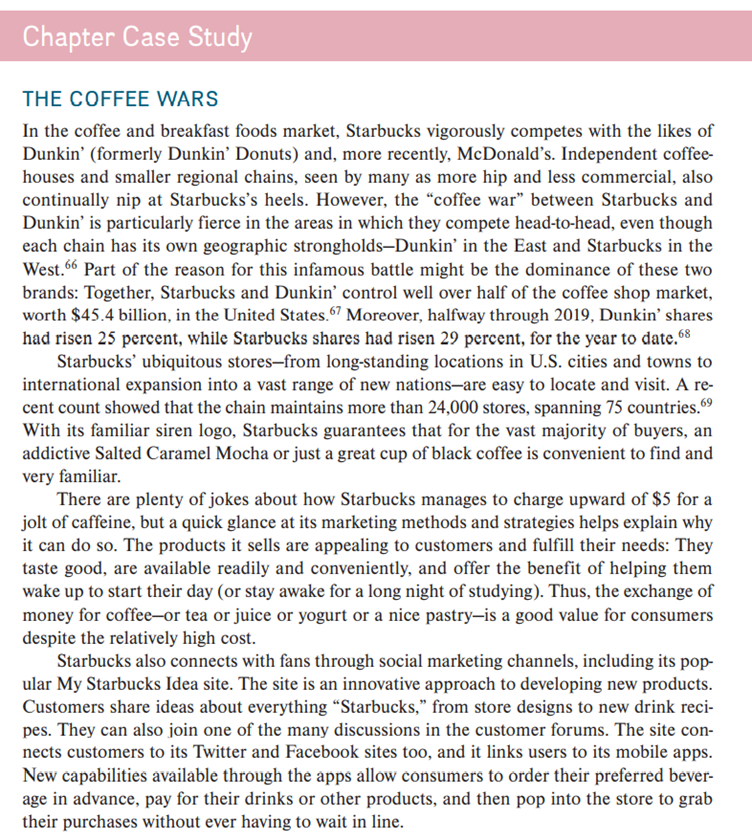
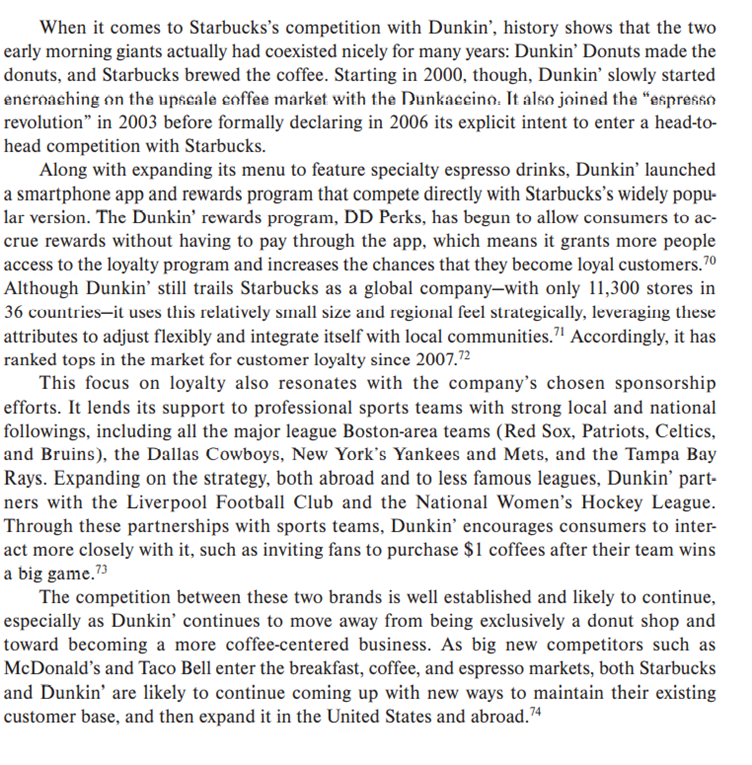
In the coffee and breakfast foods market, Starbucks vigorously competes with the likes of Dunkin' (formerly Dunkin' Donuts) and, more recently, McDonald's. Independent coffeehouses and smaller regional chains, seen by many as more hip and less commercial, also continually nip at Starbucks's heels. However, the "coffee war" between Starbucks and Dunkin' is particularly fierce in the areas in which they compete head-to-head, even though each chain has its own geographic strongholds-Dunkin' in the East and Starbucks in the West. 66 Part of the reason for this infamous battle might be the dominance of these two brands: Together, Starbucks and Dunkin' control well over half of the coffee shop market, worth $45.4 billion, in the United States. 67 Moreover, halfway through 2019, Dunkin' shares had risen 25 percent, while Starbucks shares had risen 29 percent, for the year to date. 68 Starbucks' ubiquitous stores-from long-standing locations in U.S. cities and towns to international expansion into a vast range of new nations-are easy to locate and visit. A recent count showed that the chain maintains more than 24,000 stores, spanning 75 countries. 69 With its familiar siren logo, Starbucks guarantees that for the vast majority of buyers, an addictive Salted Caramel Mocha or just a great cup of black coffee is convenient to find and very familiar. There are plenty of jokes about how Starbucks manages to charge upward of $5 for a jolt of caffeine, but a quick glance at its marketing methods and strategies helps explain why it can do so. The products it sells are appealing to customers and fulfill their needs: They taste good, are available readily and conveniently, and offer the benefit of helping them wake up to start their day (or stay awake for a long night of studying). Thus, the exchange of money for coffee-or tea or juice or yogurt or a nice pastry-is a good value for consumers despite the relatively high cost. Starbucks also connects with fans through social marketing channels, including its popular My Starbucks Idea site. The site is an innovative approach to developing new products. Customers share ideas about everything "Starbucks," from store designs to new drink recipes. They can also join one of the many discussions in the customer forums. The site connects customers to its Twitter and Facebook sites too, and it links users to its mobile apps. New capabilities available through the apps allow consumers to order their preferred beverage in advance, pay for their drinks or other products, and then pop into the store to grab their purchases without ever having to wait in line. When it comes to Starbucks's competition with Dunkin', history shows that the two early morning giants actually had coexisted nicely for many years: Dunkin' Donuts made the donuts, and Starbucks brewed the coffee. Starting in 2000, though, Dunkin' slowly started enernaching on the upseale enffee market with the Dunkaccinn. It also joined the "espresin revolution" in 2003 before formally declaring in 2006 its explicit intent to enter a head-tohead competition with Starbucks. Along with expanding its menu to feature specialty espresso drinks, Dunkin' launched a smartphone app and rewards program that compete directly with Starbucks's widely popular version. The Dunkin' rewards program, DD Perks, has begun to allow consumers to accrue rewards without having to pay through the app, which means it grants more people access to the loyalty program and increases the chances that they become loyal customers. 70 Although Dunkin' still trails Starbucks as a global company-with only 11,300 stores in 36 countries-it uses this relatively small size and regional feel strategically, leveraging these attributes to adjust flexibly and integrate itself with local communities. 71 Accordingly, it has ranked tops in the market for customer loyalty since 2007.72 This focus on loyalty also resonates with the company's chosen sponsorship efforts. It lends its support to professional sports teams with strong local and national followings, including all the major league Boston-area teams (Red Sox, Patriots, Celtics, and Bruins), the Dallas Cowboys, New York's Yankees and Mets, and the Tampa Bay Rays. Expanding on the strategy, both abroad and to less famous leagues, Dunkin' partners with the Liverpool Football Club and the National Women's Hockey League. Through these partnerships with sports teams, Dunkin' encourages consumers to interact more closely with it, such as inviting fans to purchase $1 coffees after their team wins a big game. 73 The competition between these two brands is well established and likely to continue, especially as Dunkin' continues to move away from being exclusively a donut shop and toward becoming a more coffee-centered business. As big new competitors such as McDonald's and Taco Bell enter the breakfast, coffee, and espresso markets, both Starbucks and Dunkin' are likely to continue coming up with new ways to maintain their existing customer base, and then expand it in the United States and abroad. 74
Step by Step Solution
There are 3 Steps involved in it
1 Expert Approved Answer
Step: 1 Unlock

Question Has Been Solved by an Expert!
Get step-by-step solutions from verified subject matter experts
Step: 2 Unlock
Step: 3 Unlock
 Study Help