



Question: Reading Like a Writer: Academic Argument Beginning on the next page is an argumentative essay written by a student. As you read through the essay,
Reading Like a Writer: Academic Argument Beginning on the next page is an argumentative essay written by a student. As you read through the essay, think about what you have learned about academic arguments through the various readings we have completed for this week (especially "Argument" and "Evidence"). Then, answer the following questions, being sure to change your font color or style. Tip: When given a sample essay to read, your instructor wants you to focus on what choices the writer made and why s/he made those choices so that you might make similar (or different) choices in your own essay. 1. What is the argument being made in the essay that begins on the next page? How do you know this is the argument (point to the specific place(s) that help you know what the argument is)? 2. Who is the intended audience for the essay that begins on the next page of this document and how do you know? 3. What evidence or types of evidence does the author use to support her/his claim? (Point to specific examples) 4. How appropriate or effective is the evidence used? (Point to specific examples and explain your answer) 5. How does the author transition or move from one idea to another? How effective are the transitions? (Point to specific examples) 6. Where does the author consider the counterargument or opposing position(s)? How effectively does s/he introduce and respond to the counterarguments? 7. What techniques (or moves) does the writer make and how might you use similar techniques? (for example, do you notice the use of any templates from TSIS? What about summary as a technique? What about the introduction strategies we read about earlier? Etc.)
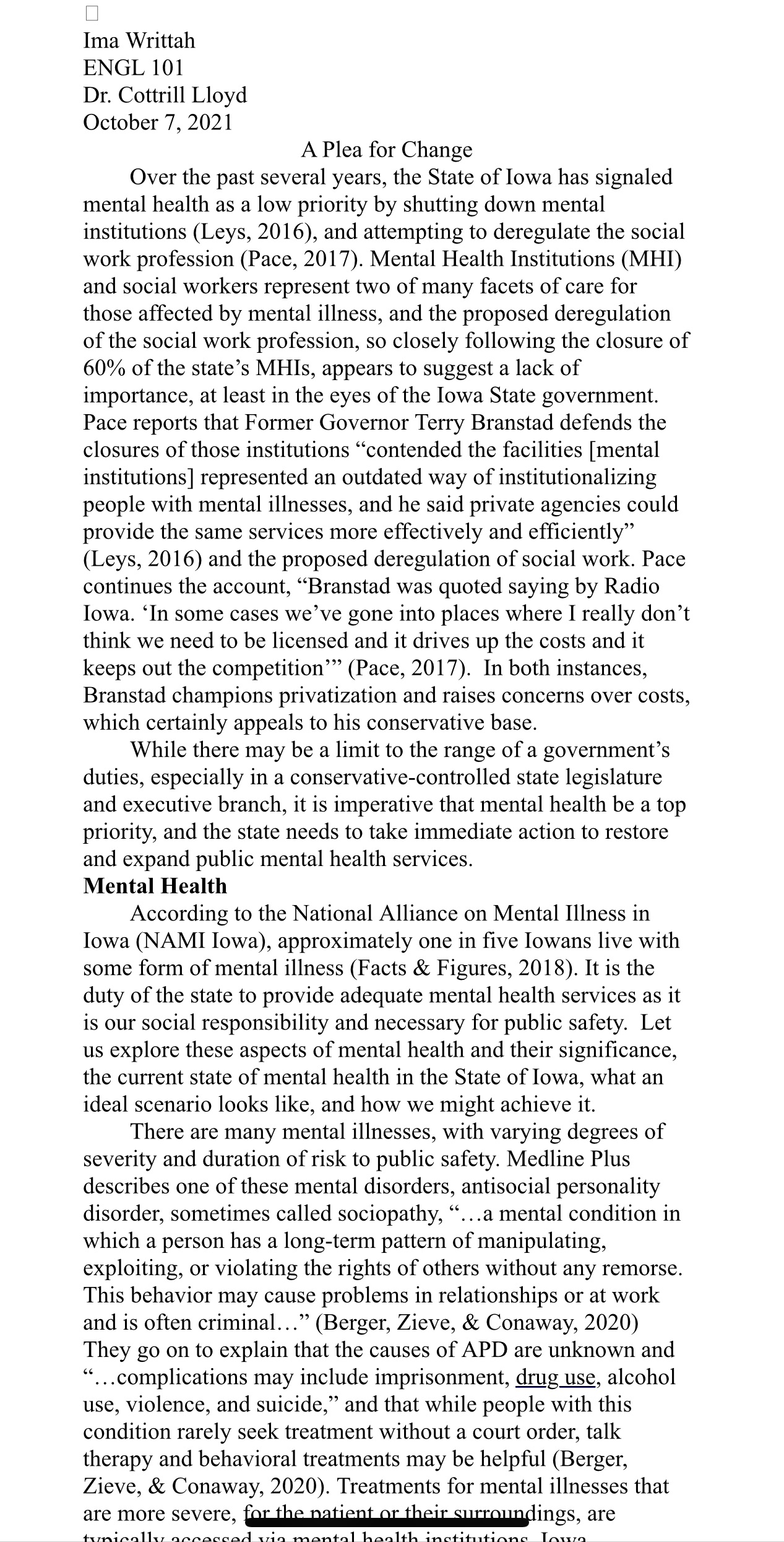
l Ima Writtah ENGL 101 Dr. Cottrill Lloyd October 7, 2021 A Plea for Change Over the past several years, the State of Iowa has signaled mental health as a low priority by shutting down mental institutions (Leys, 2016), and attempting to deregulate the social work profession (Pace, 2017). Mental Health Institutions (MHI) and social workers represent two of many facets of care for those affected by mental illness, and the proposed deregulation of the social work profession, so closely following the closure of 60% of the state's MHIs, appears to suggest a lack of importance, at least in the eyes of the Iowa State government. Pace reports that Former Governor Terry Branstad defends the closures of those institutions \"contended the facilities [mental institutions] represented an outdated way of institutionalizing people with mental illnesses, and he said private agencies could provide the same services more effectively and efficiently\" (Leys, 2016) and the proposed deregulation of social work. Pace continues the account, \"Branstad was quoted saying by Radio Iowa. \"In some cases we've gone into places where I really don't think we need to be licensed and it drives up the costs and it keeps out the competition\" (Pace, 2017). In both instances, Branstad champions privatization and raises concerns over costs, which certainly appeals to his conservative base. While there may be a limit to the range of a govemment's duties, especially in a conservative-controlled state legislature and executive branch, it is imperative that mental health be a top priority, and the state needs to take immediate action to restore and expand public mental health services. Mental Health According to the National Alliance on Mental Illness in Iowa (NAMI Iowa), approximately one in ve Iowans live with some form of mental illness (Facts & Figures, 2018). It is the duty of the state to provide adequate mental health services as it is our social responsibility and necessary for public safety. Let us explore these aspects of mental health and their signicance, the current state of mental health in the State of Iowa, what an ideal scenario looks like, and how we might achieve it. There are many mental illnesses, with varying degrees of severity and duration of risk to public safety. Medline Plus describes one of these mental disorders, antisocial personality disorder, sometimes called sociopathy, \".. .a mental condition in which a person has a long-term pattern of manipulating, exploiting, or violating the rights of others without any remorse. This behavior may cause problems in relationships or at work and is often criminal. . .\" (Berger, Zieve, & Conaway, 2020) They go on to explain that the causes of AFB are unknown and \". . .complications may include imprisonment, dLug, alcohol use, Violence, and suicide,\" and that while people with this condition rarely seek treatment without a court order, talk therapy and behavioral treatments may be helpful (Berger, Zieve, & Conaway, 2020). Treatments for mental illnesses that are more severe, Wings, are fxrninnllxr nnnnnonr' \ 1'r1 mnnfol lanolflm innfifnh'nno Innro
Step by Step Solution
There are 3 Steps involved in it

Get step-by-step solutions from verified subject matter experts