



Question: ( ref . : Carlos F . Daganzo: Logistics Systems Analysis, 4 th Ed . Springer, 2 0 0 4 ) 3 . 6 Freight
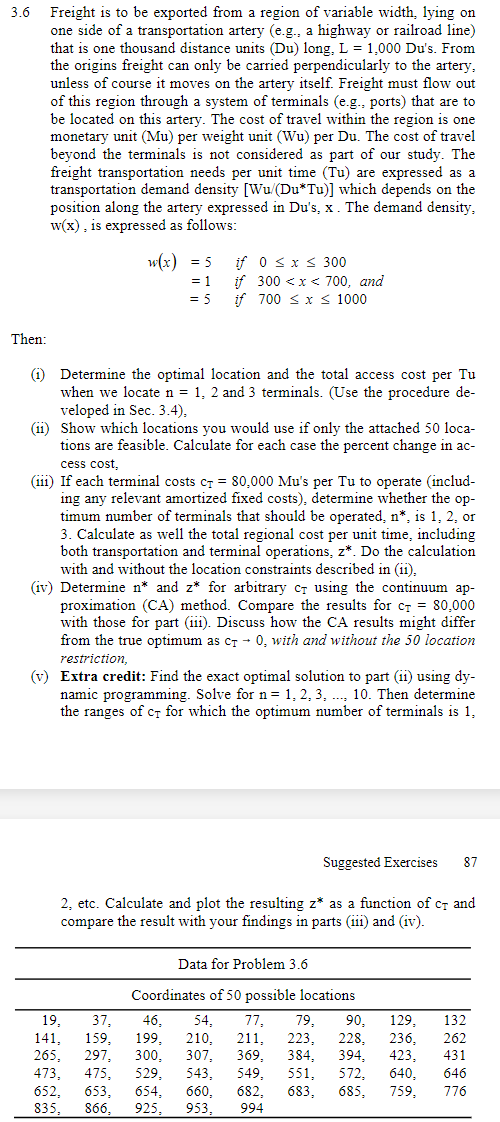
ref: Carlos F Daganzo: Logistics Systems Analysis, th Ed Springer, Freight is to be exported from a region of variable width, lying on
one side of a transportation artery eg a highway or railroad line
that is one thousand distance units Du long, s From
the origins freight can only be carried perpendicularly to the artery,
unless of course it moves on the artery itself. Freight must flow out
of this region through a system of terminals eg ports that are to
be located on this artery. The cost of travel within the region is one
monetary unit per weight unit per The cost of travel
beyond the terminals is not considered as part of our study. The
freight transportation needs per unit time are expressed as a
transportation demand density which depends on the
position along the artery expressed in Du's, The demand density,
is expressed as follows:
Tundots,
Then:
Determine the optimal location and the total access cost per
when locate and terminals. the procedure
veloped Sec.
Show which locations you would use only the attached loca
tions are feasible. Calculate for each case the percent change
cess cost,
each terminal costs per operate
ing any relevant amortized fixed costs determine whether the
timum number terminals that should operated,
Calculate well the total regional cost per unit time, including
both transportation and terminal operations, the calculation
with and without the location constraints described
Determine and for arbitrary using the continuum
proximation method. Compare the results for
with those for part Discuss how the results might differ
from the true optimum with and without the location
restriction,
Extra credit: Find the exact optimal solution part using
namic programming. Solve for dots, Then determine
the ranges for which the optimum number terminals
etc. Calculate and plot the resulting a function and
compare the result with your findings parts and
Data for Problem
Coordinates possible locations
Step by Step Solution
There are 3 Steps involved in it
1 Expert Approved Answer
Step: 1 Unlock

Question Has Been Solved by an Expert!
Get step-by-step solutions from verified subject matter experts
Step: 2 Unlock
Step: 3 Unlock