





Question: Refer to Table 56.1 - Factors for Computing Control Chart Limits (3 sigma) for this problem. A process that is considered to be in control
Refer to Table 56.1 - Factors for ComputingRefer to Table 56.1 - Factors for Computing

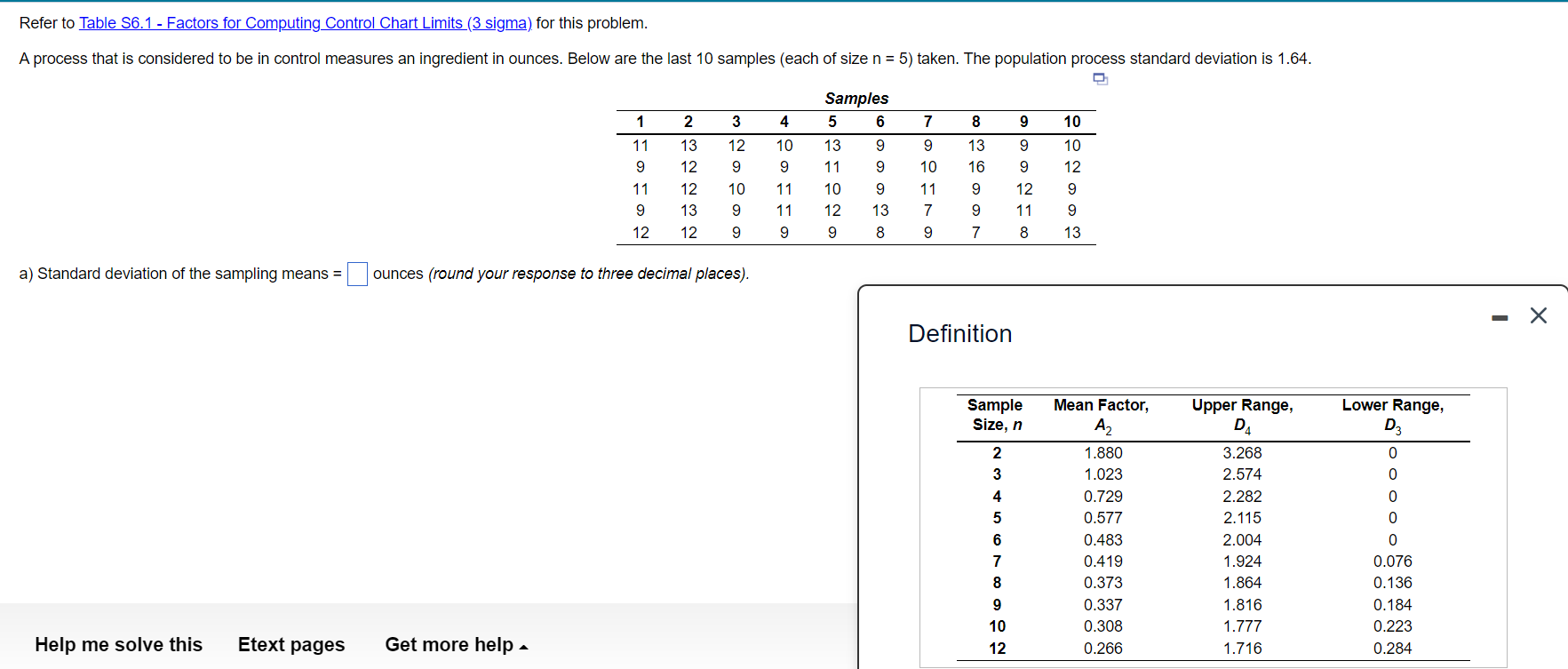
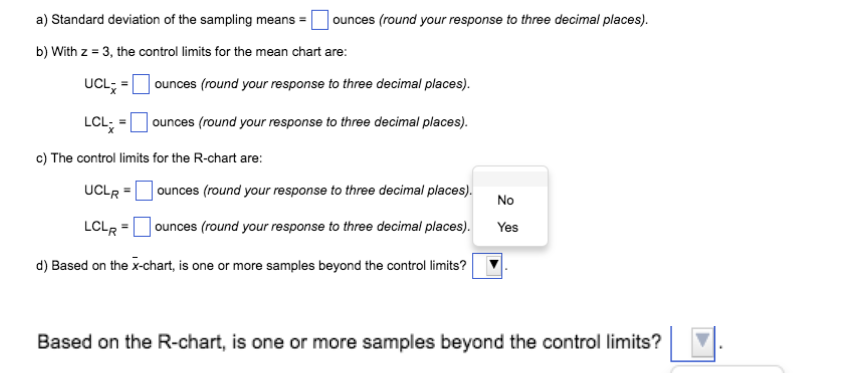
Refer to Table 56.1 - Factors for Computing Control Chart Limits (3 sigma) for this problem. A process that is considered to be in control measures an ingredient in ounces. Below are the last 10 samples (each of size n = 5) taken. The population process standard deviation is 1.64. 1 2 3 7 8 9 11 13 10 9 13 16 9 12 Samples 5 6 13 9 11 9 10 9 12 13 9 8 10 4 12 9 1 19 12 9 10 9 9 9 9 12 11 10 10 12 9 9 13 11 9 12 13 12 11 11 9 11 7 9 9 7 12 8 a) Standard deviation of the sampling means = ounces (round your response to three decimal places). - Definition Sample Size, n Upper Range, DA Lower Range, D3 0 0 0 2 3 4 4 5 5 6 7 8 9 10 12 Mean Factor, A2 1.880 1.023 0.729 0.577 0.483 0.419 0.373 0.337 0.308 0.266 3.268 2.574 2.282 2.115 2.004 1.924 1.864 1.816 1.777 1.716 0 0 0.076 0.136 0.184 0.223 0.284 Help me solve this Etext pages Get more help A a) Standard deviation of the sampling means = ounces (round your response to three decimal places). b) With z = 3, the control limits for the mean chart are: UCLE ounces (round your response to three decimal places). LCL; -ounces (round your response to three decimal places). c) The control limits for the R-chart are: UCLR-ounces (round your response to three decimal places). LCLR ounces (round your response to three decimal places). No Yes d) Based on the x-chart, is one or more samples beyond the control limits? Based on the R-chart, is one or more samples beyond the control limits

Step by Step Solution

There are 3 Steps involved in it

1 Expert Approved Answer
Step: 1 Unlock blur-text-image

Question Has Been Solved by an Expert!

Get step-by-step solutions from verified subject matter experts

Step: 2 Unlock
Step: 3 Unlock

Students Have Also Explored These Related General Management Questions!