







Question: Refer to the case study Before attempting the exercise, click to read the Rochester Manufacturing's Process Decision case study. Why is the production manager at
Refer to the case study 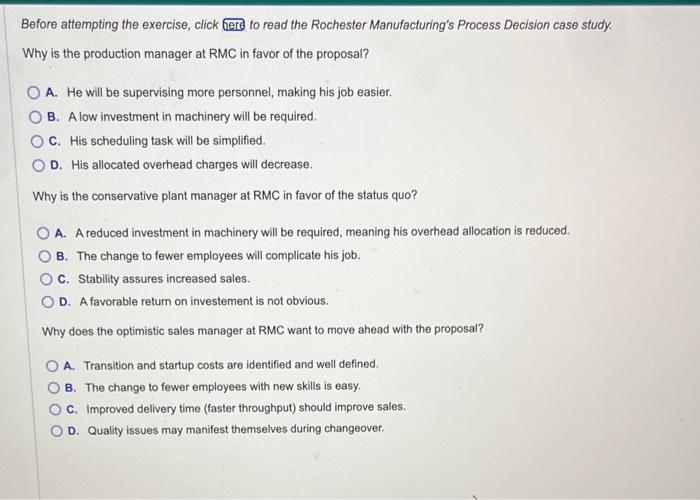
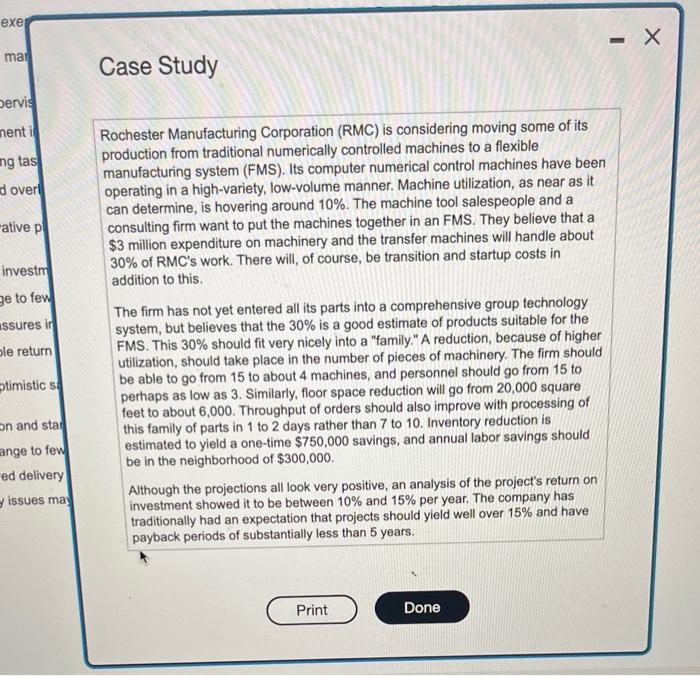
Before attempting the exercise, click to read the Rochester Manufacturing's Process Decision case study. Why is the production manager at RMC in favor of the proposal? A. He will be supervising more personnel, making his job easier. B. A low investment in machinery will be required. C. His scheduling task will be simplified. D. His allocated overhead charges will decrease. Why is the conservative plant manager at RMC in favor of the status quo? A. A reduced investment in machinery will be required, meaning his overhead allocation is reduced. B. The change to fewer employees will complicate his job. C. Stability assures increased sales. D. A favorable return on investement is not obvious. Why does the optimistic sales manager at RMC want to move ahead with the proposal? A. Transition and startup costs are identified and well defined. B. The change to fewer employees with new skills is easy. C. Improved delivery time (faster throughput) should improve sales. D. Quality issues may manifest themselves during changeover. Case Study Rochester Manufacturing Corporation (RMC) is considering moving some of its production from traditional numerically controlled machines to a flexible manufacturing system (FMS). Its computer numerical control machines have been operating in a high-variety, low-volume manner. Machine utilization, as near as it can determine, is hovering around 10%. The machine tool salespeople and a consulting firm want to put the machines together in an FMS. They believe that a $3 million expenditure on machinery and the transfer machines will handle about 30% of RMC's work. There will, of course, be transition and startup costs in addition to this. The firm has not yet entered all its parts into a comprehensive group technology system, but believes that the 30% is a good estimate of products suitable for the FMS. This 30% should fit very nicely into a "family." A reduction, because of higher utilization, should take place in the number of pieces of machinery. The firm should be able to go from 15 to about 4 machines, and personnel should go from 15 to perhaps as low as 3 . Similarly, floor space reduction will go from 20,000 square feet to about 6,000 . Throughput of orders should also improve with processing of this family of parts in 1 to 2 days rather than 7 to 10 . Inventory reduction is estimated to yield a one-time $750,000 savings, and annual labor savings should be in the neighborhood of $300,000. Although the projections all look very positive, an analysis of the project's return on investment showed it to be between 10% and 15% per year. The company has traditionally had an expectation that projects should yield well over 15% and have payback periods of substantially less than 5 years Step by Step Solution
There are 3 Steps involved in it
1 Expert Approved Answer
Step: 1 Unlock

Question Has Been Solved by an Expert!
Get step-by-step solutions from verified subject matter experts
Step: 2 Unlock
Step: 3 Unlock
 Study Help