







Question: Reference: Calculus and Its Applications, 12th, by Marvin L. Bittinger and David Ellenbogen Book Elementary Applied Calculus I need help with questions These are practice
Reference: Calculus and Its Applications, 12th, by Marvin L. Bittinger and David Ellenbogen Book
Elementary Applied Calculus
I need help with questions
These are practice questions
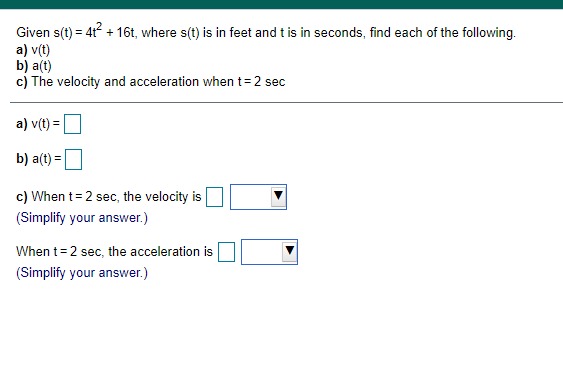
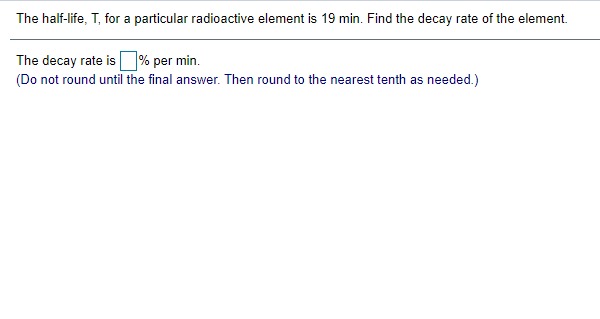
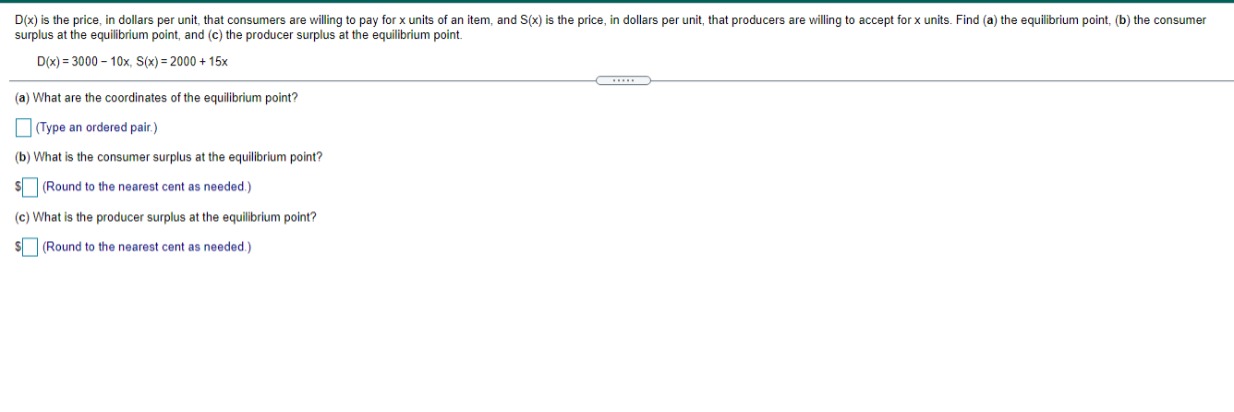
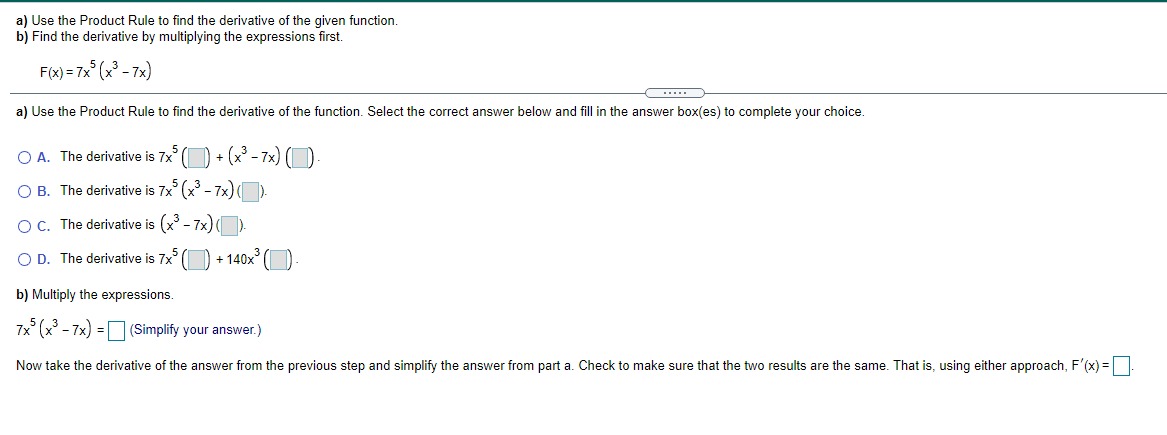
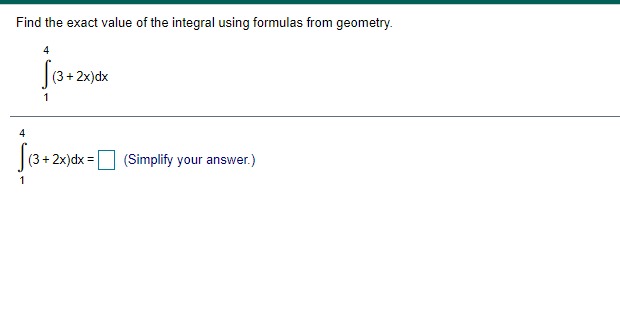
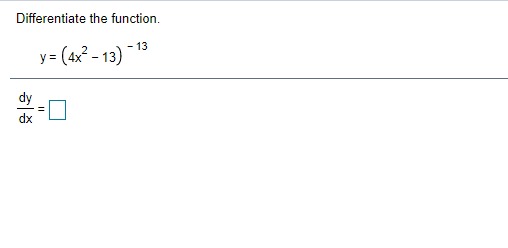
\fGiven s(t) = 41- + 16t, where s(t) is in feet and t is in seconds, find each of the following a) v(t) b) a(t) c) The velocity and acceleration when t = 2 sec a) v(t) = b) a(t) = c) When t = 2 sec, the velocity is (Simplify your answer.) When t=2 sec, the acceleration is (Simplify your answer.)The half-life, T, for a particular radioactive element is 19 min. Find the decay rate of the element. The decay rate is % per min. (Do not round until the final answer. Then round to the nearest tenth as needed.)D(x) is the price, in dollars per unit, that consumers are willing to pay for x units of an item, and S(x) is the price, in dollars per unit, that producers are willing to accept for x units. Find (a) the equilibrium point, (b) the consumer surplus at the equilibrium point, and (c) the producer surplus at the equilibrium point. D(x) = 3000 - 10x, S(x) =2000 + 15x (a) What are the coordinates of the equilibrium point? (Type an ordered pair.) (b) What is the consumer surplus at the equilibrium point? s(Round to the nearest cent as needed.) (c) What is the producer surplus at the equilibrium point? s(Round to the nearest cent as needed.)a) Use the Product Rule to find the derivative of the given function. b) Find the derivative by multiplying the expressions first. F(x) = 7x (x - 7x) . . . . . a) Use the Product Rule to find the derivative of the function. Select the correct answer below and fill in the answer box(es) to complete your choice. O A. The derivative is 7x ( ) + (x3 - 7x) ( D) O B. The derivative is 7x (x3 - 7x) () O C. The derivative is (x - 7x) () O D. The derivative is 7x ( ) + 140x () b) Multiply the expressions. 7x (x3 - 7x) = (Simplify your answer.) Now take the derivative of the answer from the previous step and simplify the answer from part a. Check to make sure that the two results are the same. That is, using either approach, F'(x) =.Find the exact value of the integral using formulas from geometry. 4 ( 3 + 2 x ) dx (3+ 2x)dx = (Simplify your answer.)
Step by Step Solution
There are 3 Steps involved in it

Get step-by-step solutions from verified subject matter experts
 Study Help