



Question: Remark 1. The following problem aims to highlight how important every ingTedient in the parametrisation of a surface is. In Problem 4 both surfaces you
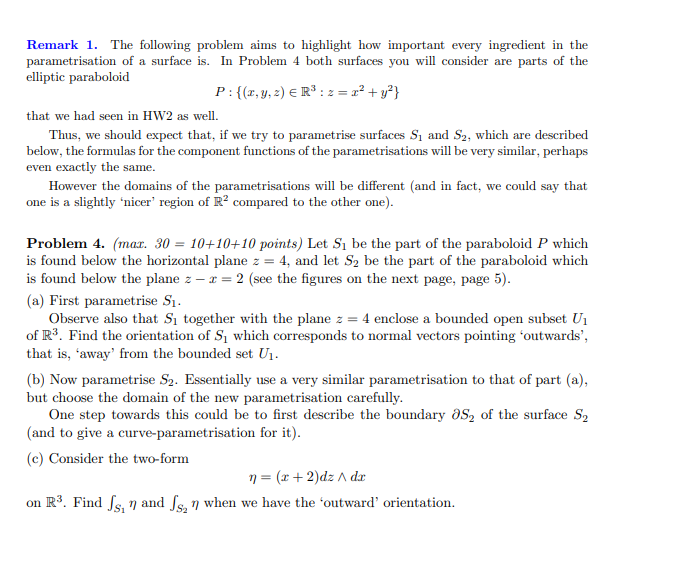
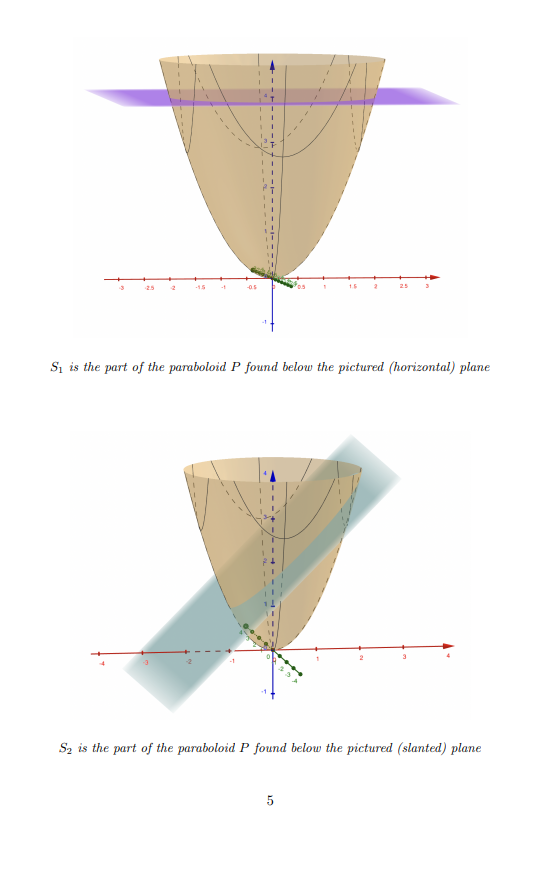
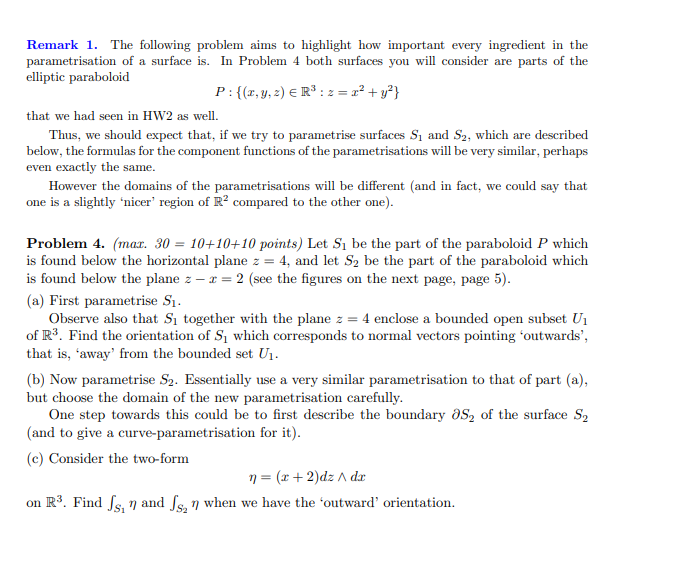
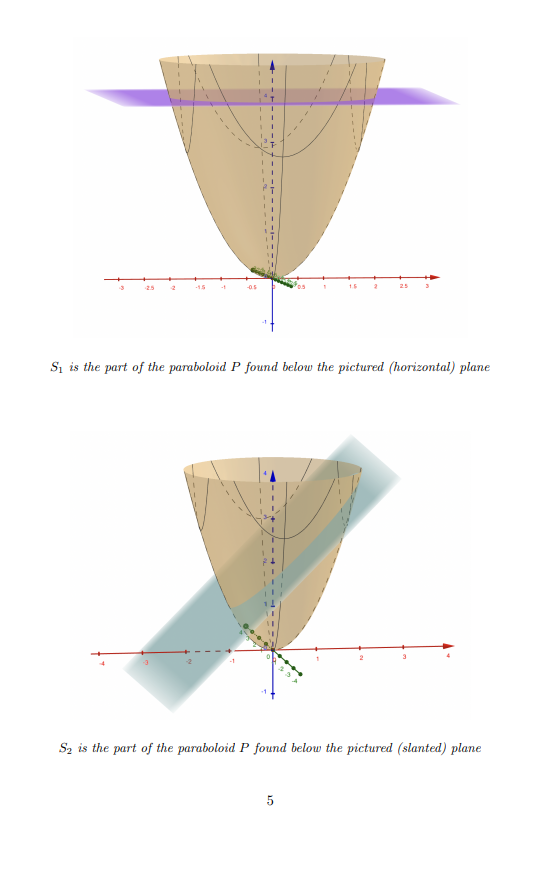
Remark 1. The following problem aims to highlight how important every ingTedient in the parametrisation of a surface is. In Problem 4 both surfaces you will consider are parts of the elliptic paraboloid P : {(3.3},2) E 133:2 = 2:2 +33} that we had seen in H\"? as well. Thus._ we should expect that. if we tr),r to parametrise smfaces 5'1 and 5'21 which are described below. the formulas for the component functions ofthe parametrisations will he very similar, perhaps even exactly the same. However the domains of the parametrisations will be different [and in fact. we could say that one is a slightly 'nicer' region of R2 compared to the other one). Problem 4. (max. so = 10+10+I points) Let 31 be the part of the paraboloid P which is found below the horizontal plane z = 41 and let 32 be the part of the paraboloid which is found below the plane z :5 = 2 [see the gures on the next page1 page 5}. [a] First parametrise 3]. Observe also that 51 together with the plane z = 4 enclose a bounded open subset U1 of 111\". Find the orientation of SI which corresponds to normal vectors pointing "ontwards'1 that is, "away' from the bounded set {31. [b) Now parametrise 33. Essentially use a very similar parametrisation to that of part (a)1 but choose the domain of the new parametrisation carefully. One step towards this could be to rst describe the boundaryr {J52 of the snrfane 32 [and to give a carve-parametrisation for it}. (e) Consider the twoform 1}: (I+2]dzf\\d: on R3. Find ls, 1'} and [92 1'; when we have the "ontward' orientation. 25 2 15 2 5 Si is the part of the paraboloid P found below the pictured (horizontal) plane 2 -3 Sz is the part of the paraboloid P found below the pictured (slanted) plane 5
Step by Step Solution
There are 3 Steps involved in it

Get step-by-step solutions from verified subject matter experts