Question: Require Firstly summarized the case above by extracting out all the important facts(Critically analyze and summarize the whole case) 700words! In each situation above, students
Require
- Firstly summarized the case above by extracting out all the important facts(Critically analyze and summarize the whole case)700words!
- In each situation above, students should decide what they would have ruled, based on the facts as presented, had they been the arbitrator, and why they would have so ruled(Content/Argument /Discussion clearly stated) 700words!
- Examples of cases are encouraged to justify your answer. This will add extra validity to your answer.(Provide FOUR(4)constructive recommendations for the company to prevent the issue mentioned in the case) 700words!
- (2000 WORDS 2000 WORDS 2000 WORDS
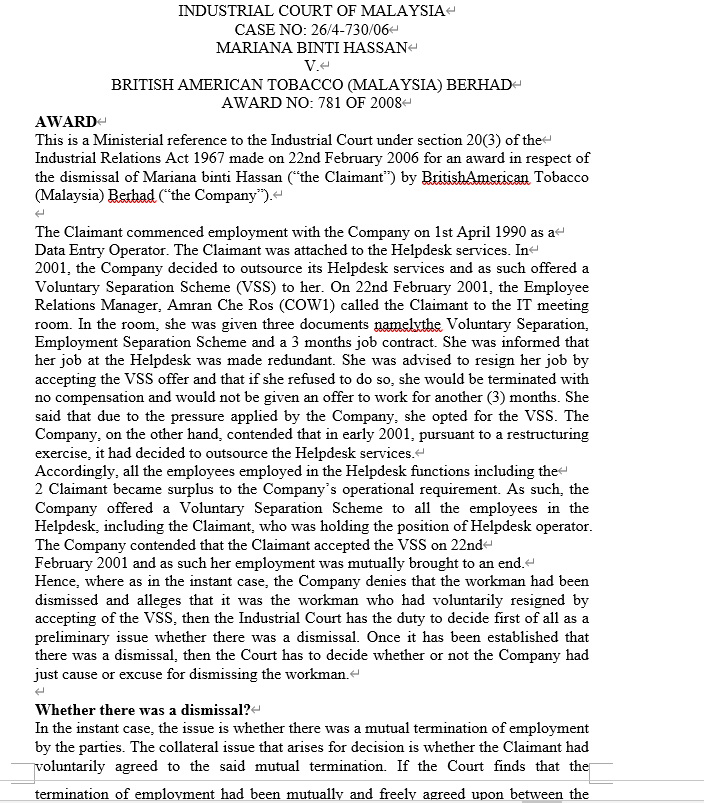
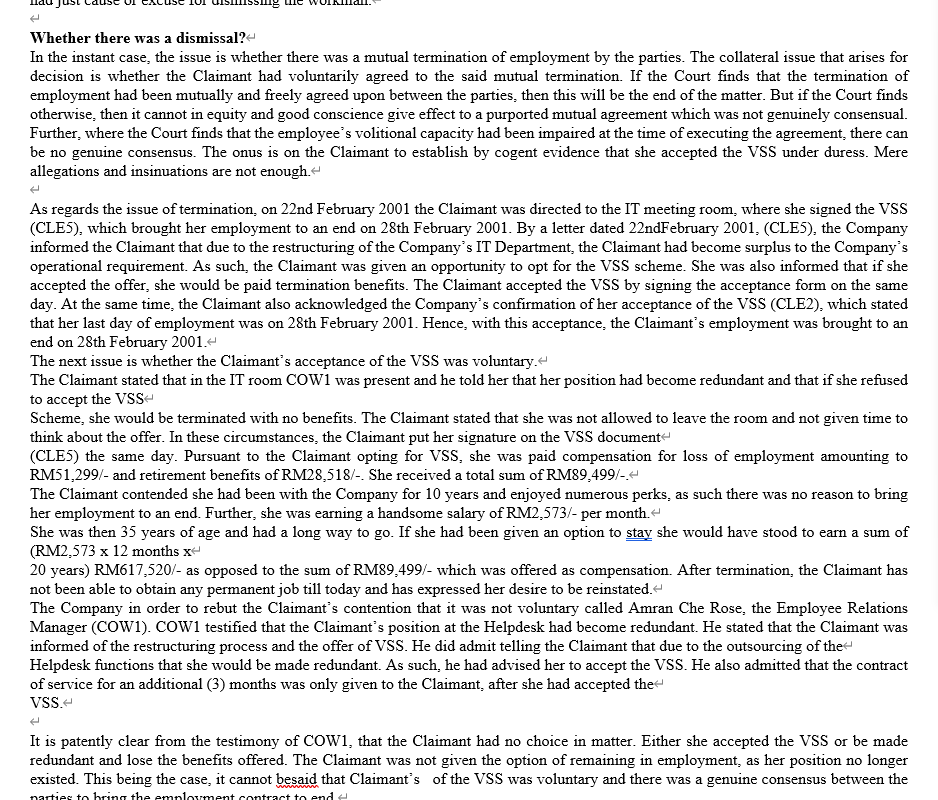
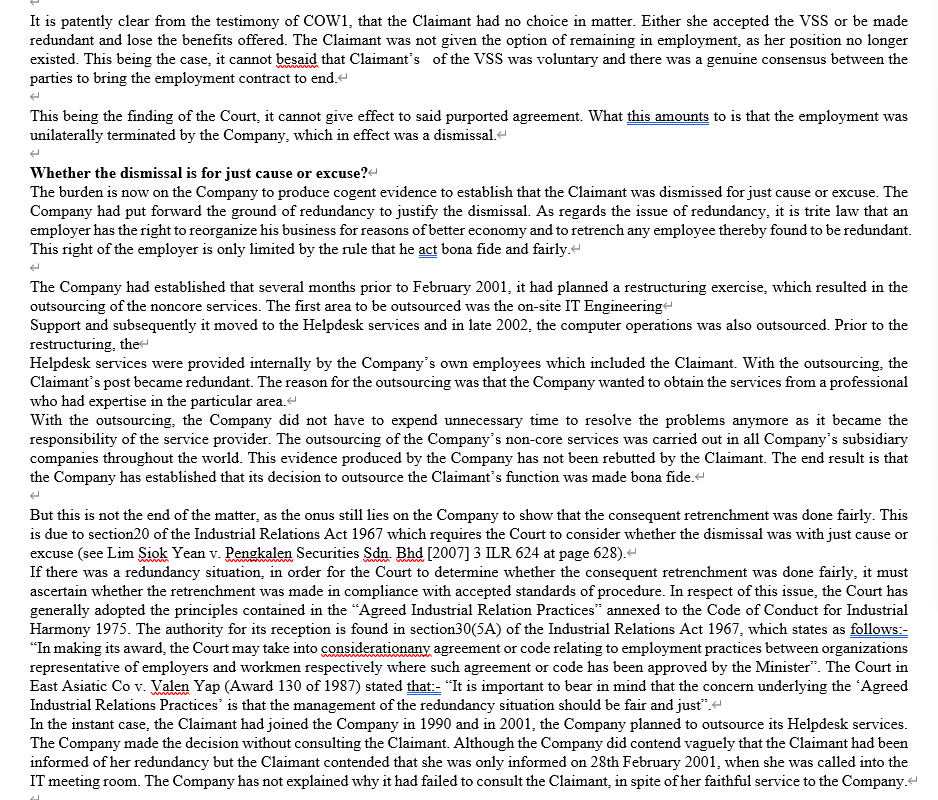
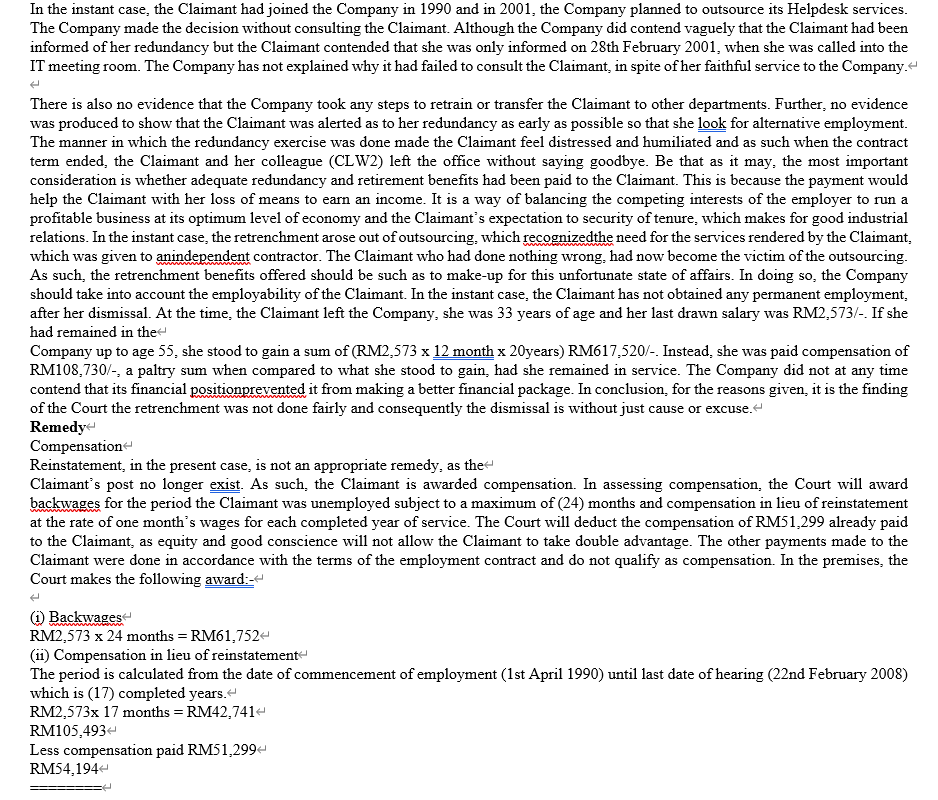
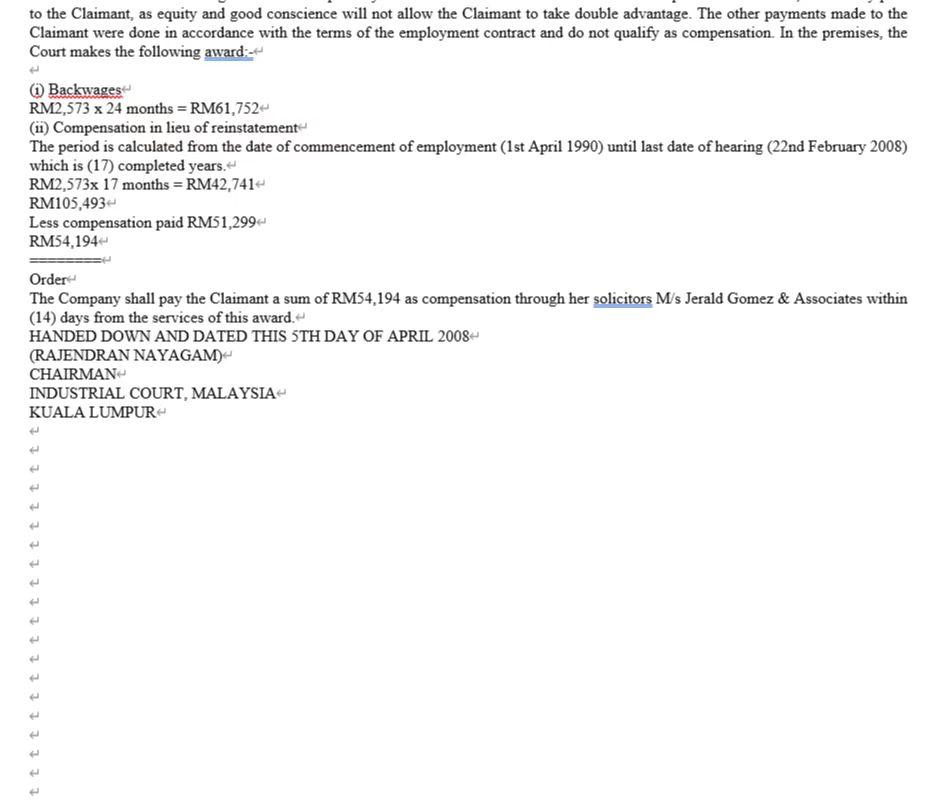
INDUSTRIAL COURT OF MALAYSIA CASE NO: 26/4-730/06 MARIANA BINTI HASSAN V. BRITISH AMERICAN TOBACCO (MALAYSIA) BERHAD AWARD NO: 781 OF 2008 AWARD This is a Ministerial reference to the Industrial Court under section 20(3) of the Industrial Relations Act 1967 made on 22nd February 2006 for an award in respect of the dismissal of Mariana binti Hassan (the Claimant) by British American Tobacco (Malaysia) Berhad (the Company').- w The Claimant commenced employment with the Company on 1st April 1990 as a Data Entry Operator. The Claimant was attached to the Helpdesk services. In 2001, the Company decided to outsource its Helpdesk services and as such offered a Voluntary Separation Scheme (VSS) to her. On 22nd February 2001, the Employee Relations Manager, Amran Che Ros (COW1) called the Claimant to the IT meeting room. In the room, she was given three documents namelythe Voluntary Separation, Employment Separation Scheme and a 3 months job contract. She was informed that her job at the Helpdesk was made redundant. She was advised to resign her job by accepting the VSS offer and that if she refused to do so, she would be terminated with no compensation and would not be given an offer to work for another (3) months. She said that due to the pressure applied by the Company, she opted for the VSS. The Company, on the other hand, contended that in early 2001, pursuant to a restructuring exercise, it had decided to outsource the Helpdesk services. Accordingly, all the employees employed in the Helpdesk functions including the 2 Claimant became surplus to the Company's operational requirement. As such, the Company offered a Voluntary Separation Scheme to all the employees in the Helpdesk, including the Claimant, who was holding the position of Helpdesk operator. The Company contended that the Claimant accepted the VSS on 22nd February 2001 and as such her employment was mutually brought to an end. Hence, where as in the instant case, the Company denies that the workman had been dismissed and alleges that it was the workman who had voluntarily resigned by accepting of the VSS, then the Industrial Court has the duty to decide first of all as a preliminary issue whether there was a dismissal. Once it has been established that there was a dismissal, then the Court has to decide whether or not the Company had just cause or excuse for dismissing the workman. Whether there was a dismissal?- In the instant case, the issue is whether there was a mutual termination of employment by the parties. The collateral issue that arises for decision is whether the Claimant had voluntarily agreed to the said mutual termination. If the Court finds that the termination of employment had been mutually and freely agreed upon between the Whether there was a dismissal? In the instant case, the issue is whether there was a mutual termination of employment by the parties. The collateral issue that arises for decision is whether the Claimant had voluntarily agreed to the said mutual termination. If the Court finds that the termination of employment had been mutually and freely agreed upon between the parties, then this will be the end of the matter. But if the Court finds otherwise, then it cannot in equity and good conscience give effect to a purported mutual agreement which was not genuinely consensual. Further, where the Court finds that the employee's volitional capacity had been impaired at the time of executing the agreement, there can be no genuine consensus. The onus is on the Claimant to establish by cogent evidence that she accepted the VSS under duress. Mere allegations and insinuations are not enough. As regards the issue of termination, on 22nd February 2001 the Claimant was directed to the IT meeting room, where she signed the VSS (CLE5), which brought her employment to an end on 28th February 2001. By a letter dated 22ndFebruary 2001, (CLE5), the Company informed the Claimant that due to the restructuring of the Company's IT Department, the Claimant had become surplus to the Company's operational requirement. As such, the Claimant was given an opportunity to opt for the VSS scheme. She was also informed that if she accepted the offer, she would be paid termination benefits. The Claimant accepted the VSS by signing the acceptance form on the same day. At the same time, the Claimant also acknowledged the Company's confirmation of her acceptance of the VSS (CLE2), which stated that her last day of employment was on 28th February 2001. Hence, with this acceptance, the Claimant's employment was brought to an end on 28th February 2001.- The next issue is whether the Claimant's acceptance of the VSS was voluntary. The Claimant stated that in the IT room COW1 was present and he told her that her position had become redundant and that if she refused to accept the VSS- Scheme, she would be terminated with no benefits. The Claimant stated that she was not allowed to leave the room and not given time to think about the offer. In these circumstances, the Claimant put her signature on the VSS document (CLE5) the same day. Pursuant to the Claimant opting for VSS, she was paid compensation for loss of employment amounting to RM51,299/- and retirement benefits of RM28,518/-. She received a total sum of RM89.499/--- The Claimant contended she had been with the Company for 10 years and enjoyed numerous perks, as such there was no reason to bring her employment to an end. Further, she was earning a handsome salary of RM2,573/- per month She was then 35 years of age and had a long way to go. If she had been given an option to stay she would have stood to earn a sum of (RM2,573 x 12 months x 20 years) RM617,520/- as opposed to the sum of RM89,499/- which was offered as compensation. After termination, the Claimant has not been able to obtain any permanent job till today and has expressed her desire to be reinstated. The Company in order to rebut the Claimant's contention that it was not voluntary called Amran Che Rose, the Employee Relations Manager (COW1). COW1 testified that the Claimant's position at the Helpdesk had become redundant. He stated that the Claimant was informed of the restructuring process and the offer of VSS. He did admit telling the Claimant that due to the outsourcing of the Helpdesk functions that she would be made redundant. As such, he had advised her to accept the VSS. He also admitted that the contract of service for an additional (3) months was only given to the Claimant, after she had accepted the VSS. a It is patently clear from the testimony of COW1, that the Claimant had no choice in matter. Either she accepted the VSS or be made redundant and lose the benefits offered. The Claimant was not given the option of remaining in employment, as her position no longer existed. This being the case, it cannot besaid that Claimant's of the VSS was voluntary and there was a genuine consensus between the parties to bring the employment contract to end It is patently clear from the testimony of COW1, that the Claimant had no choice in matter. Either she accepted the VSS or be made redundant and lose the benefits offered. The Claimant was not given the option of remaining in employment, as her position no longer existed. This being the case, it cannot besaid that Claimant's of the VSS was voluntary and there was a genuine consensus between the parties to bring the employment contract to end. This being the finding of the Court, it cannot give effect to said purported agreement. What this amounts to is that the employment was unilaterally terminated by the Company, which in effect was a dismissal. Whether the dismissal is for just cause or excuse? The burden is now on the Company to produce cogent evidence to establish that the Claimant was dismissed for just cause or excuse. The Company had put forward the ground of redundancy to justify the dismissal. As regards the issue of redundancy, it is trite law that an employer has the right to reorganize his business for reasons of better economy and to retrench any employee thereby found to be redundant. This right of the employer is only limited by the rule that he act bona fide and fairly. The Company had established that several months prior to February 2001, it had planned a restructuring exercise, which resulted in the outsourcing of the noncore services. The first area to be outsourced was the on-site IT Engineering Support and subsequently it moved to the Helpdesk services and in late 2002, the computer operations was also outsourced. Prior to the restructuring, the Helpdesk services were provided internally by the Company's own employees which included the Claimant. With the outsourcing, the Claimant's post became redundant. The reason for the outsourcing was that the Company wanted to obtain the services from a professional who had expertise in the particular area. With the outsourcing, the Company did not have to expend unnecessary time to resolve the problems anymore as it became the responsibility of the service provider. The outsourcing of the Company's non-core services was carried out in all Company's subsidiary companies throughout the world. This evidence produced by the Company has not been rebutted by the Claimant. The end result is that the Company has established that its decision to outsource the Claimant's function was made bona fide. But this is not the end of the matter, as the onus still lies on the Company to show that the consequent retrenchment was done fairly. This is due to section 20 of the Industrial Relations Act 1967 which requires the Court to consider whether the dismissal was with just cause or excuse (see Lim Siok Yean v. Pengkalen Securities Sdn. Bhd [2007] 3 ILR 624 at page 628). If there was a redundancy situation in order for the Court to determine whether the consequent retrenchment was done fairly, it must ascertain whether the retrenchment was made in compliance with accepted standards of procedure. In respect of this issue, the Court has generally adopted the principles contained in the Agreed Industrial Relation Practices annexed to the Code of Conduct for Industrial Harmony 1975. The authority for its reception is found in section30(5A) of the Industrial Relations Act 1967, which states as follows:- "In making its award, the Court may take into considerationany agreement or code relating to employment practices between organizations representative of employers and workmen respectively where such agreement or code has been approved by the Minister. The Court in East Asiatic Co v. Valen Yap (Award 130 of 1987) stated that: - "It is important to bear in mind that the concern underlying the 'Agreed Industrial Relations Practices' is that the management of the redundancy situation should be fair and just. In the instant case, the Claimant had joined the Company in 1990 and in 2001, the Company planned to outsource its Helpdesk services. The Company made the decision without consulting the Claimant. Although the Company did contend vaguely that the Claimant had been informed of her redundancy but the Claimant contended that she was only informed on 28th February 2001, when she was called into the IT meeting room. The Company has not explained why it had failed to consult the Claimant, in spite of her faithful service to the Company. w In the instant case, the Claimant had joined the Company in 1990 and in 2001, the Company planned to outsource its Helpdesk services. The Company made the decision without consulting the Claimant. Although the Company did contend vaguely that the Claimant had been informed of her redundancy but the Claimant contended that she was only informed on 28th February 2001, when she was called into the IT meeting room. The Company has not explained why it had failed to consult the Claimant, in spite of her faithful service to the Company. There is also no evidence that the Company took any steps to retrain or transfer the Claimant to other departments. Further, no evidence was produced to show that the Claimant was alerted as to her redundancy as early as possible so that she look for alternative employment. The manner in which the redundancy exercise was done made the Claimant feel distressed and humiliated and as such when the contract term ended, the Claimant and her colleague (CLW2) left the office without saying goodbye. Be that as it may, the most important consideration is whether adequate redundancy and retirement benefits had been paid to the Claimant. This is because the payment would help the Claimant with her loss of means to earn an income. It is a way of balancing the competing interests of the employer to run a profitable business at its optimum level of economy and the Claimant's expectation to security of tenure, which makes for good industrial relations. In the instant case, the retrenchment arose out of outsourcing, which recognizedthe need for the services rendered by the Claimant, which was given to anindependent contractor. The Claimant who had done nothing wrong, had now become the victim of the outsourcing. As such, the retrenchment benefits offered should be such as to make-up for this unfortunate state of affairs. In doing so, the Company should take into account the employability of the Claimant. In the instant case, the Claimant has not obtained any permanent employment, after her dismissal. At the time, the Claimant left the Company, she was 33 years of age and her last drawn salary was RM2,573/-. If she had remained in the Company up to age 55, she stood to gain a sum of (RM2,573 x 12 month x 20years) RM617,520/-. Instead, she was paid compensation of RM108,730/-, a paltry sum when compared to what she stood to gain, had she remained in service. The Company did not at any time contend that its financial positionprevented it from making a better financial package. In conclusion, for the reasons given, it is the finding of the Court the retrenchment was not done fairly and consequently the dismissal is without just cause or excuse. Remedy Compensation Reinstatement, in the present case, is not an appropriate remedy, as the Claimant's post no longer exist. As such, the Claimant is awarded compensation. In assessing compensation, the Court will award backwages for the period the Claimant was unemployed subject to a maximum of (24) months and compensation in lieu of reinstatement at the rate of one month's wages for each completed year of service. The Court will deduct the compensation of RM51,299 already paid to the Claimant, as equity and good conscience will not allow the Claimant to take double advantage. The other payments made to the Claimant were done in accordance with the terms of the employment contract and do not qualify as compensation. In the premises, the Court makes the following award:- Backwages RM2,573 x 24 months = RM61,7524 (11) Compensation in lieu of reinstatement- The period is calculated from the date of commencement of employment (1st April 1990) until last date of hearing (22nd February 2008) which is (17) completed years. RM2,573x 17 months = RM42,7414 RM105,4934 Less compensation paid RM51,2994 RM54,194 to the Claimant, as equity and good conscience will not allow the Claimant to take double advantage. The other payments made to the Claimant were done in accordance with the terms of the employment contract and do not qualify as compensation. In the premises, the Court makes the following award- Backwages RM2,573 x 24 months = RM61,752 (ii) Compensation in lieu of reinstatement The period is calculated from the date of commencement of employment (1st April 1990) until last date of hearing (22nd February 2008) which is (17) completed years. RM2,573x 17 months = RM42,741 RM105,493 Less compensation paid RM51,299 RM54,194 Order The Company shall pay the Claimant a sum of RM54,194 as compensation through her solicitors M's Jerald Gomez & Associates within (14) days from the services of this award. HANDED DOWN AND DATED THIS 5TH DAY OF APRIL 2008- (RAJENDRAN NAYAGAM)- CHAIRMAN INDUSTRIAL COURT, MALAYSIA KUALA LUMPUR ttt i I t t I 1 I 2 t a t t I t









 Study Help