- Reread the Management Focus on Procter & Gamble, and then answer the following questions:
- What strategy was Procter & Gamble pursuing when it first entered foreign markets?
- Why do you think this strategy became less viable later on?
- What strategy does P&G appear to be moving toward?
- What are the benefits of this strategy?
- What are the potential risks associated with it?
- c. To what do you attribute P&G's recent sales decline? Why?
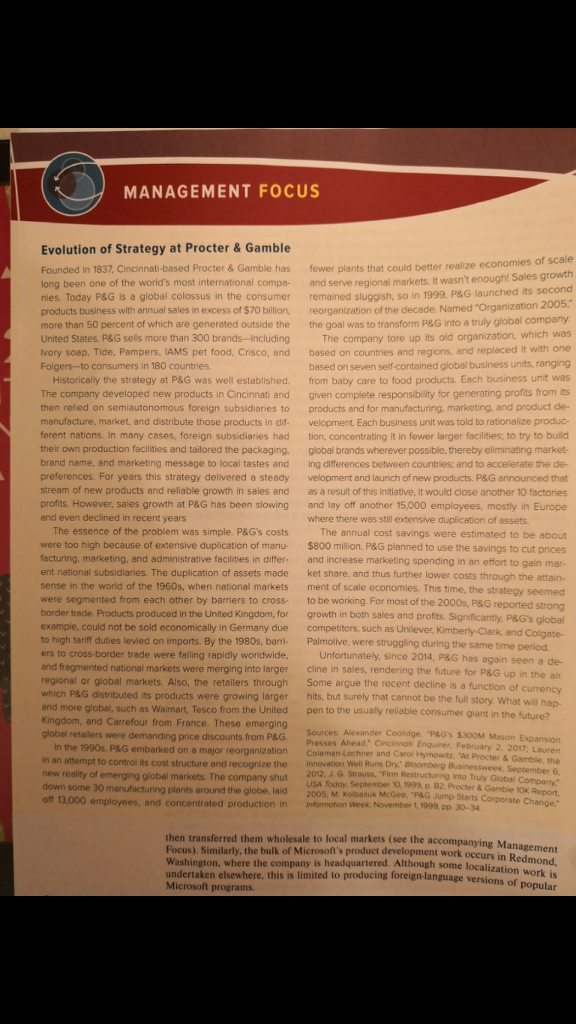
MANAGEMENT FOCUS Evolution of Strategy at Procter & Gamble Founded in 1837. Cincinnati-based Procter & Gamble has long been one of the world's most international compa onal compo- nies. Today P&G is a global colossus in the consumer products business with annual sales in excess of $70 bilion more than 50 percent of which are generated outside the United States. P&G sels more than 300 brands-including Ivory soap. Tide, Pampers, IAMS pet food, Crisco, and Folgers-to consumers in 180 countries. Historically the strategy at P&G was well established The company developed new products in Cincinnati and then relied on semiautonomous foreign subsidiaries to market, and distribute those products in dif ferent nations. In many cases, foreign subsidiaries had their own production facilities and tailored the packaging brand name, and marketing message to local tastes and preferences. For years this strategy delivered a steady Stream of new products and reliable growth in sales and profits. However, sales growth of P&G has been slowing and even declined in recent years The essence of the problem was simple. P&G's costs were too high because of extensive duplication of manu- facturing, marketing, and administrative facilities in differ- ent national subsidiaries. The duplication of assets made sense in the world of the 1960s, when national markets were segmented from each other by barriers to cross border trade Products produced in the United Kingdom, for example, could not be sold economically in Germany due to high tariff duties levied on Imports. By the 1980s, barri ers to cross-border trade were falling rapidly worldwide, and fragmented national markets were merging into larger regional or global markets. Also, the retailers through which PSG distributed its products were growing larger and more global, such as Walmart, Tesco from the United Kingdom, and Carrefour from France. These emerging global readers were demanding price discounts from P&G. in the 1990s, PSG embarked on a major reorganization in an attempt to control its cost structure and recognize the new reality of emerging global markets. The company shut down some 30 manufacturing plants around the globe, laid off 13.000 employees, and concentrated production in fewer plants that could better realize economic and serve regional markets. It wasn't enough Sales growth remained sluggish, so in 1999, PSG launched its second reorganization of the decade Named "Organization 2005." the goal was to transform P&G into a truly global company The company tore up its old organization, which was based on countries and regions, and replaced it with one based on seven self-contained global business units, ranging from baby care to food products. Each business unit was given complete responsibility for generating profits from its products and for manufacturing, marketing, and product de velopment. Each business unit was told to rationalize produc tion, concentrating it in fewer larger facilities; to try to build global brands wherever possible, thereby eliminating market ing differences between countries and to accelerate the de velopment and launch of new products. P&G announced that as a result of this initiative, it would close another 10 factories and lay off another 15,000 employees, mostly in Europe where there was still extensive duplication of assets. The annual cost savings were estimated to be about $800 million. P&G planned to use the savings to cut prices and increase marketing spending in an effort to gain mar ket share, and thus further lower costs through the attain ment of scale economies. This time, the strategy seemed to be working. For most of the 2000s, P&G reported strong growth in both sales and profits. Significantly. PSG's global competitors, such as Unilever, Kimberly-Clark, and Colgate Palmolive, were struggling during the same time period Unfortunately, since 2014, P&G has again seen a de cline in sales, rendering the future for PSG up in the air Some argue the recent decline is a function of currency hits, but surely that cannot be the full story. What we hap pen to the usually reliable consumer giant in the future? Sources Alexander Coordge"POSSOM Mson E Presses Ahead Cincinnot Engurer, February 2, 2017. Lauren Coleman Lochner and Carol Hymowite A Procter & Gamble the inovation We Run Dry Bomb See 200 G Shaussum Restructuring into the Global Com USA Today, September 10, 1999 . B2. Procter & Gamble 10K Rooon 2005 M obs McGee PSG Jump Starts Corporate Chan Information Week, November 1999. po 30-34 then transferred them wholesale to local markets (see the accompanying Mange Focus Similarly the bulk of Microsoft's product development work occurs in Red Washington where the company is headquartered. Although some localization Redmond undertaken elsewhere, this is limited to producing foreign-language versions of roducing foreign language versions of popular Microsoft programs




