Question: Respond to the Case Study quetions. Please read the case study. an Chapter 15 Managing Global Systems 591 E-Commerce in China: Opportunities and Obstacles CASE
 Respond to the Case Study quetions. Please read the case study.
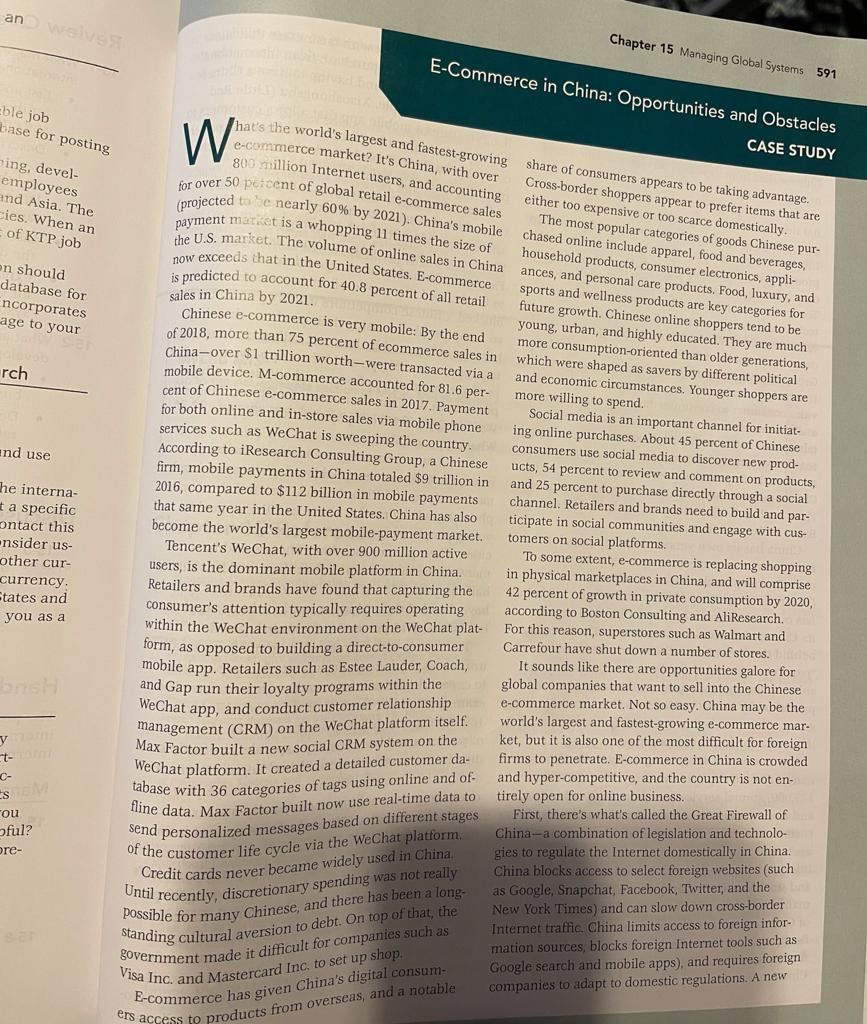
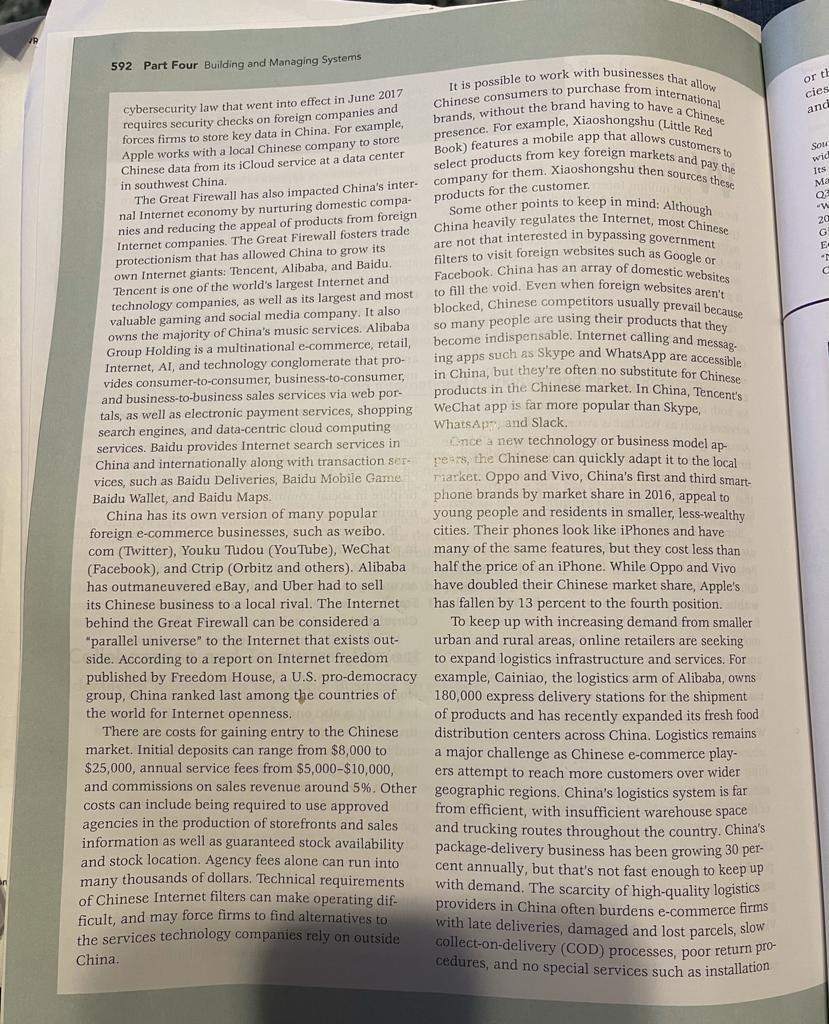
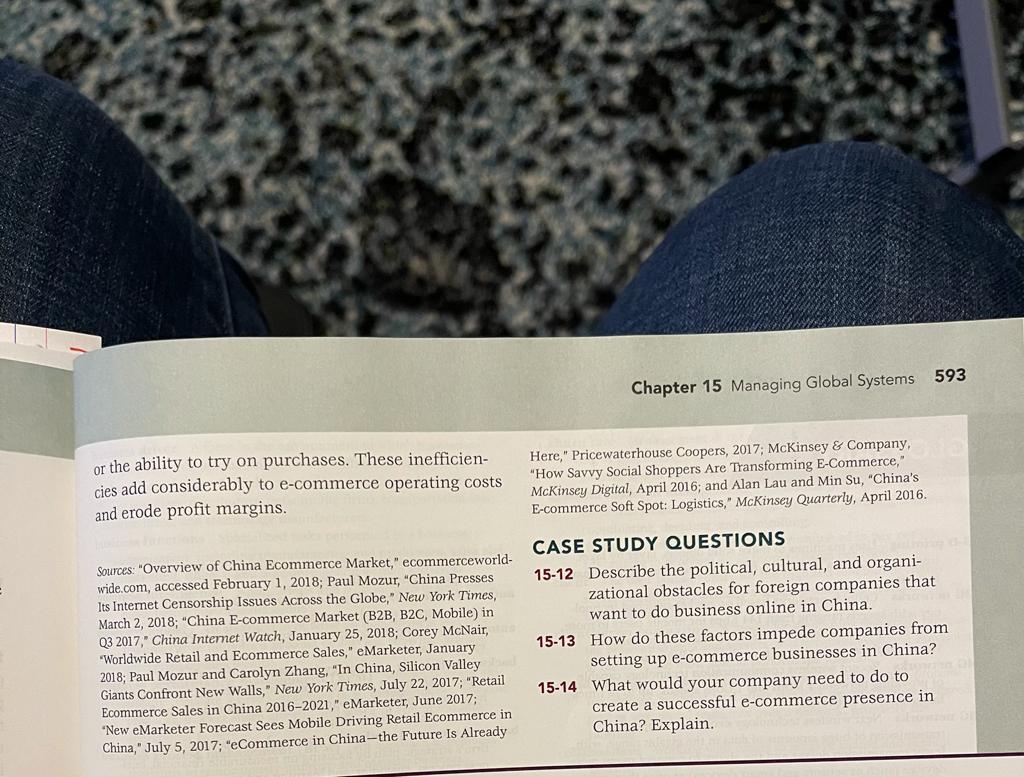
an Chapter 15 Managing Global Systems 591 E-Commerce in China: Opportunities and Obstacles CASE STUDY ble job base for posting W That's the world's largest and fastest-growing e-commerce market? It's China, with over 803 million Internet users, and accounting ing, devel- employees and Asia. The Cies. When an of KTP job share of consumers appears to be taking advantage. Cross-border shoppers appear to prefer items that are either too expensive or too scarce domestically. The most popular categories of goods Chinese pur- chased online include apparel, food and beverages, household products, consumer electronics, appli- ances, and personal care products. Food, luxury, and sports and wellness products are key categories for future growth. Chinese online shoppers tend to be young, urban, and highly educated. They are much more consumption-oriented than older generations, is predicted to account for 40.8 percent of all retail en should database for Encorporates age to your for over 50 percent of global retail e-commerce sales (projected to be nearly 60% by 2021). China's mobile payment market is a whopping 11 times the size of the U.S. market. The volume of online sales in China now exceeds that in the United States. E-commerce Until recently, discretionary spending was not really possible for many Chinese, and there has been a long- Standing cultural aversion to debt. On top of that, the government made it difficult for companies such as Visa Inc. and Mastercard Inc, to set up shop. E-commerce has given China's digital consum- ers access to products from overseas, and a notable sales in China by 2021. Chinese e-commerce is very mobile: By the end of 2018, more than 75 percent of ecommerce sales in which were shaped as savers by different political China-over $1 trillion worth-were transacted via a mobile device. M-commerce accounted for 81.6 per- and economic circumstances. Younger shoppers are rch cent of Chinese e-commerce sales in 2017. Payment more willing to spend. for both online and in-store sales via mobile phone Social media is an important channel for initiat- services such as WeChat is sweeping the country. ing online purchases. About 45 percent of Chinese consumers use social media to discover new prod- According to iResearch Consulting Group, a Chinese and use ucts, 54 percent to review and comment on products, firm, mobile payments in China totaled $9 trillion in and 25 percent to purchase directly through a social he interna- 2016, compared to $112 billion in mobile payments channel. Retailers and brands need to build and par- t a specific that same year in the United States. China has also ticipate in social communities and engage with cus- ontact this become the world's largest mobile-payment market. tomers on social platforms. onsider us- Tencent's WeChat, with over 900 million active To some extent, e-commerce is replacing shopping other cur- users, is the dominant mobile platform in China. in physical marketplaces in China, and will comprise currency Retailers and brands have found that capturing the 42 percent of growth in private consumption by 2020, tates and consumer's attention typically requires operating according to Boston Consulting and AliResearch. you as a within the WeChat environment on the WeChat plat- For this reason, superstores such as Walmart and Carrefour have shut down a number of stores. form, as opposed to building a direct-to-consumer It sounds like there are opportunities galore for mobile app. Retailers such as Estee Lauder, Coach, global companies that want to sell into the Chinese and Gap run their loyalty programs within the e-commerce market. Not so easy. China may be the WeChat app, and conduct customer relationship world's largest and fastest-growing e-commerce mar- ket, but it is also one of the most difficult for foreign firms to penetrate. E-commerce in China is crowded and hyper-competitive, and the country is not en- tirely open for online business. First, there's what's called the Great Firewall of China-a combination of legislation and technolo- gies to regulate the Internet domestically in China. China blocks access to select foreign websites (such as Google, Snapchat, Facebook, Twitter, and the management (CRM) on the WeChat platform itself. Max Factor built a new social CRM system on the WeChat platform. It created a detailed customer da- tabase with 36 categories of tags using online and of fline data. Max Factor built now use real-time data to send personalized messages based on different stages of the customer life cycle via the WeChat platform. Credit cards never became widely used in China, cou ful? re- New York Times) and can slow down cross-border Internet traffic. China limits access to foreign infor- mation sources, blocks foreign Internet tools such as Google search and mobile apps), and requires foreign companies to adapt to domestic regulations. A new or ti cies and Xiaoshongshu ( ) SOM wid Its ME 03 products for the 20 G E are or It is possible to work with businesses that allow Chinese consumers to purchase from international brands, without the brand having to have a Chinese presence. For mobile app that allows customers to select products from key foreign markets and pay the company for them. Xiaoshongshu then sources these customer Some other points to keep in mind: Although China heavily regulates the Internet, most Chinese ve not that interested Facebook, China has an array of domestic websites to fill the void. Even when foreign websites aren't blocked, Chinese competitors usually prevail because so many people are using their products that they become indispensable. Internet calling and messag. ing apps such as Skype and WhatsApp are accessible 592 Part Four Building and Managing Systems cybersecurity law that went into effect in June 2017 requires security checks on foreign companies and forces firms to store key data in China. For example, Apple works with a local Chinese company to store a data center Chinese data from its iCloud service in southwest China The Great Firewall has also impacted China's inter- nal Internet economy by nurturing domestic compa- nies and reducing the appeal of products from foreign in by passing Internet companies. The Great Firewall fosters trade government protectionism that has allowed China to grow its Baidu filters to visit foreign websites such as Google own Internet giants: Tencent, Alibaba, and Tencent is one of the world's largest Internet and technology companies, as well as its largest and most valuable gaming and social media company. It also owns the majority of China's music services. Alibaba Group Holding is a multinational e-commerce, retail, Internet, AI, and technology pro- chrommer business-to-consumer, vides consumer-to-consumer, business- in China, but they're often no substitute for Chinese and business-to-business siness sales services via web por- products in the Chinese market. In China, Tencent's tals, as well as electronic payment services, shopping WeChat app is far more popular than Skype, search engines, and data-centric cloud computing WhatsApp and Slack. services. Baidu provides Internet search services in Once a new technology or business model ap- China and internationally along with transaction ser rears, the Chinese can quickly adapt it to the local vices, such as Baidu Deliveries, Baidu Mobile Game market. Oppo and Vivo, China's first and third smart- Baidu Wallet, and Baidu Maps. phone brands by market share in 2016, appeal to China has its own version of many popular young people and residents in smaller, less-wealthy foreign e-commerce businesses, such as weibo. cities. Their phones look like iPhones and have com (Twitter), Youku Tudou (YouTube), WeChat many of the same features, but they cost less than (Facebook), and Ctrip (Orbitz and others). Alibaba half the price of an iPhone. While Oppo and Vivo has outmaneuvered eBay, and Uber had to sell have doubled their Chinese market share, Apple's its Chinese business to a local rival. The Internet has fallen by 13 percent to the fourth position behind the Great Firewall can be considered a To keep up with increasing demand from smaller "parallel universe" to the Internet that exists out- urban and rural areas, online retailers are seeking side. According to a report on Internet freedom to expand logistics infrastructure and services. For published by Freedom House, a U.S. pro-democracy example, Cainiao, the logistics arm of Alibaba, owns group, China ranked last among the countries of 180,000 express delivery stations for the shipment the world for Internet openness. of products and has recently expanded its fresh food There are costs for gaining entry to the Chinese distribution centers across China. Logistics remains market. Initial deposits can range from $8,000 to a major challenge as Chinese e-commerce play- $25,000, annual service fees from $5,000-$10,000, ers attempt to reach more customers over wider and commissions on sales revenue around 5%. Other geographic regions. China's logistics system is far costs can include being required to use approved from efficient, with insufficient warehouse space agencies in the production of storefronts and sales and trucking routes throughout the country. China's information as well as guaranteed stock availability and stock location Agency fees alone can run into package-delivery business has been growing 30 per- many thousands of dollars. Technical requirements cent annually, but that's not fast enough to keep up of Chinese Internet filters can make operating dif- with demand. The scarcity of high-quality logistics providers in China often burdens e-commerce firms ficult, and may force firms to find alternatives to the services technology companies rely an outside with late deliveries, damaged and lost parcels, slow collect-on-delivery (COD) processes, poor return pro China cedures, and no special services such as installation Chapter 15 Managing Global Systems 593 or the ability to try on purchases. These inefficien- cies add considerably to e-commerce operating costs and erode profit margins. Here," Pricewaterhouse Coopers, 2017, McKinsey & Company, "How Savvy Social Shoppers Are Transforming E-Commerce," McKinsey Digital, April 2016; and Alan Lau and Min Su, "China's E-commerce Soft Spot: Logistics," McKinsey Quarterly, April 2016. Sources: "Overview of China Ecommerce Market," ecommerceworld- wide.com, accessed February 1, 2018; Paul Mozur, "China Presses Its Internet Censorship Issues Across the Globe," New York Times, March 2, 2018; "China E-commerce Market (B2B, B2C, Mobile) in Q3 2017," China Internet Watch, January 25, 2018; Corey McNair, "Worldwide Retail and Ecommerce Sales," eMarketer, January 2018; Paul Mozur and Carolyn Zhang, "In China, Silicon Valley Giants Confront New Walls," New York Times, July 22, 2017; "Retail Ecommerce Sales in China 2016-2021," eMarketer, June 2017; "New eMarketer Forecast Sees Mobile Driving Retail Ecommerce in China," July 5, 2017; "eCommerce in China - the Future Is Already CASE STUDY QUESTIONS 15-12 Describe the political, cultural, and organi- zational obstacles for foreign companies that want to do business online in China. 15-13 How do these factors impede companies from setting up e-commerce businesses in China? 15-14 What would your company need to do to create a successful e-commerce presence in China? Explain









 Study Help