







Question: RESTRICTION: You may not use the Python built-in function you are implementing within its own implementation. In the absence of additional restrictions, you may use
RESTRICTION: You may not use the Python built-in function you are implementing within its own implementation. In the absence of additional restrictions, you may use other Python built-in functions and methods. If given a list or sequence as input, you must not change the original list or sequence.
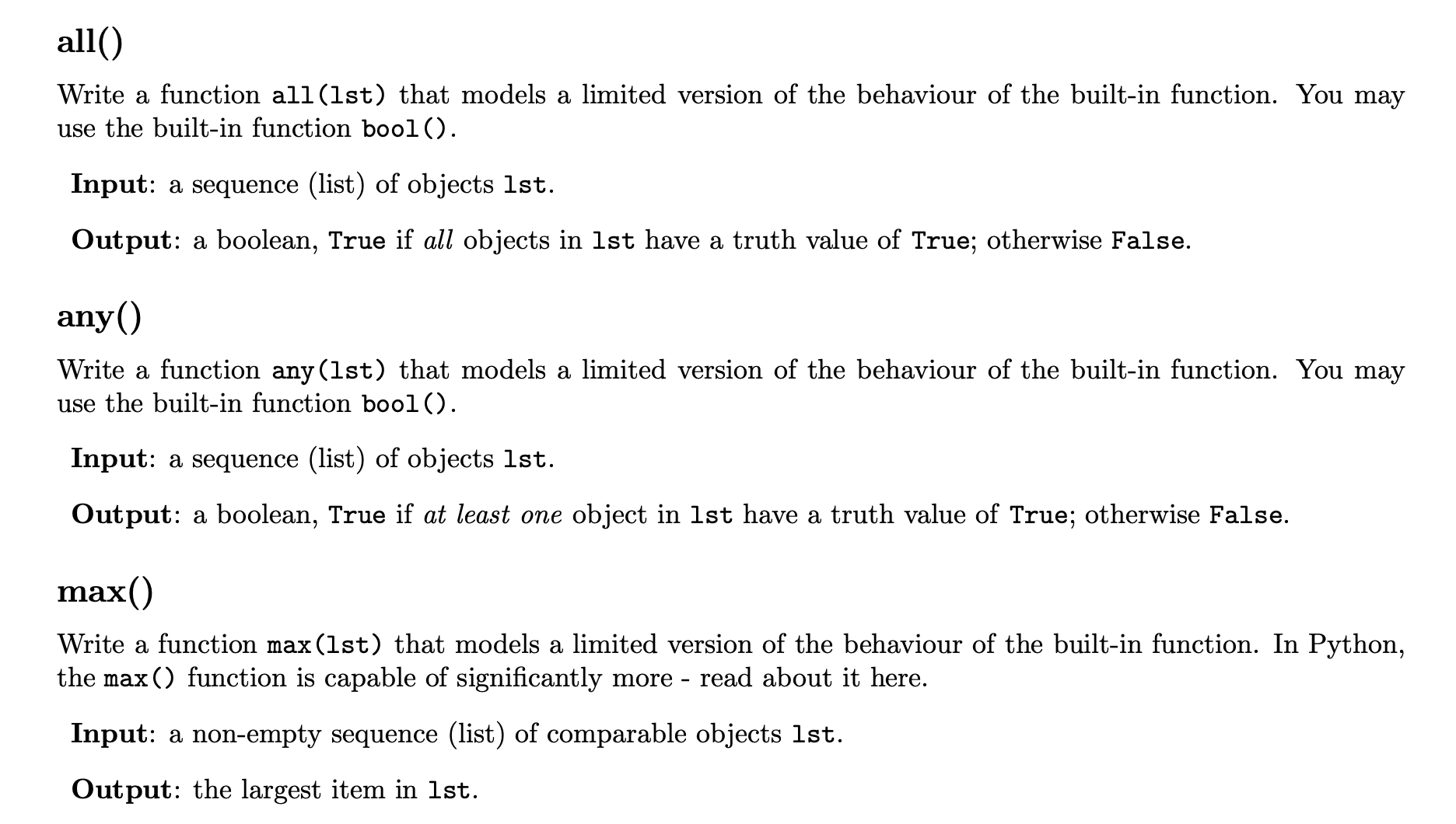
all() Write a function all (1st) that models a limited version of the behaviour of the built-in function. You may use the built-in function bool (). Input: a sequence (list) of objects Ist. Output: a boolean, True if all objects in 1st have a truth value of True; otherwise False. any () Write a function any (1st) that models a limited version of the behaviour of the built-in function. You may use the built-in function bool (). Input: a sequence (list) of objects Ist. Output: a boolean, True if at least one object in Ist have a truth value of True; otherwise False. max() Write a function max (1st) that models a limited version of the behaviour of the built-in function. In Python, the max () function is capable of significantly more - read about it here. Input: a non-empty sequence (list) of comparable objects Ist. Output: the largest item in 1st
Step by Step Solution
There are 3 Steps involved in it

Get step-by-step solutions from verified subject matter experts
 Study Help