







Question: RESTRICTION: You may not use the Python built-in function you are implementing within its own implementation. In the absence of additional restrictions, you may use
RESTRICTION: You may not use the Python built-in function you are implementing within its own implementation. In the absence of additional restrictions, you may use other Python built-in functions and methods. If given a list or sequence as input, you must not change the original list or sequence.
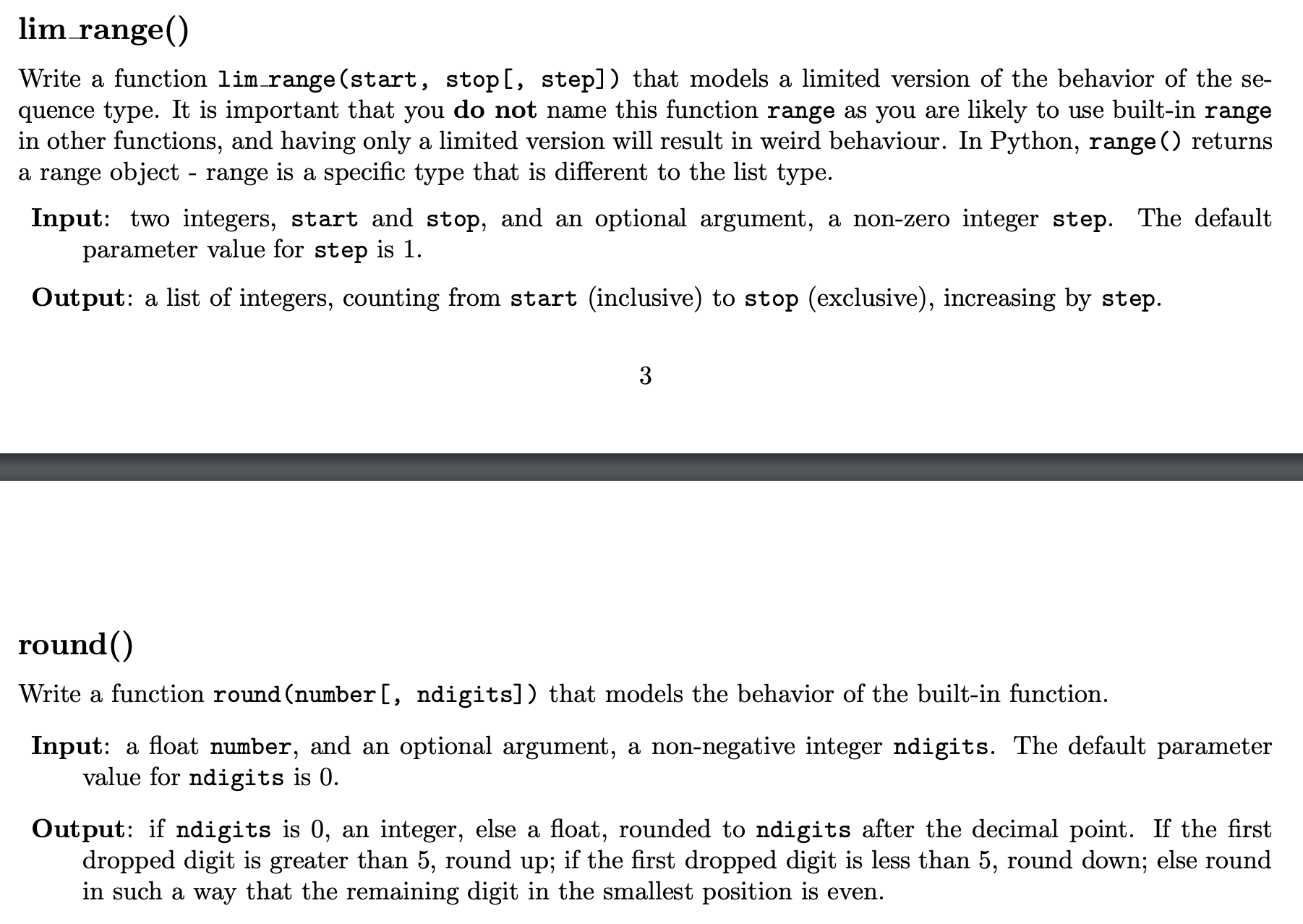
limmangeO Write a function lim_range(start, stop[, step]) that models a limited version of the behavior of the se- quence type. It is important that you do not name this function range as you are likely to use builtin range in other functions, and having only a limited version will result in weird behaviour. In Python, range () returns a range object range is a specic type that is different to the list type. Input: two integers, start and stop, and an optional argument, a nonzero integer step. The default parameter value for step is 1. Output: a list of integers, counting from start (inclusive) to stop (exclusive), increasing by step. round() Write a function round (numberE, ndigits] ) that models the behavior of the builtin function. Input: a oat number, and an optional argument, a non-negative integer ndigits. The default parameter value for ndigits is 0. Output: if ndigits is 0, an integer, else a oat, rounded to ndigits after the decimal point. If the rst dropped digit is greater than 5, round up; if the rst dropped digit is less than 5, round down; else round in such a way that the remaining digit in the smallest position is even
Step by Step Solution
There are 3 Steps involved in it

Get step-by-step solutions from verified subject matter experts
 Study Help