



Question: sand Problem 2: Consider a packet of length L which begins at end system A, travels over one link to a packet switch, and travels
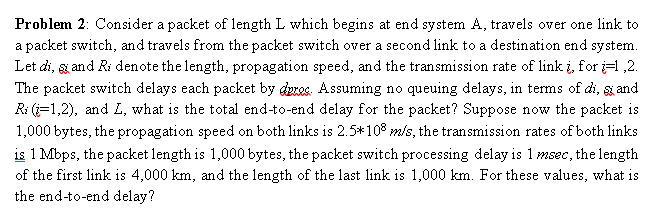
sand Problem 2: Consider a packet of length L which begins at end system A, travels over one link to a packet switch, and travels from the packet switch over a second link to a destination end system. Let di, si and Ri denote the length, propagation speed, and the transmission rate of link i, for i=1,2. The packet switch delays each packet by deres. Assuming no queuing delays, in terms of di, Ri(i=1,2), and L, what is the total end-to-end delay for the packet? Suppose now the packet is 1,000 bytes, the propagation speed on both links is 2.5*108 m/s, the transmission rates of both links is 1 Mbps, the packet length is 1,000 bytes, the packet switch processing delay is 1 msec, the length of the first link is 4,000 km, and the length of the last link is 1,000 km. For these values, what is the end-to-end delay
Step by Step Solution
There are 3 Steps involved in it

Get step-by-step solutions from verified subject matter experts