







Question: Most galaxies have a supermassive black hole at the centre. Describe two methods by which these black holes accumulate mass. (b) The gravitational wave
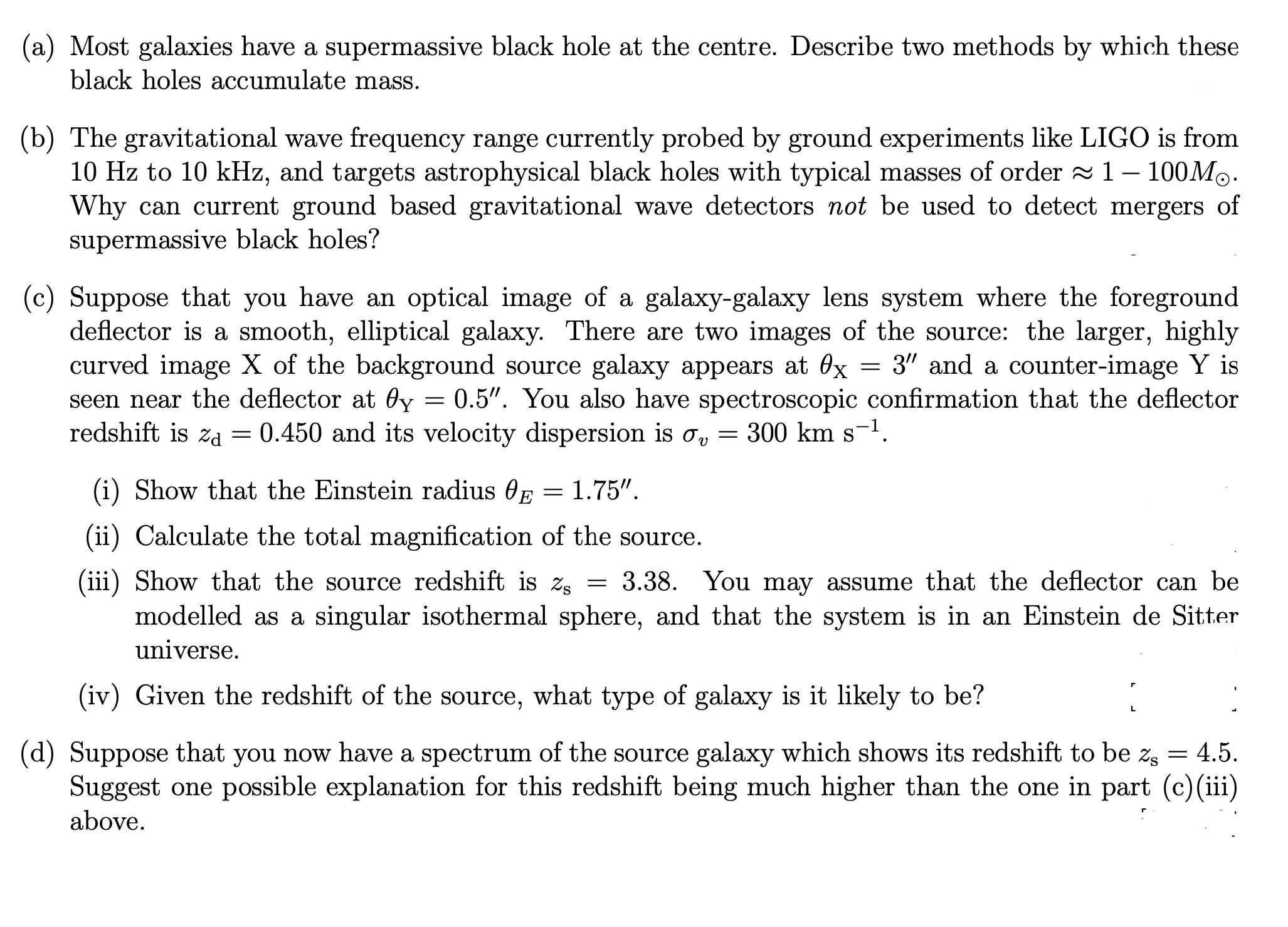
Most galaxies have a supermassive black hole at the centre. Describe two methods by which these black holes accumulate mass. (b) The gravitational wave frequency range currently probed by ground experiments like LIGO is from 10 Hz to 10 kHz, and targets astrophysical black holes with typical masses of order 1-100M. Why can current ground based gravitational wave detectors not be used to detect mergers of supermassive black holes? (c) Suppose that you have an optical image of a galaxy-galaxy lens system where the foreground deflector is a smooth, elliptical galaxy. There are two images of the source: the larger, highly curved image X of the background source galaxy appears at Ox 3" and a counter-image Y is seen near the deflector at 0y = 0.5". You also have spectroscopic confirmation that the deflector redshift is za = 0.450 and its velocity dispersion is o = 300 km s-1. = (i) Show that the Einstein radius 0 = 1.75". E (ii) Calculate the total magnification of the source. (iii) Show that the source redshift is zs 3.38. You may assume that the deflector can be modelled as a singular isothermal sphere, and that the system is in an Einstein de Sitter universe. (iv) Given the redshift of the source, what type of galaxy is it likely to be? (d) Suppose that you now have a spectrum of the source galaxy which shows its redshift to be % = 4.5. Suggest one possible explanation for this redshift being much higher than the one in part (c)(iii) above. = L
Step by Step Solution
3.48 Rating (161 Votes )
There are 3 Steps involved in it
Lets break down the questions one by one a Accumulation of Mass by Supermassive Black Holes 1 Accretion of Gas Black holes accumulate mass by accreting gas from their surroundings Gas clouds in the ga... View full answer

Get step-by-step solutions from verified subject matter experts
 Study Help