Question: Saved Read the overview below and answer the questions that follow. In this exercise, you will be asked to assess the positioning of key competitors
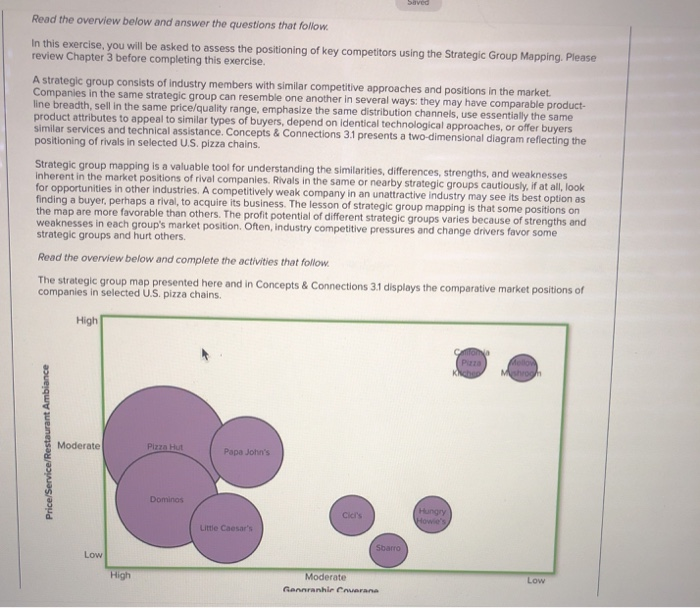
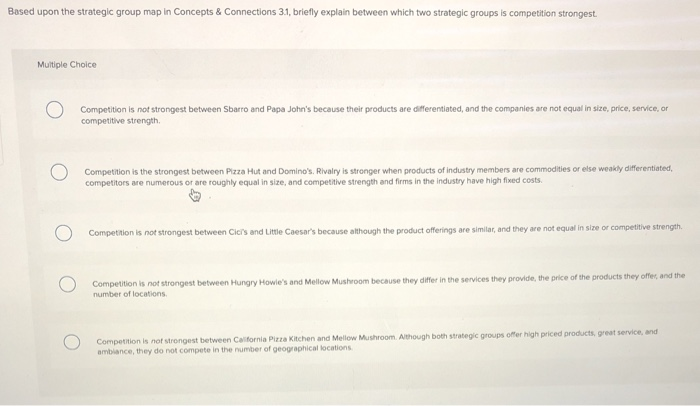
Saved Read the overview below and answer the questions that follow. In this exercise, you will be asked to assess the positioning of key competitors using the Strategic Group Mapping. Please review Chapter 3 before completing this exercise A strategic group consists of industry members with similar competitive approaches and positions in the market. Companies in the same strategic group can resemble one another in several ways: they may have comparable product- line breadth, sell in the same price/quality range, emphasize the same distribution channels, use essentially the same product attributes to appeal to similar types of buyers, depend on identical technological approaches, or offer buyers similar services and technical assistance. Concepts & Connections 3.1 presents a two-dimensional diagram reflecting the positioning of rivals in selected U.S. pizza chains Strategic group mapping is a valuable tool for understanding the similarities, differences, strengths, and weaknesses Inherent in the market positions of rival companies. Rivals in the same or nearby strategic groups cautiously, if at all, look for opportunities in other industries. A competitively weak company in an unattractive industry may see its best option as finding a buyer, perhaps a rival, to acquire its business. The lesson of strategic group mapping is that some positions on the map are more favorable than others. The profit potential of different strategic groups varies because of strengths and weaknesses in each group's market position. Often, industry competitive pressures and change drivers favor some strategic groups and hurt others. Read the overview below and complete the activities that follow. The strategic group map presented here and in Concepts & Connections 31 displays the comparative market positions of companies in selected U.S. pizza chains. High PU Khiche Mehrogh Price/Service/Restaurant Ambiance Moderate Pizza Hut Papa John's Dominos Cici's Little Caesar's Sbarro Low High Moderate Gonnanhir Caverna Low Based upon the strategic group map in Concepts & Connections 3.1, briefly explain between which two strategic groups is competition strongest. Multiple Choice Competition is not strongest between Sbarro and Papa John's because their products are differentiated, and the companies are not equal in size, price, service, or competitive strength Competition is the strongest between Pizza Hut and Domino's. Rivalry is stronger when products of industry members are commodities or else weakly differentiated, competitors are numerous or are roughly equal in size, and competitive strength and firms in the industry have high fixed costs. Competition is not strongest between Cic's and Little Caesar's bec although the product offerings are similar, and they are not equal in size or competitive strength Competition is not strongest between Hungry Howie's and Mellow Mushroom because they differ in the services they provide, the price of the products they offer, and the number of locations Competition is not strongest between California Pizza Kitchen and Mellow Mushroom Although both strategic groups offer high priced products, great service, and ambiance, they do not compete in the number of geographical locations









 Study Help