





Question: Scheduled hours worked (Due Date - Today's Date) - Process Time Remaining Time to due date / Remaining processing time Available lead time-Order lead time
Scheduled hours worked (Due Date - Today's Date)
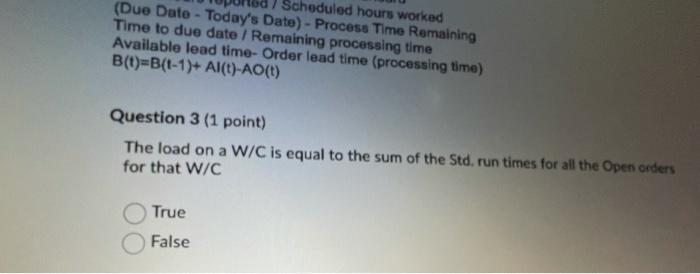
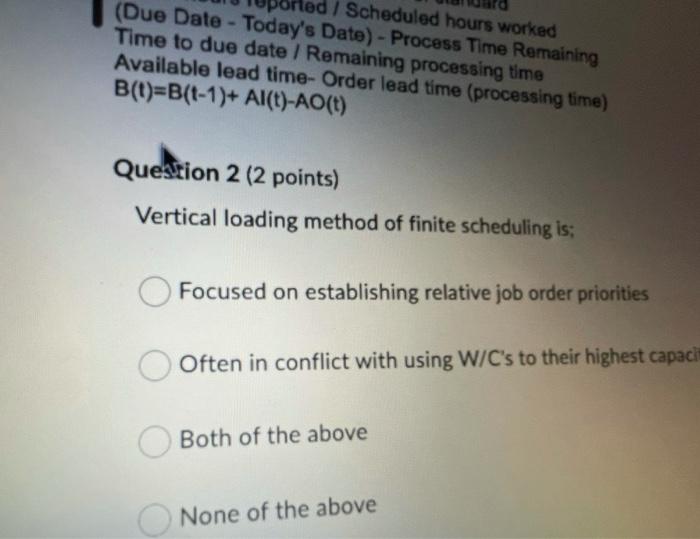
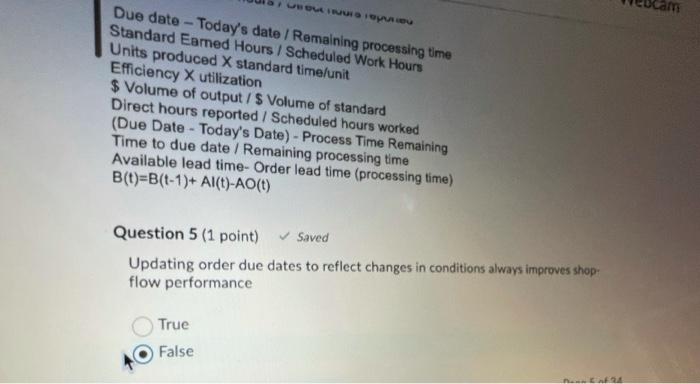
Scheduled hours worked (Due Date - Today's Date) - Process Time Remaining Time to due date / Remaining processing time Available lead time-Order lead time (processing time) B(t)=B(1-1)+ Al(t)-AO(t) Question 3 (1 point) The load on a W/C is equal to the sum of the Std. run times for all the Open orders for that W/C True False ed / Scheduled hours worked (Due Date - Today's Date) - Process Time Remaining Time to due date / Remaining processing time Available lead time-Order lead time (processing time) B(t)=B(t-1)+ Al(t)-AO(t) Question 2 (2 points) Vertical loading method of finite scheduling is: Focused on establishing relative job order priorities Often in conflict with using W/C's to their highest capaci Both of the above None of the above NOVINUMAN Due date - Today's date / Remaining processing time Standard Eamed Hours / Scheduled Work Hours Units produced X standard timelunit Efficiency X utilization $ Volume of output / $ Volume of standard Direct hours reported / Scheduled hours worked (Due Date - Today's Date) - Process Time Remaining Time to due date / Remaining processing time Available lead time-Order lead time (processing time) B(t)=B(t-1)+ Al(t)-AO(t) Question 5 (1 point) Saved Updating order due dates to reflect changes in conditions always improves shop flow performance True False
Step by Step Solution

There are 3 Steps involved in it

1 Expert Approved Answer
Step: 1 Unlock blur-text-image

Question Has Been Solved by an Expert!

Get step-by-step solutions from verified subject matter experts

Step: 2 Unlock
Step: 3 Unlock

Students Have Also Explored These Related General Management Questions!