







Question: SECTION 111: FINANCIAL MANAGEMENT 270 Case Cost/Benefit Analysis Study You are the laboratory manager. The hospital administration trate the market and expand the business by
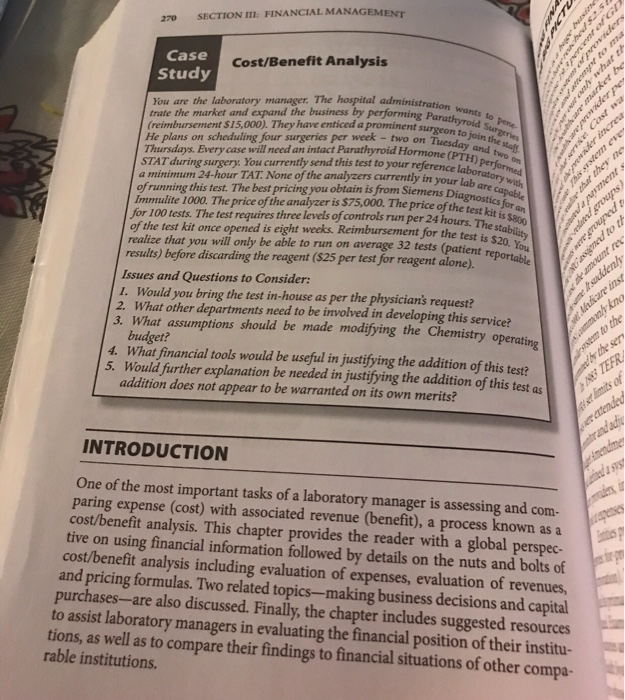
SECTION 111: FINANCIAL MANAGEMENT 270 Case Cost/Benefit Analysis Study You are the laboratory manager. The hospital administration trate the market and expand the business by performing Parants freimbursement $15,000). They have enticed a prominent surgeon He plans on scheduling four surgeres per week - two on the ay Hormone (PTH) and t Thursdays. Every case will need an intact Parathyroid STAT during surgery: You currently send this test to your reference labo a minimum 24-hour TAT. None of the analyzers currently in your la ratory of running this test. The best pricing you obtain is from Siemens Diag ca Immulite 1000. The price of the analyzer is $75,000. The price of thetest ks Jor for 100 tests. The test requires three levels of controls run per 24 hours The t the test kit once opened is eight weeks. Reimbursement for the test is s20 realize that you will only be able to run on average 32 tests (patient results) before discarding the reagent ($25 per test for reagent alone). report bl Issues and Questions to Consider: 1. Would you bring the test in-house as per the physician's request? 2. What other departments need to be involved in developing this service? 3. What assumptions should be made modifying the Chemistry operatin budget? ing 4. What financial tools would be useful in justifying the addition of this test? 5. Would further explanation be needed in justifying the addition of this test as addition does not appear to be warranted on its own merits? INTRODUCTION One of the most important tasks of a laboratory manager is assessing and com- paring expense (cost) with associated revenue (benefit), a process known as a oP cost/benefit analysis. This chapter provides the reader with a global perspec- tive on using financial information followed by details on the nuts and bolts of cost/benefit analysis including evaluation of expenses, evaluation of revenues, and pricing formulas. Two related topics-making business decisions and capital purchases-are also discussed. Finally, the chapter includes suggested resources to assist laboratory managers in evaluating the financial position of their institu- tions, as well as to compare their findings to financial situations of other compa- rable institutions SECTION 111: FINANCIAL MANAGEMENT 270 Case Cost/Benefit Analysis Study You are the laboratory manager. The hospital administration trate the market and expand the business by performing Parants freimbursement $15,000). They have enticed a prominent surgeon He plans on scheduling four surgeres per week - two on the ay Hormone (PTH) and t Thursdays. Every case will need an intact Parathyroid STAT during surgery: You currently send this test to your reference labo a minimum 24-hour TAT. None of the analyzers currently in your la ratory of running this test. The best pricing you obtain is from Siemens Diag ca Immulite 1000. The price of the analyzer is $75,000. The price of thetest ks Jor for 100 tests. The test requires three levels of controls run per 24 hours The t the test kit once opened is eight weeks. Reimbursement for the test is s20 realize that you will only be able to run on average 32 tests (patient results) before discarding the reagent ($25 per test for reagent alone). report bl Issues and Questions to Consider: 1. Would you bring the test in-house as per the physician's request? 2. What other departments need to be involved in developing this service? 3. What assumptions should be made modifying the Chemistry operatin budget? ing 4. What financial tools would be useful in justifying the addition of this test? 5. Would further explanation be needed in justifying the addition of this test as addition does not appear to be warranted on its own merits? INTRODUCTION One of the most important tasks of a laboratory manager is assessing and com- paring expense (cost) with associated revenue (benefit), a process known as a oP cost/benefit analysis. This chapter provides the reader with a global perspec- tive on using financial information followed by details on the nuts and bolts of cost/benefit analysis including evaluation of expenses, evaluation of revenues, and pricing formulas. Two related topics-making business decisions and capital purchases-are also discussed. Finally, the chapter includes suggested resources to assist laboratory managers in evaluating the financial position of their institu- tions, as well as to compare their findings to financial situations of other compa- rable institutions
Step by Step Solution
There are 3 Steps involved in it

Get step-by-step solutions from verified subject matter experts
 Study Help