







Question: SECTION A (60 MARKS) Answer ALL the following questions. You may use books, online journals/articles/ magazines as references to support you answer. CASE: General
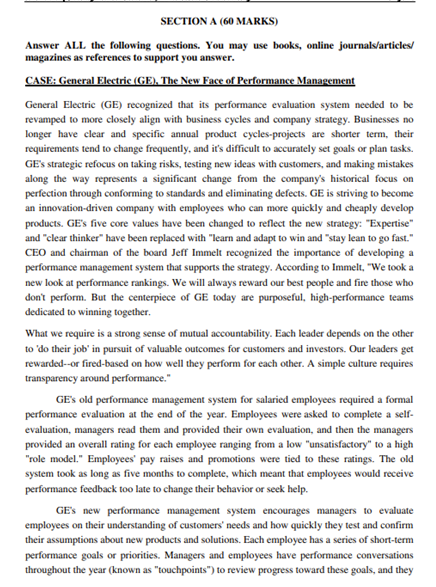
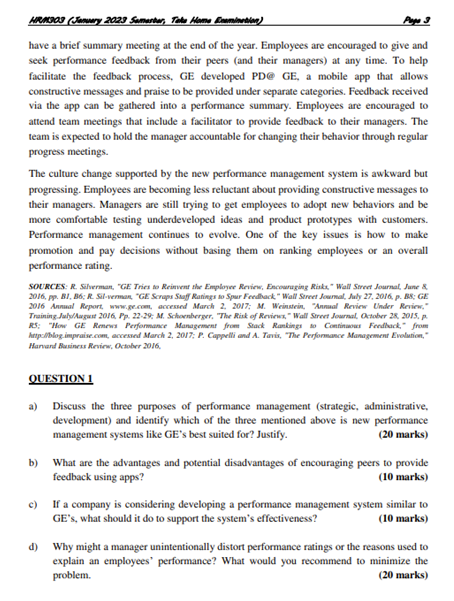
SECTION A (60 MARKS) Answer ALL the following questions. You may use books, online journals/articles/ magazines as references to support you answer. CASE: General Electric (GE), The New Face of Performance Management General Electric (GE) recognized that its performance evaluation system needed to be revamped to more closely align with business cycles and company strategy. Businesses no longer have clear and specific annual product cycles-projects are shorter term, their requirements tend to change frequently, and it's difficult to accurately set goals or plan tasks. GE's strategic refocus on taking risks, testing new ideas with customers, and making mistakes along the way represents a significant change from the company's historical focus on perfection through conforming to standards and eliminating defects. GE is striving to become an innovation-driven company with employees who can more quickly and cheaply develop products. GE's five core values have been changed to reflect the new strategy: "Expertise" and "clear thinker" have been replaced with "learn and adapt to win and "stay lean to go fast." CEO and chairman of the board Jeff Immelt recognized the importance of developing a performance management system that supports the strategy. According to Immelt. "We took a new look at performance rankings. We will always reward our best people and fire those who don't perform. But the centerpiece of GE today are purposeful, high-performance teams dedicated to winning together. What we require is a strong sense of mutual accountability. Each leader depends on the other to 'do their job' in pursuit of valuable outcomes for customers and investors. Our leaders get rewarded--or fired-based on how well they perform for each other. A simple culture requires transparency around performance." GE's old performance management system for salaried employees required a formal performance evaluation at the end of the year. Employees were asked to complete a self- evaluation, managers read them and provided their own evaluation, and then the managers provided an overall rating for each employee ranging from a low "unsatisfactory" to a high "role model." Employees' pay raises and promotions were tied to these ratings. The old system took as long as five months to complete, which meant that employees would receive performance feedback too late to change their behavior or seek help. GE's new performance management system encourages managers to evaluate employees on their understanding of customers' needs and how quickly they test and confirm their assumptions about new products and solutions. Each employee has a series of short-term performance goals or priorities. Managers and employees have performance conversations throughout the year (known as "touchpoints") to review progress toward these goals, and they HRM303 (January 2023 Samarber, Take Home Examination) have a brief summary meeting at the end of the year. Employees are encouraged to give and seek performance feedback from their peers (and their managers) at any time. To help facilitate the feedback process, GE developed PD GE, a mobile app that allows constructive messages and praise to be provided under separate categories. Feedback received via the app can be gathered into a performance summary. Employees are encouraged to attend team meetings that include a facilitator to provide feedback to their managers. The team is expected to hold the manager accountable for changing their behavior through regular progress meetings. The culture change supported by the new performance management system is awkward but progressing. Employees are becoming less reluctant about providing constructive messages to their managers. Managers are still trying to get employees to adopt new behaviors and be more comfortable testing underdeveloped ideas and product prototypes with customers. Performance management continues to evolve. One of the key issues is how to make promotion and pay decisions without basing them on ranking employees or an overall performance rating. Page 3 SOURCES: R. Silverman, "GE Tries to Reinvent the Employee Review, Encouraging Risks," Wall Street Journal, June & 2016, pp. B1, B6; R. Sil-verman, "GE Scraps Staff Ratings to Spur Feedback" Wall Street Journal, July 27, 2016, p. B8: GE 2016 Annual Report, www.ge.com, accessed March 2, 2017; M. Weinstein, "Annual Review Under Review, Training July/August 2016, Pp. 22-29; M. Schoenberger, "The Risk of Reviews," Wall Street Journal, October 28, 2015, p. RS: "How GE Renews Performance Management from Stack Rankings to Continuous Feedback," from http://blog.impraise.com, accessed March 2, 2017; P. Cappelli and A. Tavis, "The Performance Management Evolution," Harvard Business Review, October 2016, QUESTION I Discuss the three purposes of performance management (strategic, administrative, development) and identify which of the three mentioned above is new performance management systems like GE's best suited for? Justify. (20 marks) a) b) What are the advantages and potential disadvantages of encouraging peers to provide feedback using apps? (10 marks) c) If a company is considering developing a performance management system similar to GE's, what should it do to support the system's effectiveness? (10 marks) d) Why might a manager unintentionally distort performance ratings or the reasons used to explain an employees' performance? What would you recommend to minimize the problem. (20 marks)
Step by Step Solution
3.58 Rating (151 Votes )
There are 3 Steps involved in it
Question 1a Purpose of Performance Management Performance management serves three main purposes strategic administrative and developmental Analyze which of these purposes the new performance managemen... View full answer

Get step-by-step solutions from verified subject matter experts
 Study Help