Question: SECTION A Answer all Ouestions Nick recently became project manager of a critical biotech enterprise at Silicon Valley. The project involved creating hardware and software
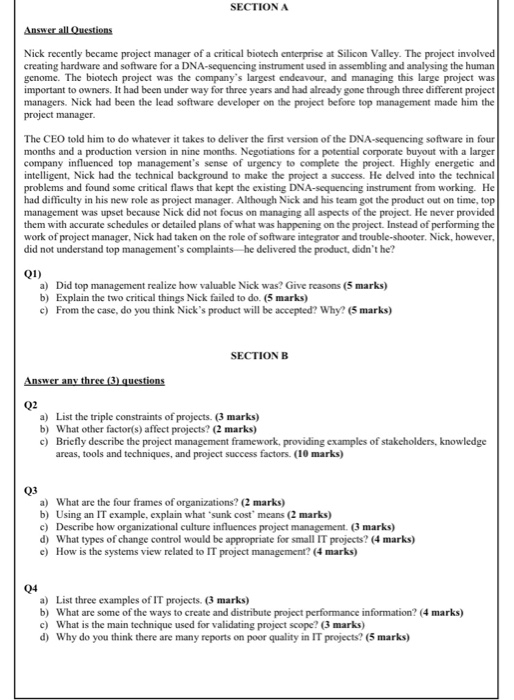
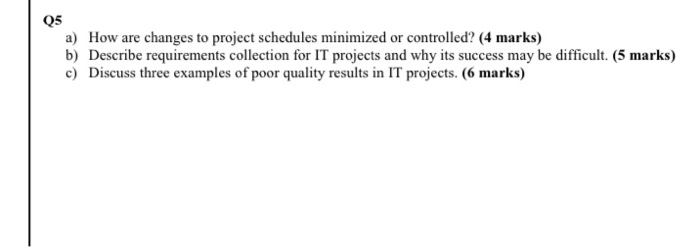
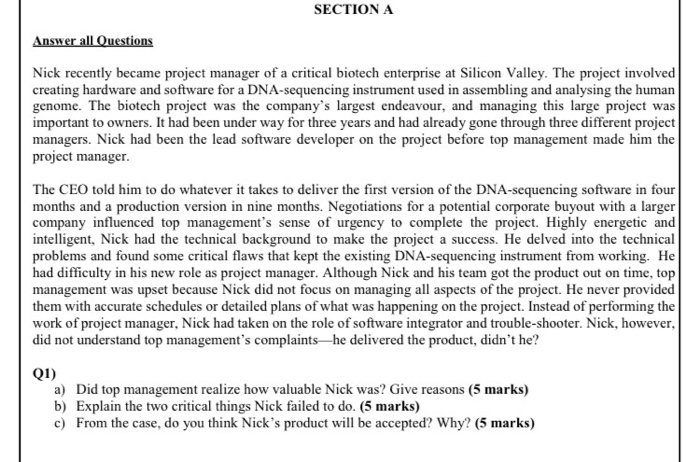
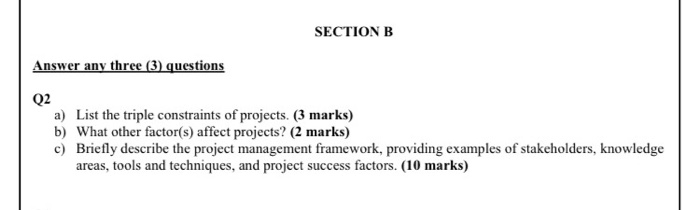
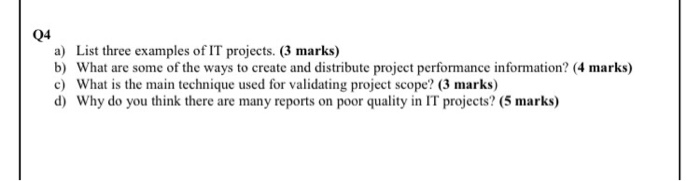
SECTION A Answer all Ouestions Nick recently became project manager of a critical biotech enterprise at Silicon Valley. The project involved creating hardware and software for a DNA-sequencing instrument used in assembling and analysing the human genome. The biotech project was the company's largest endeavour, and managing this large project was important to owners. It had been under way for three years and had already gone through three different project managers. Nick had been the lead software developer on the project before top management made him the project manager The CEO told him to do whatever it takes to deliver the first version of the DNA-sequencing software in four months and a production version in nine months. Negotiations for a potential corporate buyout with a larger company influenced top management's sense of urgency to complete the project. Highly energetic and intelligent, Nick had the technical background to make the project a success. He delved into the technical problems and found some critical flaws that kept the existing DNA-sequencing instrument from working. He had difficulty in his new role as project manager. Although Nick and his team got the product out on time, top management was upset because Nick did not focus on managing all aspects of the project. He never provided them with accurate schedules or detailed plans of what was happening on the project. Instead of performing the work of project manager, Nick had taken on the role of software integrator and trouble-shooter. Nick, however, did not understand top management's complaints he delivered the product, didn't he? 01) a) Did top management realize how valuable Nick was? Give reasons (5 marks) b) Explain the two critical things Nick failed to do. (5 marks) c) From the case, do you think Nick's product will be accepted? Why? (5 marks) SECTION B Answer any three (3) questions Q2 a) List the triple constraints of projects. (3 marks) b) What other factor(s) affect projects? (2 marks) c) Briefly describe the project management framework, providing examples of stakeholders, knowledge areas, tools and techniques, and project success factors. (10 marks) Q3 a) What are the four frames of organizations? (2 marks) b) Using an IT example, explain what "sunk cost' means (2 marks) c) Describe how organizational culture influences project management. (3 marks) d) What types of change control would be appropriate for small IT projects? (4 marks) c) How is the systems view related to IT project management? (4 marks) 04 a) List three examples of IT projects. (3 marks) b) What are some of the ways to create and distribute project performance information? (4 marks) c) What is the main technique used for validating project scope? (3 marks) d) Why do you think there are many reports on poor quality in IT projects? (5 marks) Q5 a) How are changes to project schedules minimized or controlled? (4 marks) b) Describe requirements collection for IT projects and why its success may be difficult. (5 marks) c) Discuss three examples of poor quality results in IT projects. (6 marks) SECTION A Answer all Questions Nick recently became project manager of a critical biotech enterprise at Silicon Valley. The project involved creating hardware and software for a DNA-sequencing instrument used in assembling and analysing the human genome. The biotech project was the company's largest endeavour, and managing this large project was important to owners. It had been under way for three years and had already gone through three different project managers. Nick had been the lead software developer on the project before top management made him the project manager. The CEO told him to do whatever it takes to deliver the first version of the DNA-sequencing software in four months and a production version in nine months. Negotiations for a potential corporate buyout with a larger company influenced top management's sense of urgency to complete the project. Highly energetic and intelligent, Nick had the technical background to make the project a success. He delved into the technical problems and found some critical flaws that kept the existing DNA-sequencing instrument from working. He had difficulty in his new role as project manager. Although Nick and his team got the product out on time, top management was upset because Nick did not focus on managing all aspects of the project. He never provided them with accurate schedules or detailed plans of what was happening on the project. Instead of performing the work of project manager, Nick had taken on the role of software integrator and trouble-shooter. Nick, however, did not understand top management's complaintshe delivered the product, didn't he? (1) a) Did top management realize how valuable Nick was? Give reasons (5 marks) b) Explain the two critical things Nick failed to do. (5 marks) c) From the case, do you think Nick's product will be accepted? Why? (5 marks) SECTION B Answer any three (3) questions Q2 a) List the triple constraints of projects. (3 marks) b) What other factor(s) affect projects? (2 marks) c) Briefly describe the project management framework, providing examples of stakeholders, knowledge areas, tools and techniques, and project success factors. (10 marks) Q4 a) List three examples of IT projects. (3 marks) b) What are some of the ways to create and distribute project performance information? (4 marks) c) What is the main technique used for validating project scope? (3 marks) d) Why do you think there are many reports on poor quality in IT projects? (5 marks) Q3 a) What are the four frames of organizations? (2 marks) b) Using an IT example, explain what sunk cost' means (2 marks) c) Describe how organizational culture influences project management. (3 marks) d) What types of change control would be appropriate for small IT projects? (4 marks) e) How is the systems view related to IT project management? (4 marks)










 Study Help