Question: SECTION B: Case Study B (Total = 30 Marks) Source: Griffin, R.W., Phillips, J.M., & Gully, S. M. (2017). Organizational Behavior: Managing People and Organizations
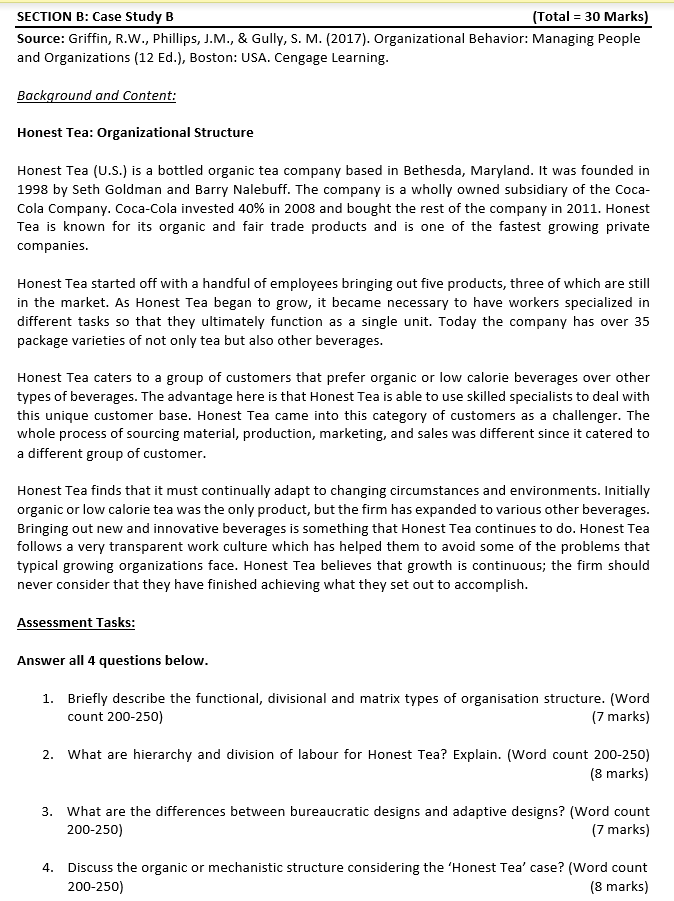
SECTION B: Case Study B (Total = 30 Marks) Source: Griffin, R.W., Phillips, J.M., & Gully, S. M. (2017). Organizational Behavior: Managing People and Organizations (12 Ed.), Boston: USA. Cengage Learning. Background and Content: Honest Tea: Organizational Structure Honest Tea (U.S.) is a bottled organic tea company based in Bethesda, Maryland. It was founded in 1998 by Seth Goldman and Barry Nalebuff. The company is a wholly owned subsidiary of the Coca- Cola Company. Coca-Cola invested 40% in 2008 and bought the rest of the company in 2011. Honest Tea is known for its organic and fair trade products and is one of the fastest growing private companies. Honest Tea started off with a handful of employees bringing out five products, three of which are still in the market. As Honest Tea began to grow, it became necessary to have workers specialized in different tasks so that they ultimately function as a single unit. Today the company has over 35 package varieties of not only tea but also other beverages. Honest Tea caters to a group of customers that prefer organic or low calorie beverages over other types of beverages. The advantage here is that Honest Tea is able to use skilled specialists to deal with this unique customer base. Honest Tea came into this category of customers as a challenger. The whole process of sourcing material, production, marketing, and sales was different since it catered to a different group of customer. Honest Tea finds that it must continually adapt to changing circumstances and environments. Initially organic or low calorie tea was the only product, but the firm has expanded to various other beverages. Bringing out new and innovative beverages is something that Honest Tea continues to do. Honest Tea follows a very transparent work culture which has helped them to avoid some of the problems that typical growing organizations face. Honest Tea believes that growth is continuous; the firm should never consider that they have finished achieving what they set out to accomplish. Assessment Tasks: Answer all 4 questions below. 1. Briefly describe the functional, divisional and matrix types of organisation structure. (Word count 200-250) (7 marks) 2. What are hierarchy and division of labour for Honest Tea? Explain. (Word count 200-250) (8 marks) 3. What are the differences between bureaucratic designs and adaptive designs? (Word count 200-250) (7 marks) 4. Discuss the organic or mechanistic structure considering the 'Honest Tea' case? (Word count 200-250) (8 marks)









 Study Help