







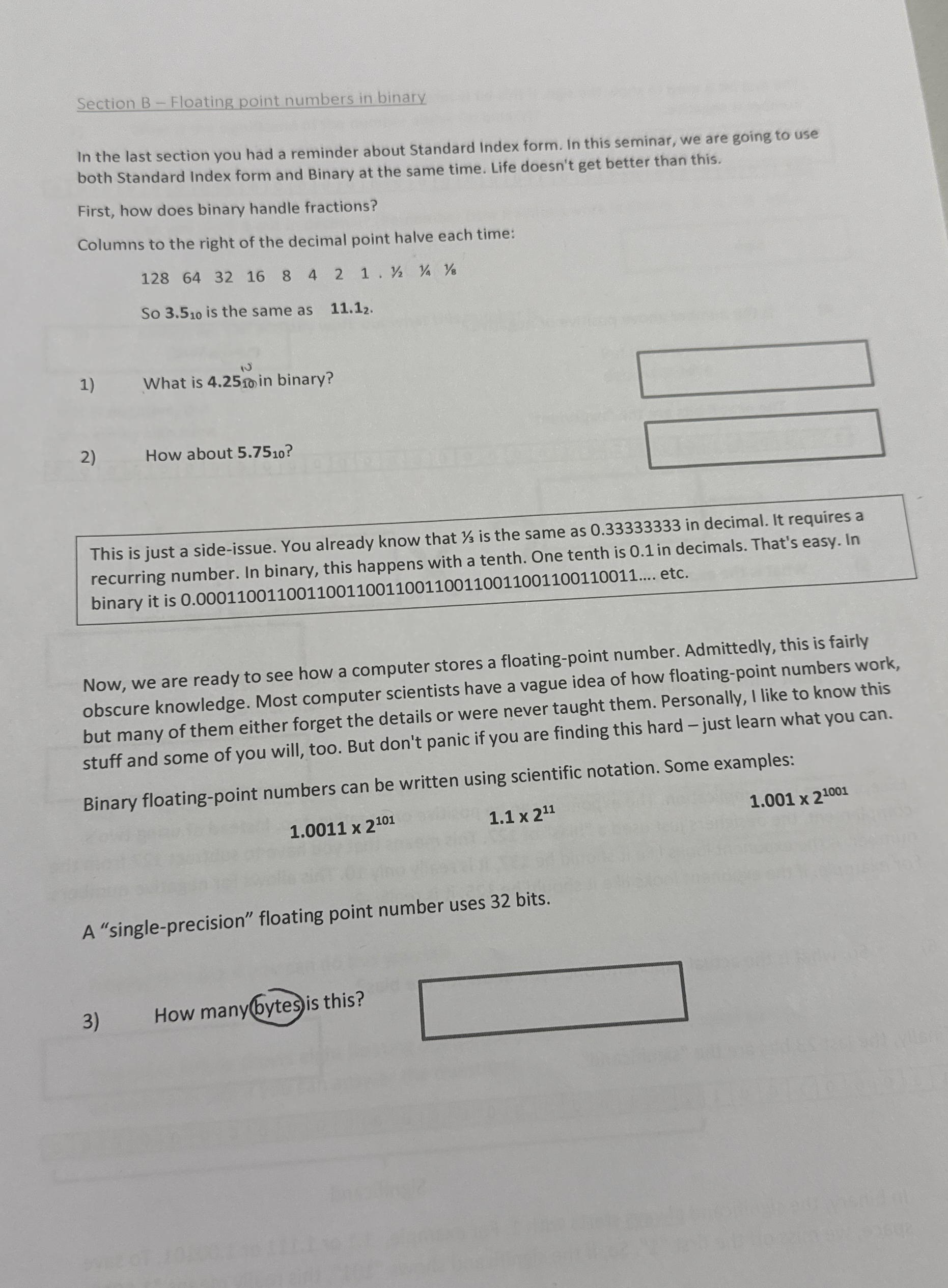
Question: Section B - Floating point numbers in binary In the last section you had a reminder about Standard Index form. In this seminar, we are
Section B Floating point numbers in binary
In the last section you had a reminder about Standard Index form. In this seminar, we are going to use both Standard Index form and Binary at the same time. Life doesn't get better than this.
First, how does binary handle fractions?
Columns to the right of the decimal point halve each time:
So is the same as
What is is in binary?
How about
This is just a sideissue. You already know that is the same as in decimal. It requires a recurring number. In binary, this happens with a tenth. One tenth is in decimals. That's easy. In binary it is dots. etc.
Now, we are ready to see how a computer stores a floatingpoint number. Admittedly, this is fairly obscure knowledge. Most computer scientists have a vague idea of how floatingpoint numbers work, but many of them either forget the details or were never taught them. Personally, I like to know this stuff and some of you will, too. But don't panic if you are finding this hard just learn what you can.
Binary floatingpoint numbers can be written using scientific notation. Some examples:
A "singleprecision" floating point number uses bits.
How many bytes is this?
Step by Step Solution
There are 3 Steps involved in it
1 Expert Approved Answer
Step: 1 Unlock

Question Has Been Solved by an Expert!
Get step-by-step solutions from verified subject matter experts
Step: 2 Unlock
Step: 3 Unlock
 Study Help