Question: Section B Question 1 Read the passage below and answer the questions that follow. Answer in your own words. STRIKE COSTS S.A. R3.4BN - AND
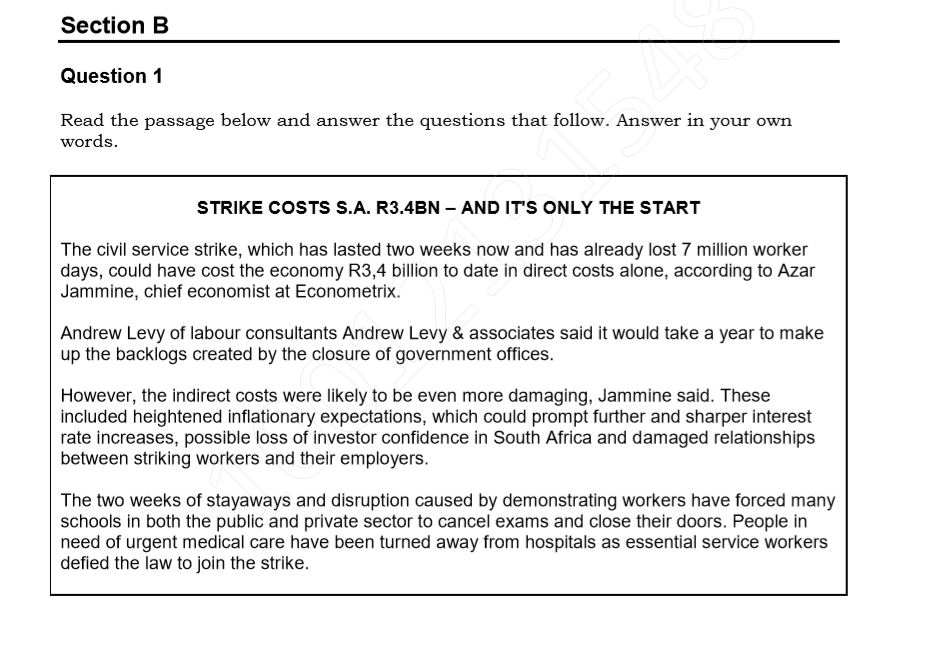
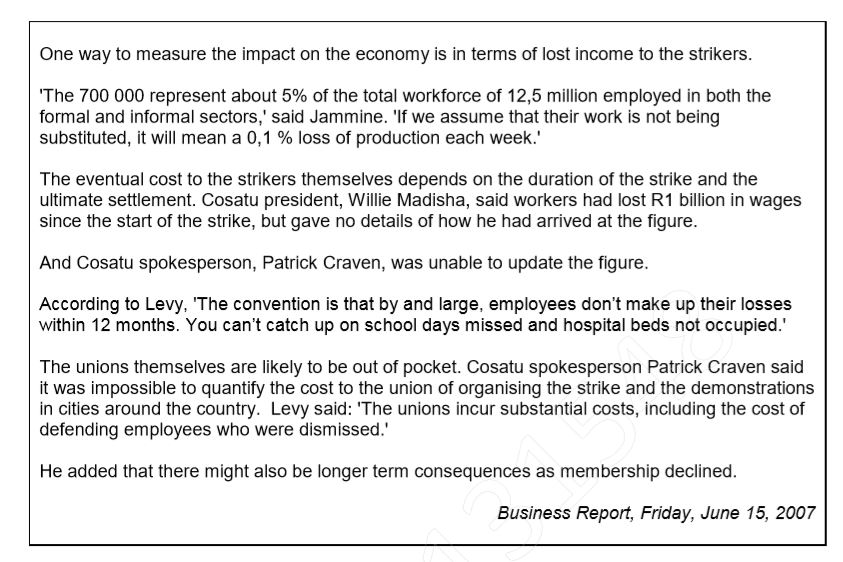
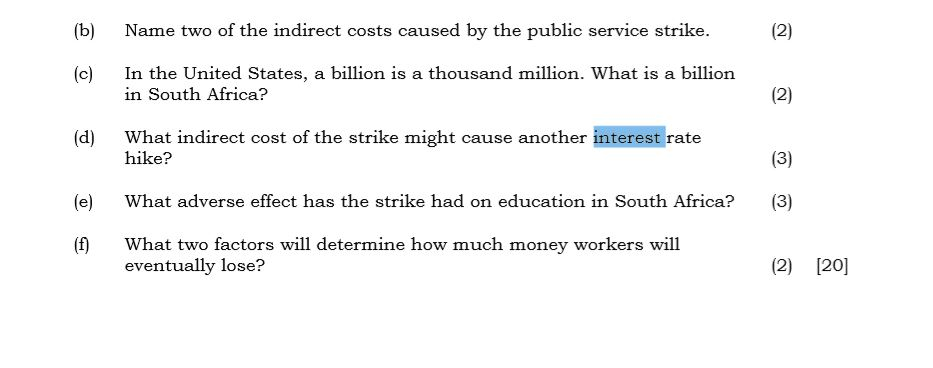
Section B Question 1 Read the passage below and answer the questions that follow. Answer in your own words. STRIKE COSTS S.A. R3.4BN - AND IT'S ONLY THE START The civil service strike, which has lasted two weeks now and has already lost 7 million worker days, could have cost the economy R3,4 billion to date in direct costs alone, according to Azar Jammine, chief economist at Econometrix. Andrew Levy of labour consultants Andrew Levy & associates said it would take a year to make up the backlogs created by the closure of government offices. However, the indirect costs were likely to be even more damaging, Jammine said. These included heightened inflationary expectations, which could prompt further and sharper interest rate increases, possible loss of investor confidence in South Africa and damaged relationships between striking workers and their employers. The two weeks of stayaways and disruption caused by demonstrating workers have forced many schools in both the public and private sector to cancel exams and close their doors. People in need of urgent medical care have been turned away from hospitals as essential service workers defied the law to join the strike. One way to measure the impact on the economy is in terms of lost income to the strikers. 'The 700 000 represent about 5% of the total workforce of 12,5 million employed in both the formal and informal sectors,' said Jammine. 'If we assume that their work is not being substituted, it will mean a 0,1 % loss of production each week.' The eventual cost to the strikers themselves depends on the duration of the strike and the ultimate settlement. Cosatu president, Willie Madisha, said workers had lost R1 billion in wages since the start of the strike, but gave no details of how he had arrived at the figure. And Cosatu spokesperson, Patrick Craven, was unable to update the figure. According to Levy, 'The convention is that by and large, employees don't make up their losses within 12 months. You can't catch up on school days missed and hospital beds not occupied.' The unions themselves are likely to be out of pocket. Cosatu spokesperson Patrick Craven said it was impossible to quantify the cost to the union of organising the strike and the demonstrations in cities around the country. Levy said: 'The unions incur substantial costs, including the cost of defending employees who were dismissed.' He added that there might also be longer term consequences as membership declined. Business Report, Friday, June 15, 2007 (b) Name two of the indirect costs caused by the public service strike. (c) In the United States, a billion is a thousand million. What is a billion in South Africa? (d) What indirect cost of the strike might cause another interest rate hike? (e) What adverse effect has the strike had on education in South Africa? (3) What two factors will determine how much money workers will eventually lose? (2) [20]









 Study Help