







Question: See two case studies below. Case study1: Read the case study and answer following question Full case study is available at http://www.propertycasualty360.com/2014/06/23/increasing-employee-engagement-during-times-of-org?t=agency-management&page=2 Q. Why did
See two case studies below.
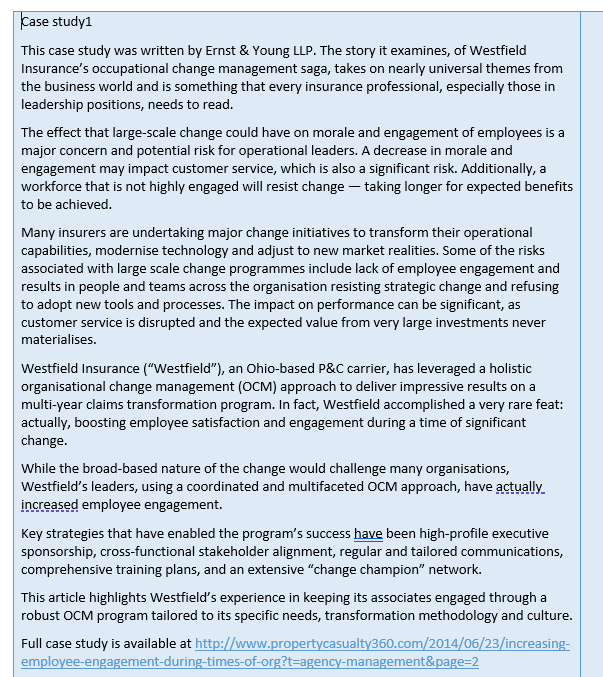
Case study1: Read the case study and answer following question Full case study is available at http://www.propertycasualty360.com/2014/06/23/increasing-employee-engagement-during-times-of-org?t=agency-management&page=2
Q. Why did the organisation decide to review and prioritise change requirements or opportunities with relevant leaders/managers?
Case study2:
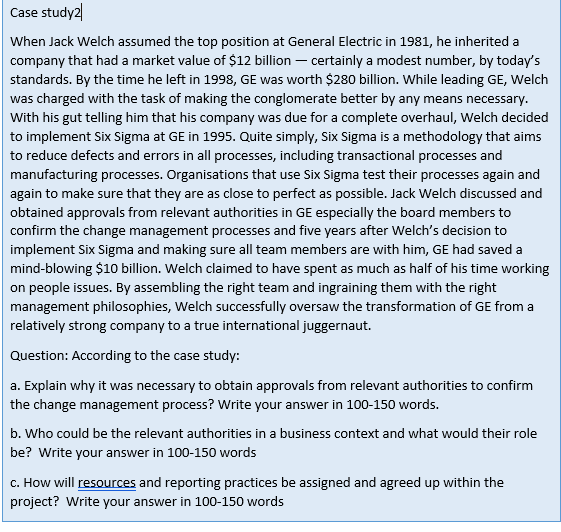
Question: According to the case study: a. Explain why it was necessary to obtain approvals from relevant authorities to confirm the change management process? b. Who could be the relevant authorities in a business context and what would their role be? c. How will resources and reporting practices be assigned and agreed up within the project?
base studyl This case study was written by Ernst 81 Young LLP. The story it examines, of Westfield Insurance's occupational change management saga, takes on nearly universal themes from the business world and is something that every insurance professional, especially those in leadership positions, needs to read. The effect that largescale change could have on morale and engagement of employees is a major concern and potential risk for operational leaders. A decrease in morale and engagement may impact customer service, which is also a signicant risk. Additionally, a workforce that is not highly engaged will resist change taking longer for expected benefits to be achieved. Many insurers are undertaking major change initiatives to transform their operational capabilities, modernise technology and adjust to newr market realities. Some of the risks associated with large scale change programmes include lack of employee engagement and results in people and teams across the organisation resisting strategic change and refusing to adopt new tools and processes. The impact on performance can be signicant, as customer service is disrupted and the expected value from very large investments never materialises. Westeld Insurance ["Westfield"), an Ohiobased P89: carrier, has leveraged a holistic organisational change management {DEM} approach to deliverimpressive results on a multiyear claims transformation program. In fact, Westeld accomplished a very rare feat: actually, boosting employee satisfaction and engagement during a time of significant change. While the broadbased nature of the change would challenge many organisations, jn_c_r_ea_s_ed_ employee engagement. Key strategies that have enabled the program's success hale been high-prole executive sponsorship, cross-functional stakeholder alignment, regular and tailored communications, comprehensive training plans, and an extensive "change champion"I network. This article highlights Westeld's experience in keeping its associates engaged through a robust DEM program tailored to its specic needs, bansfonnation methodology and culture. Full case study is available at htt : vnvw. ro e casual 360.com 2014 06 23 increasin - employgeengagement-during-times-oforg?t=agengymanagementStpage=2 Case studyzl When Jack Welch assumed the top position at General Electric in 1981, he inherited a company that had a market value of$12 billion certainly a modest number, by today's standards. By the time he left in 1998, GE was worth $280 billion. While leading GE, Welch was charged with the task of making the conglomerate better by any means necessary. With his gut telling him that his company was due for a complete overhaul, lI'll'elch decided to implement Six Sigma at GE in 1995. Quite simply, Six Sigma is a methodology that aims to reduce defects and errors in all processes, including transactional processes and manufacturing processes. Organisations that use Six Sigma test their processes again and again to make sure that they are as close to perfect as possible. Jack Welch dismissed and obtained approvals from relevant authorities in GE especially the board members to conrm the change management processes and ve years after Weldi's decision to implement Six Sigma and making sure all team members are with him, GE had saved a mind-blowing $10 billion. Welch claimed to have spent as much as half of his time working on people issues. By assembling the right team and ingraining them with the right management philosophi, Weld] successfully oversaw the ti'ansfonnation of GE from a relatively strong company to a true international juggemaut. Question: According to the case study: a. Explain why it was necessary to obtain approvals from relevant authorities to confirm the change management process? Write your answer in 100-150 words. b. Who could be the relevant authorities in a business context and what would their role be? Write your answer in 100-150 words c. How will Lemand reporting practices be assigned and agreed up within the project? Write your answer in 100150 words
Step by Step Solution
There are 3 Steps involved in it

Get step-by-step solutions from verified subject matter experts
 Study Help