Question: select a paragraph from the one page and Analyze it. Identify and describe the 3 Classical Appeals--LOGOS, ETHOS, & PATHOS--at work in this paragraph. 1
select a paragraph from the one page and Analyze it. Identify and describe the 3 Classical Appeals--LOGOS, ETHOS, & PATHOS--at work in this paragraph.
1 paragraph per classical appeal. Support main ideas with specific examples--for example, specific words or phrases.
Required Length: 3 Full Paragraphs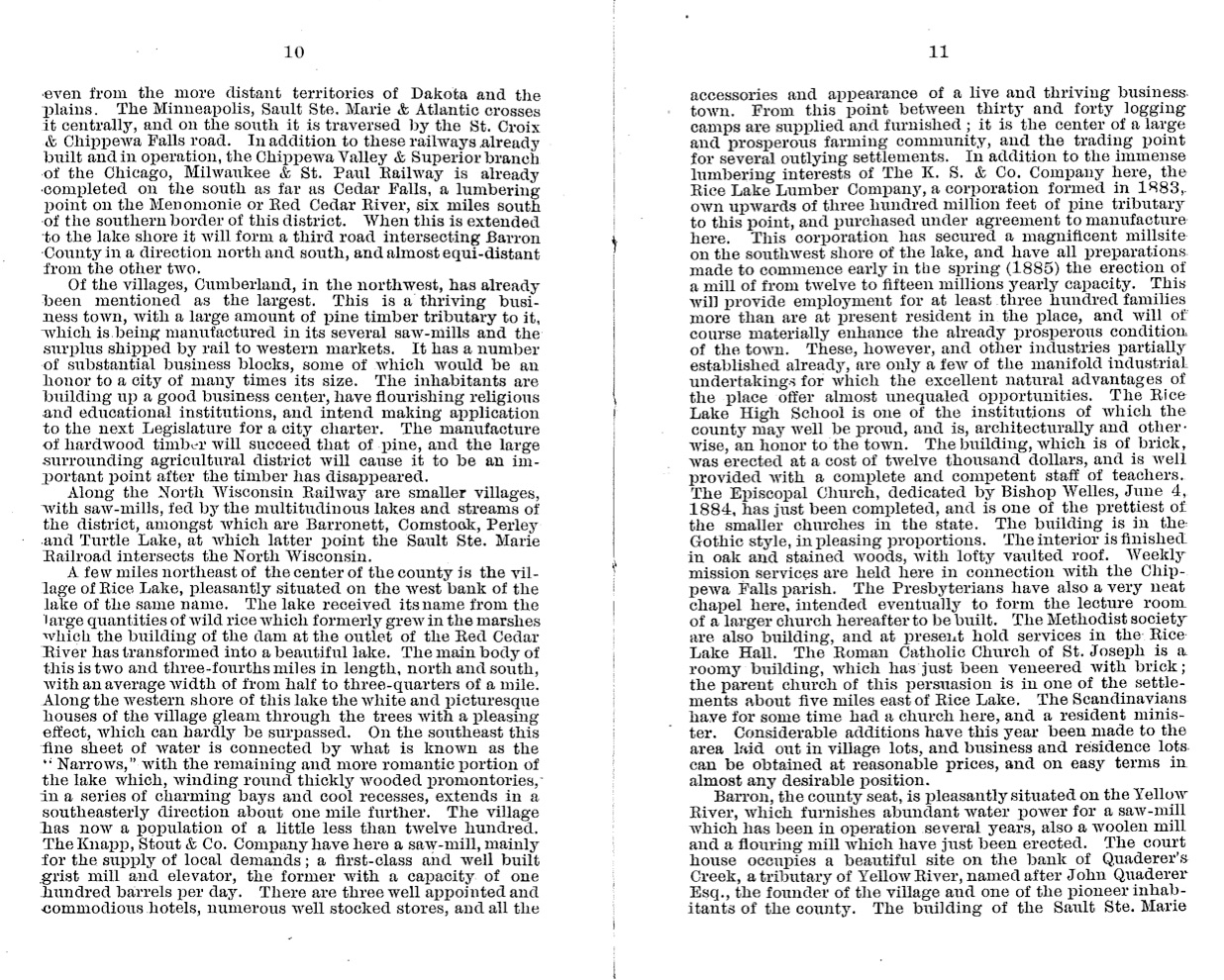
10 11 even from the more distant territories of Dakota and the plains. The Minneapolis, Sault Ste. Marie & Atlantic crosses it centrally, and on the south it is traversed by the St. Croix & Chippewa Falls road. In addition to these railways already built and in operation, the Chippewa Valley & Superior branch of the Chicago, Milwaukee & St. Paul Railway is already completed on the south as far as Cedar Falls, a lumbering point on the Menomonie or Red Cedar River, six miles south of the southern border of this district. When this is extended to the lake shore it will form a third road intersecting Barron County in a direction north and south, and almost equi-distant from the other two. Of the villages, Cumberland, in the north west, has already been mentioned as the largest. This is a thriving busi- ness town, with a large amount of pine timber tributary to it, which is being manufactured in its several saw-mills and the surplus shipped by rail to western markets. It has a number of substantial business blocks, some of which would be an honor to a city of many times its size. The inhabitants are building up a good business center, have flourishing religious and educational institutions, and intend making application to the next Legislature for a city charter. The manufacture of hardwood timber will succeed that of pine, and the large surrounding agricultural district will cause it to be an im- portant point after the timber has disappeared. Along the North Wisconsin Railway are smaller villages, with saw-mills, fed by the multitudinous lakes and streams of the district, amongst which are Barronett, Comstock, Perley and Turtle Lake, at which latter point the Sault Ste. Marie Railroad intersects the North Wisconsin. A few miles northeast of the center of the county is the vil- lage of Rice Lake, pleasantly situated on the west bank of the lake of the same name. The lake received its name from the Targe quantities of wild rice which formerly grew in the marshes which the building of the dam at the outlet of the Red Cedar River has transformed into a beautiful lake. The main body of this is two and three-fourths miles in length, north and south, with an average width of from half to three-quarters of a mile. Along the western shore of this lake the white and picturesque houses of the village gleam through the trees with a pleasing effect, which can hardly be surpassed. On the southeast this fine sheet of water is connected by what is known as the * Narrows," with the remaining and more romantic portion of the lake which, winding round thickly wooded promontories, in a series of charming bays and cool recesses, extends in a southeasterly direction about one mile further. The village has now a population of a little less than twelve hundred. The Knapp, Stout & Co. Company have here a saw-mill, mainly for the supply of local demands; a first-class and well built grist mill and elevator, the former with a capacity of one hundred barrels per day. There are three well appointed and commodious hotels, numerous well stocked stores, and all the accessories and appearance of a live and thriving business town. From this point between thirty and forty logging camps are supplied and furnished; it is the center of a large and prosperous farming community, and the trading point for several outlying settlements. In addition to the immense lumbering interests of The K. S. & Co. Company here, the Rice Lake Lumber Company, a corporation formed in 1883, own upwards of three hundred million feet of pine tributary to this point, and purchased under agreement to manufacture here. This corporation has secured a magnificent millsite on the south west shore of the lake, and have all preparations made to commence early in the spring (1885) the erection of a mill of from twelve to fifteen millions yearly capacity. This will provide employment for at least three hundred families more than are at present resident in the place, and will of course materially enhance the already prosperous condition of the town. These, however, and other industries partially established already, are only a few of the manifold industrial undertakings for which the excellent natural advantages of the place offer almost unequaled opportunities. The Rice Lake High School is one of the institutions of which the county may well be proud, and is, architecturally and other wise, an honor to the town. The building, which is of brick, was erected at a cost of twelve thousand dollars, and is well provided with a complete and competent staff of teachers. The Episcopal Church, dedicated by Bishop Welles, June 4, 1884, has just been completed, and is one of the prettiest of the smaller churches in the state. The building is in the Gothic style, in pleasing proportions. The interior is finished in oak and stained woods, with lofty vaulted roof. Weekly mission services are held here in connection with the Chip- pewa Falls parish. The Presbyterians have also a very neat chapel here, intended eventually to form the lecture room of a larger church hereafter to be built. The Methodist society are also building, and at present hold services in the Rice Lake Hall. The Roman Catholic Church of St. Joseph is a roomy building, which has just been veneered with brick; the parent church of this persuasion is in one of the settle- ments about five miles east of Rice Lake. The Scandinavians have for some time had a church here, and a resident minis- ter. Considerable additions have this year been made to the area lsid out in village lots, and business and residence lots can be obtained at reasonable prices, and on easy terms in almost any desirable position. Barron, the county seat, is pleasantly situated on the Yellow River, which furnishes abundant water power for a saw-mill which has been in operation several years, also a woolen mill and a flouring mill which have just been erected. The court house occupies a beautiful site on the bank of Quaderer's Creek, a tributary of Yellow River, named after John Quaderer Esq., the founder of the village and one of the pioneer inhab- itants of the county. The building of the Sault Ste. Marie 10 11 even from the more distant territories of Dakota and the plains. The Minneapolis, Sault Ste. Marie & Atlantic crosses it centrally, and on the south it is traversed by the St. Croix & Chippewa Falls road. In addition to these railways already built and in operation, the Chippewa Valley & Superior branch of the Chicago, Milwaukee & St. Paul Railway is already completed on the south as far as Cedar Falls, a lumbering point on the Menomonie or Red Cedar River, six miles south of the southern border of this district. When this is extended to the lake shore it will form a third road intersecting Barron County in a direction north and south, and almost equi-distant from the other two. Of the villages, Cumberland, in the north west, has already been mentioned as the largest. This is a thriving busi- ness town, with a large amount of pine timber tributary to it, which is being manufactured in its several saw-mills and the surplus shipped by rail to western markets. It has a number of substantial business blocks, some of which would be an honor to a city of many times its size. The inhabitants are building up a good business center, have flourishing religious and educational institutions, and intend making application to the next Legislature for a city charter. The manufacture of hardwood timber will succeed that of pine, and the large surrounding agricultural district will cause it to be an im- portant point after the timber has disappeared. Along the North Wisconsin Railway are smaller villages, with saw-mills, fed by the multitudinous lakes and streams of the district, amongst which are Barronett, Comstock, Perley and Turtle Lake, at which latter point the Sault Ste. Marie Railroad intersects the North Wisconsin. A few miles northeast of the center of the county is the vil- lage of Rice Lake, pleasantly situated on the west bank of the lake of the same name. The lake received its name from the Targe quantities of wild rice which formerly grew in the marshes which the building of the dam at the outlet of the Red Cedar River has transformed into a beautiful lake. The main body of this is two and three-fourths miles in length, north and south, with an average width of from half to three-quarters of a mile. Along the western shore of this lake the white and picturesque houses of the village gleam through the trees with a pleasing effect, which can hardly be surpassed. On the southeast this fine sheet of water is connected by what is known as the * Narrows," with the remaining and more romantic portion of the lake which, winding round thickly wooded promontories, in a series of charming bays and cool recesses, extends in a southeasterly direction about one mile further. The village has now a population of a little less than twelve hundred. The Knapp, Stout & Co. Company have here a saw-mill, mainly for the supply of local demands; a first-class and well built grist mill and elevator, the former with a capacity of one hundred barrels per day. There are three well appointed and commodious hotels, numerous well stocked stores, and all the accessories and appearance of a live and thriving business town. From this point between thirty and forty logging camps are supplied and furnished; it is the center of a large and prosperous farming community, and the trading point for several outlying settlements. In addition to the immense lumbering interests of The K. S. & Co. Company here, the Rice Lake Lumber Company, a corporation formed in 1883, own upwards of three hundred million feet of pine tributary to this point, and purchased under agreement to manufacture here. This corporation has secured a magnificent millsite on the south west shore of the lake, and have all preparations made to commence early in the spring (1885) the erection of a mill of from twelve to fifteen millions yearly capacity. This will provide employment for at least three hundred families more than are at present resident in the place, and will of course materially enhance the already prosperous condition of the town. These, however, and other industries partially established already, are only a few of the manifold industrial undertakings for which the excellent natural advantages of the place offer almost unequaled opportunities. The Rice Lake High School is one of the institutions of which the county may well be proud, and is, architecturally and other wise, an honor to the town. The building, which is of brick, was erected at a cost of twelve thousand dollars, and is well provided with a complete and competent staff of teachers. The Episcopal Church, dedicated by Bishop Welles, June 4, 1884, has just been completed, and is one of the prettiest of the smaller churches in the state. The building is in the Gothic style, in pleasing proportions. The interior is finished in oak and stained woods, with lofty vaulted roof. Weekly mission services are held here in connection with the Chip- pewa Falls parish. The Presbyterians have also a very neat chapel here, intended eventually to form the lecture room of a larger church hereafter to be built. The Methodist society are also building, and at present hold services in the Rice Lake Hall. The Roman Catholic Church of St. Joseph is a roomy building, which has just been veneered with brick; the parent church of this persuasion is in one of the settle- ments about five miles east of Rice Lake. The Scandinavians have for some time had a church here, and a resident minis- ter. Considerable additions have this year been made to the area lsid out in village lots, and business and residence lots can be obtained at reasonable prices, and on easy terms in almost any desirable position. Barron, the county seat, is pleasantly situated on the Yellow River, which furnishes abundant water power for a saw-mill which has been in operation several years, also a woolen mill and a flouring mill which have just been erected. The court house occupies a beautiful site on the bank of Quaderer's Creek, a tributary of Yellow River, named after John Quaderer Esq., the founder of the village and one of the pioneer inhab- itants of the county. The building of the Sault Ste. Marie









 Study Help