







Question: Select all the components required to represent a number in IEEE floating point format. Sign Exponent Overflow or underflow Fraction Consider a integer binary multiplication
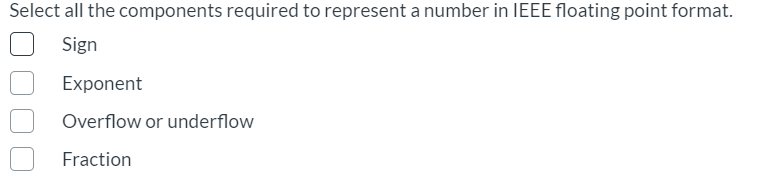



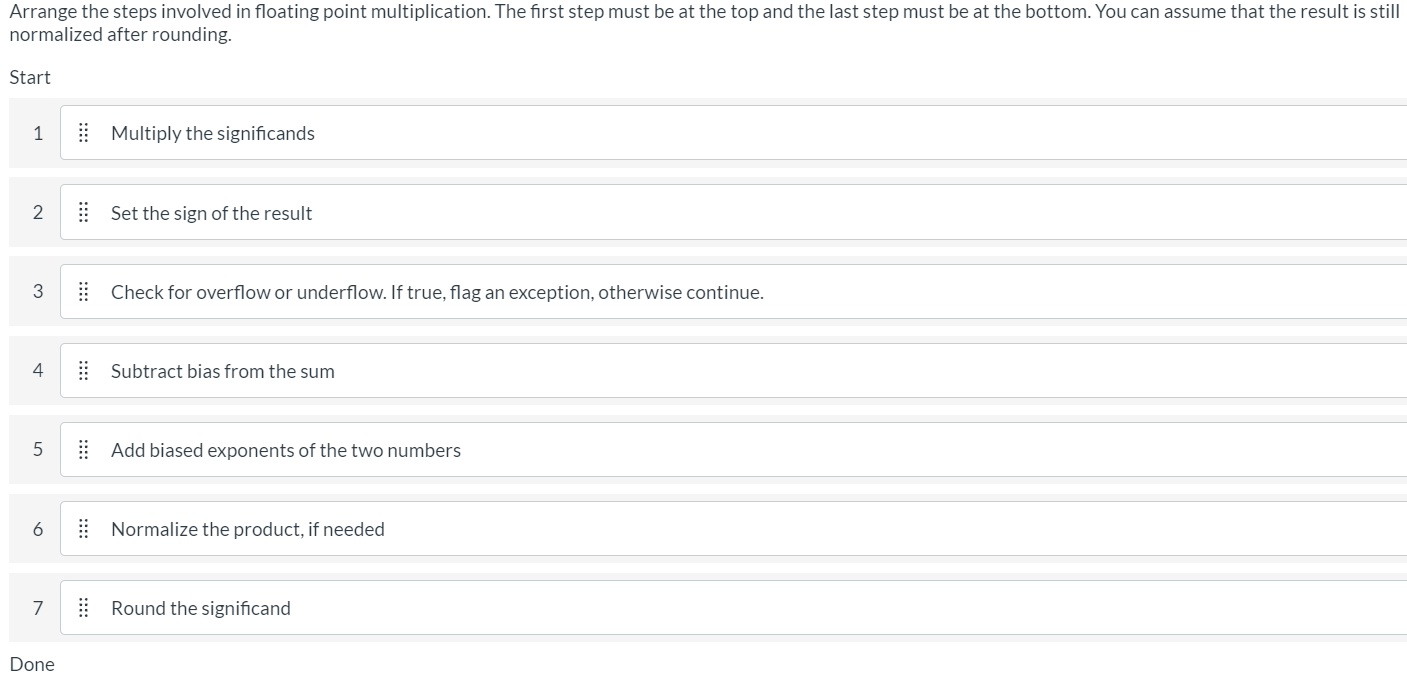
Select all the components required to represent a number in IEEE floating point format. Sign Exponent Overflow or underflow Fraction Consider a integer binary multiplication with a m bit multiplier and n bit multiplicand. What is the maximum number of bits required to store the results of the multiplication? m n m+n m-n Double precision floating point representation completely eliminates overflow and underflow present in single precision floating point representation. True False Consider the following binary number: 1.11000000000000000000100. What are the values of guard, round, and sticky bits after 8 right shifts? The encoding of the options is (guard)(round)(sticky). For example, if guard bit is 1, round is 0, and sticky bit is O, the encoding is 100. 100 001 000 010 Arrange the steps involved in floating point multiplication. The first step must be at the top and the last step must be at the bottom. You can assume that the result is still normalized after rounding. Start 1 Multiply the significands 2 Set the sign of the result 3 Check for overflow or underflow. If true, flag an exception, otherwise continue. 4. Subtract bias from the sum 5 Add biased exponents of the two numbers 6 Normalize the product, if needed 7 Round the significand Done
Step by Step Solution
There are 3 Steps involved in it

Get step-by-step solutions from verified subject matter experts
 Study Help