







Question: Show whether the MC for the gambler's ruin problem (sec 4.5.1) is time reversable. If yes, why? If not why? Prove! Derive the expected time
Show whether the MC for the gambler's ruin problem (sec 4.5.1) is time reversable. If yes, why? If not why? Prove! Derive the expected time that the MC will spend in state 0 after many steps (in the limit).
Derive the proportion of time that the MC will spend in state 0 after many steps (in the limit).
Assume that N is infinity. Show whether the state 0 is null recurrent, positive recurrent or transient.
Here is some general information about the problem that may assist you:
If we let Xn denote the player's fortune at time n, then the process {Xn, n =
0, 1, 2, . . .} is a Markov chain with transition probabilities
P00 = PNN = 1,
Pi,i+1 = p = 1 ? Pi,i?1, i = 1, 2, . . . , N ? 1
Markov Chains 221
This Markov chain has three classes, namely, {0}, {1, 2, . . . , N ?1}, and {N}; the first
and third class being recurrent and the second transient. Since each transient state is
visited only finitely often, it follows that, after some finite amount of time, the gambler
will either attain his goal of N or go broke.
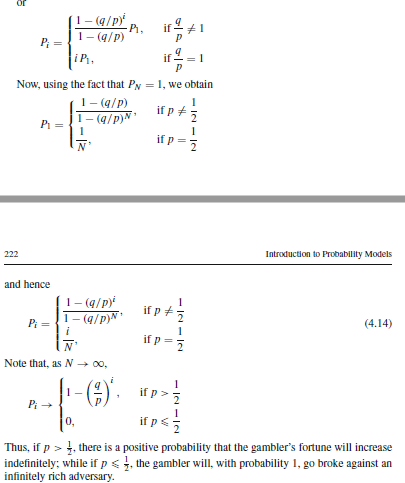
Let Pi , i = 0, 1, . . . , N, denote the probability that, starting with i, the gambler's
fortune will eventually reach N. By conditioning on the outcome of the initial play of
the game we obtain
\f
Step by Step Solution
There are 3 Steps involved in it

Get step-by-step solutions from verified subject matter experts
 Study Help