







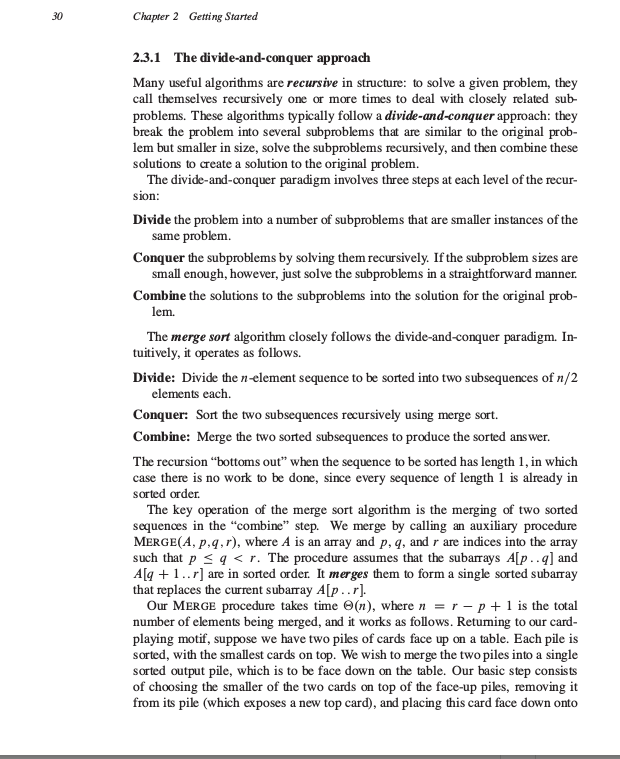
Question: Show work for problem below using loop invariant. Requires Initialization, Maitenance, and Termination. 30 Chapter 2 Getting Started 2.3.1 The divide-and-conquer approach Many useful algorithms
 Show work for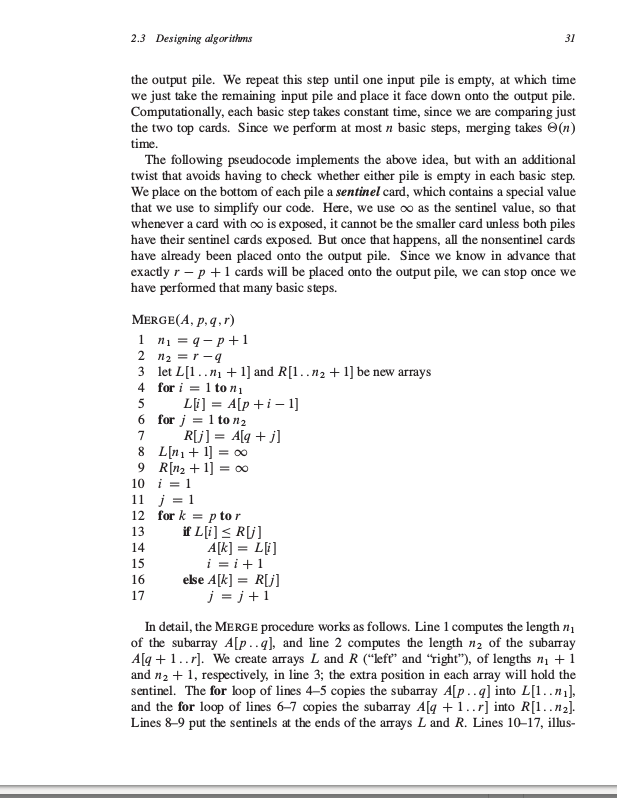
problem below using loop invariant. Requires Initialization, Maitenance, and Termination.
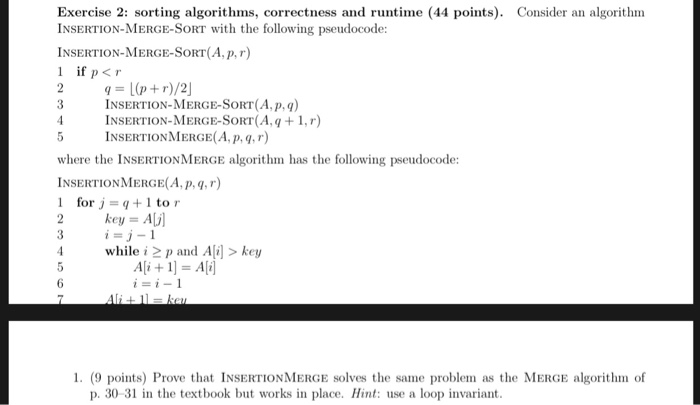
30 Chapter 2 Getting Started 2.3.1 The divide-and-conquer approach Many useful algorithms are recursive in structure: to solve a given problem, they call themselves recursively one or more times to deal with closely related sub problems. These algorithms typically follow a divide-and-conquer approach: they break the problem into several subproblems that are similar to the original prob- lem but smaller in size, solve the subproblems recursively, and then combine these solutions to create a solution to the original problem. The divide-and-conquer paradigm involves three steps at each level of the recur Sion Divide the problem into a number of subproblems that are smaller instances of the same problem. Conquer the subproblems by solving them recursively. If the subproblem sizes are small enough, however, just solve the subproblems in a straightforward manner. Combine the solutions to the subproblems into the solution for the original prob- lem. The merge sort algorithm closely follows the divide-and-conquer paradigm. In tuitively, it operates as follows. Divide: Divide the n-element sequence to be sorted into two subsequences of n/2 elements each. Conquer: Sort the two subsequences recursively using merge sort. Combine: Merge the two sorted subsequences to produce the sorted ans wer. The recursion "bottoms out" when the sequence to be sorted has length 1, in which case there is no work to be done, since every sequence of length 1 is already in sorted order. The key operation of the merge sort algorithm is the merging of two sorted sequences in the "combine" step. We merge by calling an auxiliary procedure MERGE(A, p,q,r), where A is an array and p, q, and r are indices into the array such that p sq
Step by Step Solution
There are 3 Steps involved in it

Get step-by-step solutions from verified subject matter experts
 Study Help