







Question: Since stirring rate (Factor C) is invalid for One-Way ANOVA and the experimenter strongly suspects that higher stirring would produce greater Powder Density and higher
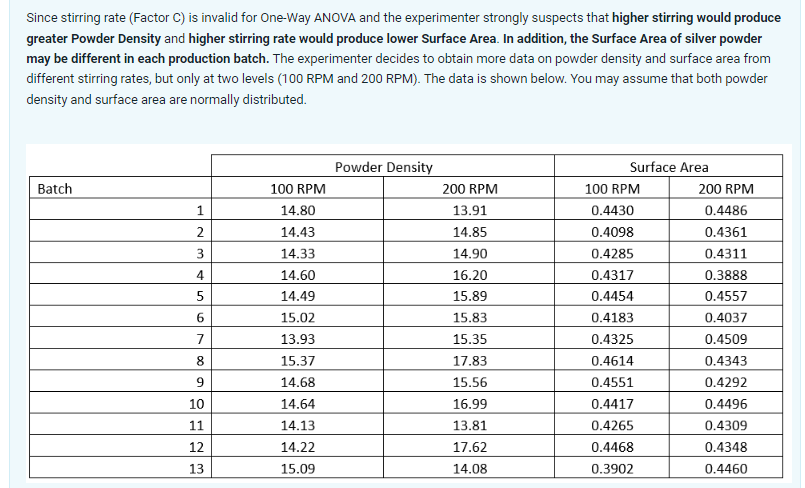
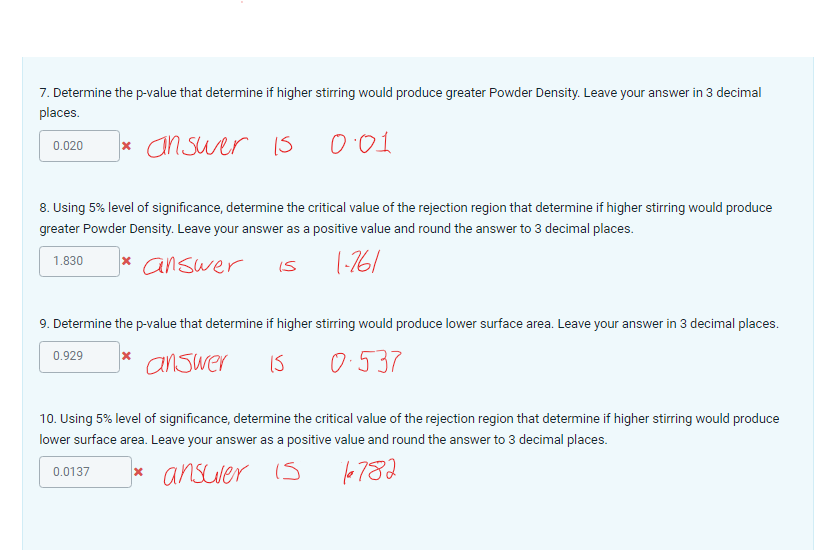
Since stirring rate (Factor C) is invalid for One-Way ANOVA and the experimenter strongly suspects that higher stirring would produce greater Powder Density and higher stirring rate would produce lower Surface Area. In addition, the Surface Area of silver powder may be different in each production batch. The experimenter decides to obtain more data on powder density and surface area from different stirring rates, but only at two levels (100 RPM and 200 RPM). The data is shown below. You may assume that both powder density and surface area are normally distributed. 7. Determine the p-value that determine if higher stirring would produce greater Powder Density. Leave your answer in 3 decimal places. * answer is 0.01 8. Using 5% level of significance, determine the critical value of the rejection region that determine if higher stirring would produce greater Powder Density. Leave your answer as a positive value and round the answer to 3 decimal places. * answer is .16 9. Determine the p-value that determine if higher stirring would produce lower surface area. Leave your answer in 3 decimal places. answer is 0.537 10. Using 5% level of significance, determine the critical value of the rejection region that determine if higher stirring would produce lower surface area. Leave your answer as a positive value and round the answer to 3 decimal places. * answer ls 10782 Since stirring rate (Factor C) is invalid for One-Way ANOVA and the experimenter strongly suspects that higher stirring would produce greater Powder Density and higher stirring rate would produce lower Surface Area. In addition, the Surface Area of silver powder may be different in each production batch. The experimenter decides to obtain more data on powder density and surface area from different stirring rates, but only at two levels (100 RPM and 200 RPM). The data is shown below. You may assume that both powder density and surface area are normally distributed. 7. Determine the p-value that determine if higher stirring would produce greater Powder Density. Leave your answer in 3 decimal places. * answer is 0.01 8. Using 5% level of significance, determine the critical value of the rejection region that determine if higher stirring would produce greater Powder Density. Leave your answer as a positive value and round the answer to 3 decimal places. * answer is .16 9. Determine the p-value that determine if higher stirring would produce lower surface area. Leave your answer in 3 decimal places. answer is 0.537 10. Using 5% level of significance, determine the critical value of the rejection region that determine if higher stirring would produce lower surface area. Leave your answer as a positive value and round the answer to 3 decimal places. * answer ls 10782
Step by Step Solution
There are 3 Steps involved in it

Get step-by-step solutions from verified subject matter experts
 Study Help