







Question: solution should be hand written The Project Audit Overview The executive boardroom was uncharacteristically quiet. The six executives sit- ting around the table had been
solution should be hand written
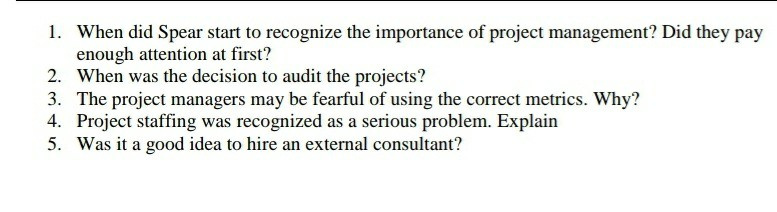
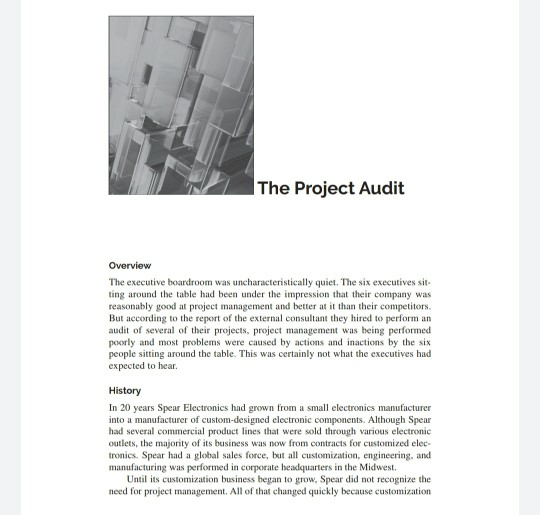
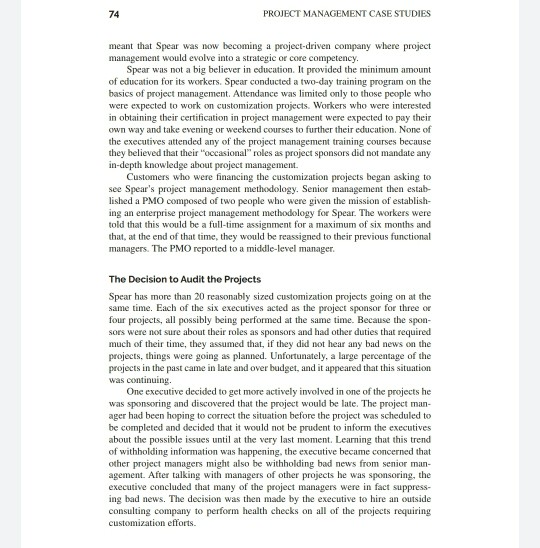
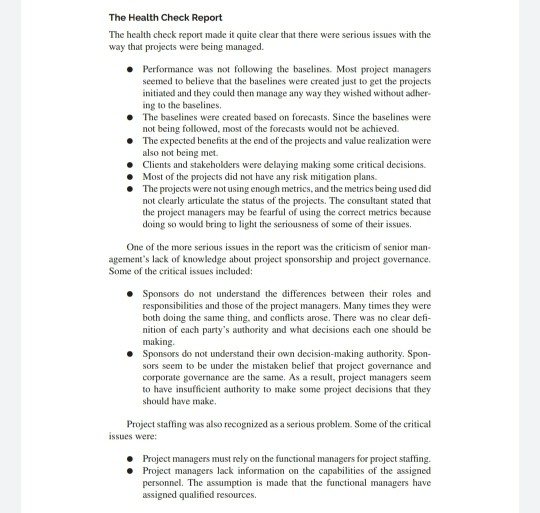
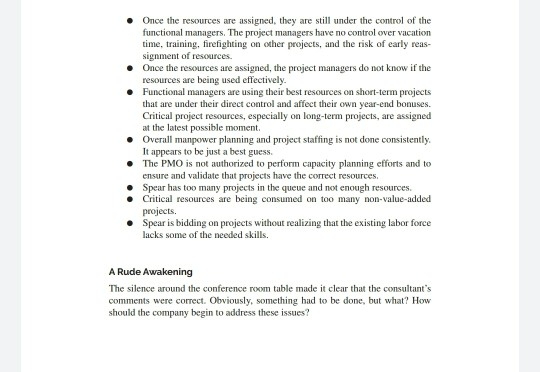
The Project Audit Overview The executive boardroom was uncharacteristically quiet. The six executives sit- ting around the table had been under the impression that their company was reasonably good at project management and better at it than their competitors But according to the report of the external consultant they hired to perform an audit of several of their projects, project management was being performed poorly and most problems were caused by actions and inactions by the six people sitting around the table. This was certainly not what the executives had expected to hear. History In 20 years Spear Electronics had grown from a small electronics manufacturer into a manufacturer of custom-designed electronic components. Although Spear had several commercial product lines that were sold through various electronic outlets, the majority of its business was now from contracts for customized elec tronics. Spear had a global sales force, but all customization, engineering, and manufacturing was performed in corporate headquarters in the Midwest. Until its customization business began to grow, Spear did not recognize the need for project management. All of that changed quickly because customization PROJECT MANAGEMENT CASE STUDIES meant that Spear was now becoming a project-driven company where project management would evolve into a strategic or core competency. Spear was not a big believer in education. It provided the minimum amount of education for its workers. Spear conducted a two-day training program on the basics of project management. Attendance was limited only to those people who were expected to work on customization projects. Workers who were interested in obtaining their certification in project management were expected to pay their own way and take evening or weekend courses to further their education. None of the executives attended any of the project management training courses because they believed that their occasional roles as project sponsors did not mandate any in-depth knowledge about project management. Customers who were financing the customization projects began asking to see Spear's project management methodology. Senior management then estab lished a PMO composed of two people who were given the mission of establish- ing an enterprise project management methodology for Spear. The workers were told that this would be a full-time assignment for a maximum of six months and that, at the end of that time, they would be reassigned to their previous functional managers. The PMO reported to a middle-level manager The Decision to Audit the Projects Spear has more than 20 reasonably sized customization projects going on at the same time. Each of the six executives acted as the project sponsor for three or four projects, all possibly being performed at the same time. Because the spon- soes were not sure about their roles as sponsors and had other duties that required much of their time, they assumed that, if they did not hear any bad news on the projects, things were going as planned. Unfortunately, a large percentage of the projects in the past came in late and over budget, and it appeared that this situation was continuing One executive decided to get more actively involved in one of the projects he was sponsoring and discovered that the project would be late. The project man ager had been hoping to correct the situation before the project was scheduled to be completed and decided that it would not be prudent to inform the executives about the possible issues until at the very last moment. Learning that this trend of withholding information was happening, the executive became concerned that other project managers might also be withholding bad news from senior man agement. After talking with managers of other projects he was sponsoring, the executive concluded that many of the project managers were in fact suppress- ing bad news. The decision was then made by the executive to hire an outside consulting company to perform health checks on all of the projects requiring customization efforts The Health Check Report The health check report made it quite clear that there were serious issues with the way that projects were being managed Performance was not following the baselines. Most project managers seemed to believe that the baselines were created just to get the projects initiated and they could then manage any way they wished without adher- ing to the baselines, The baselines were created based on forecasts. Since the baselines were not being followed, most of the forecasts would not be achieved. The expected benefits at the end of the projects and value realization were also not being met Clients and stakeholders were delaying making some critical decisions. Most of the projects did not have any risk mitigation plans. The projects were not using enkugh metrics, and the metrics being used did not clearly articulate the status of the projects. The consultant stated that the project managers may be fearful of using the correct metrics because doing so would bring to light the seriousness of some of their issues, One of the more serious issues in the report was the criticism of senior man agement's lack of knowledge about project sponsorship and project governance. Some of the critical issues included: Sponsors do not understand the differences between their roles and responsibilities and those of the project managers, Many times they were both doing the same thing, and conflicts arose. There was no clear defi- nition of each party's authority and what decisions each one should be making. Sponsors do not understand their own decision-making authority. Spon- sors seem to be under the mistaken belief that project governance and corporate governance are the same. As a result, project managers seem to have insufficient authority to make some project decisions that they should have make. Project staffing was also recognized as a serious problem. Some of the critical issues were: Project managers must rely on the functional managers for project staffing. Project managers lack information on the capabilities of the assigned personnel. The assumption is made that the functional managers have assigned qualified resources. Once the resources are assigned, they are still under the control of the functional managers. The project managers have no control over vacation time, training, firefighting on other projects, and the risk of early reas- signment of resources Once the resources are assigned, the project managers do not know if the resources are being used effectively. Functional managers are using their best resources on short-term projects that are under their direct control and affect their own year-end bonuses. Critical project resources, especially on long-term projects, are assigned at the latest possible moment. Overall manpower planning and project staffing is not done consistently It appears to be just a best guess. The PMO is not authorized to perform capacity planning efforts and to ensure and validate that projects have the correct resources Spear has too many projects in the queue and not enough resources Critical resources are being consumed on too many non-value-added projects. Spear is bidding on projects without realizing that the existing labor force lacks some of the needed skills. A Rude Awakening The silence around the conference room table made it clear that the consultant's comments were correct. Obviously, something had to be done, but what? How should the company begin to address these issues? 1. When did Spear start to recognize the importance of project management? Did they pay enough attention at first? 2. When was the decision to audit the projects? 3. The project managers may be fearful of using the correct metrics. Why? 4. Project staffing was recognized as a serious problem. Explain 5. Was it a good idea to hire an external consultant
Step by Step Solution
There are 3 Steps involved in it
1 Expert Approved Answer
Step: 1 Unlock

Question Has Been Solved by an Expert!
Get step-by-step solutions from verified subject matter experts
Step: 2 Unlock
Step: 3 Unlock
 Study Help