







Question: Solve ALL problems using a financial calculator; please do not use annuity formulas. Please show all work!!! A.) Iris Vang contributes $5,000 to her Individual
Solve ALL problems using a financial calculator; please do not use annuity formulas.
Please show all work!!!
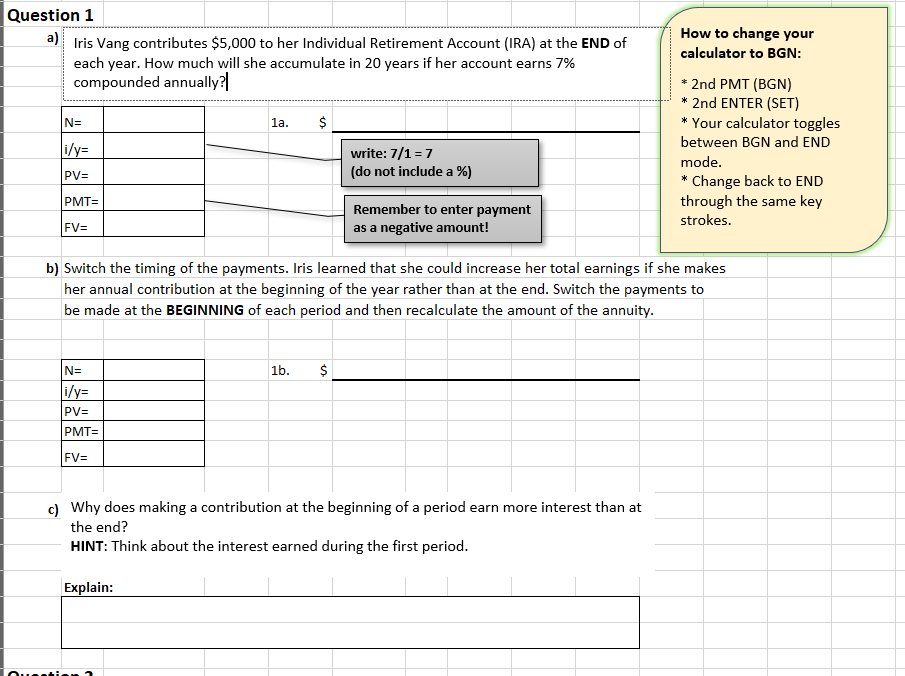
A.) Iris Vang contributes $5,000 to her Individual Retirement Account (IRA) at the END of each year. How much will she accumulate in 20 years if her account earns 7% compounded annually?
| B.) | Switch the timing of the payments. Iris learned that she could increase her total earnings if she makes | |||||||||||
| her annual contribution at the beginning of the year rather than at the end. Switch the payments to | ||||||||||||
| be made at the BEGINNING of each period and then recalculate the amount of the annuity. | ||||||||||||
| N= | 1b. $ | |||||||||||
| i/y= | ||||||||||||
| PV= | ||||||||||||
| PMT= | ||||||||||||
| FV= | ||||||||||||
C.) Why does making a contribution at the beginning of a period earn more interest than at the end?
HINT: Think about the interest earned during the first period.
Explain:
b) Switch the timing of the payments. Iris learned that she could increase her total earnings if she makes her annual contribution at the beginning of the year rather than at the end. Switch the payments to be made at the BEGINNING of each period and then recalculate the amount of the annuity. \begin{tabular}{|l|l|} \hline N= & \\ \hline i/y= & \\ \hline PV= & \\ \hline PMT= & \\ \hline FV= & \\ \hline \end{tabular} 1b. \$ c) Why does making a contribution at the beginning of a period earn more interest than at the end? HINT: Think about the interest earned during the first period
Step by Step Solution
There are 3 Steps involved in it

Get step-by-step solutions from verified subject matter experts
 Study Help