







Question: Solve in MATLAB Problem 1: Solving Linear Algebraic Equations Given below are four sets of linear algebraic equations a-d in two unknowns x and y:
Solve in MATLAB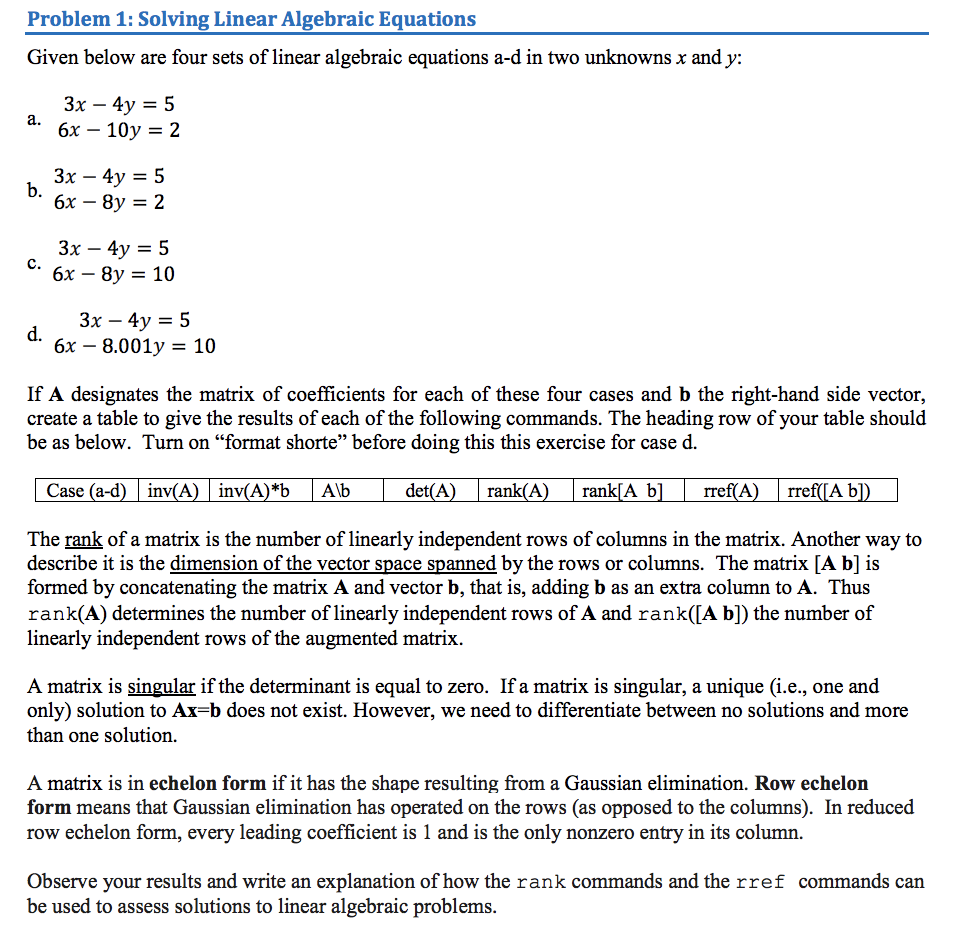
Problem 1: Solving Linear Algebraic Equations Given below are four sets of linear algebraic equations a-d in two unknowns x and y: a. 6x-10y = 2 b. 6x-8y = 10 d. 6x-8.00|y = 10 If A designates the matrix of coefficients for each of these four cases and b the right-hand side vector create a table to give the results of each of the following commands. The heading row of your table should be as below. Turn on "format shorte" before doing this this exercise for case d. Case (a-d)inv(A)inv(A)*bAllb det(A) rank(A) rank[A b rref(A) rref(TA b The rank of a matrix is the number of linearly independent rows of columns in the matrix. Another way to describe it is the dimension of the vector space spanned by the rows or columns. The matrix [A bl is formed by concatenating the matrix A and vector b, that is, adding b as an extra column to A. Thus rank(A) determines the number of linearly independent rows of A and rank([A b]) the number of linearly independent rows of the augmented matrix A matrix is singular if the determinant is equal to zero. Ifa matrix is singular, a unique (i.e., one and only) solution to Ax-b does not exist. However, we need to differentiate between no solutions and more than one solution. A matrix is in echelon form if it has the shape resulting from a Gaussian elimination. Row echelon form means that Gaussian elimination has operated on the rows (as opposed to the columns). In reduced row echelon form, every leading coefficient is 1 and is the only nonzero entry in its column. Observe your results and write an explanation of how the rank commands and the rref commands can be used to assess solutions to linear algebraic problems
Step by Step Solution
There are 3 Steps involved in it

Get step-by-step solutions from verified subject matter experts
 Study Help