







Question: Solve the problem using the Killbridge and Wester method in part and Solve the problem using the ranked positional weight method 4.22 The table below
Solve the problem using the Killbridge and Wester method in part and Solve the problem using the ranked positional weight method
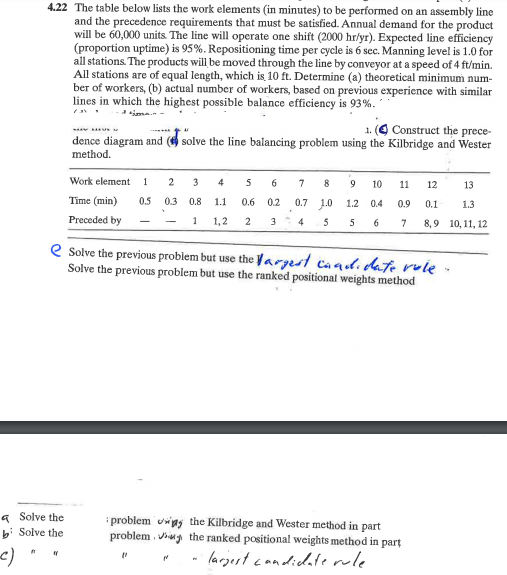
4.22 The table below lists the work elements (in minutes) to be performed on an assembly line and the precedence requirements that must be satisfied. Annual demand for the product will be 60,000 units The line will operate one shift (2000 hrlyr). Expected line efficiency (proportion uptime) is 95%. Repositioning time per cycle is 6 sec. Manning level is 1.0 for all stations.The products will be moved through the line by conveyor at a speed of 4 ft/min. All stations are of equal length, which is 10 ft. Determine (a) theoretical minimum num- ber of workers, (b) actual number of workers, based on previous experience with similar lines in which the highest possible balance efficiency is 93% . ( Construct the prece dence diagram and (solve the line balancing problem using the Kilbridge and Wester method. Work element 2 3 4 5 6 78 9 10 12 13 Time (min) 05 0.3 08 11 0.6 02 07 0 1.2 04 0.9 0.1 1.3 Preceded by1,2 23 45 5 6 78,9 10,11,12 Solve the previous problem but use the Varecaddate le Solve the previous problem but use the ranked positional weights method Solve the bSolve the problem oin the Kilbridge and Wester method in part problem vy the ranked positional weights method in part te
Step by Step Solution
There are 3 Steps involved in it

Get step-by-step solutions from verified subject matter experts
 Study Help