





Question: Solve the Prototype Example (Wyndor Glass Co.) by the Interior Point method with initial solution x1=3.0,x2=1.0. Use the IOR Tutorial: From the drop down menu
Solve the Prototype Example (Wyndor Glass Co.) bySolve the Prototype Example (Wyndor Glass Co.) by

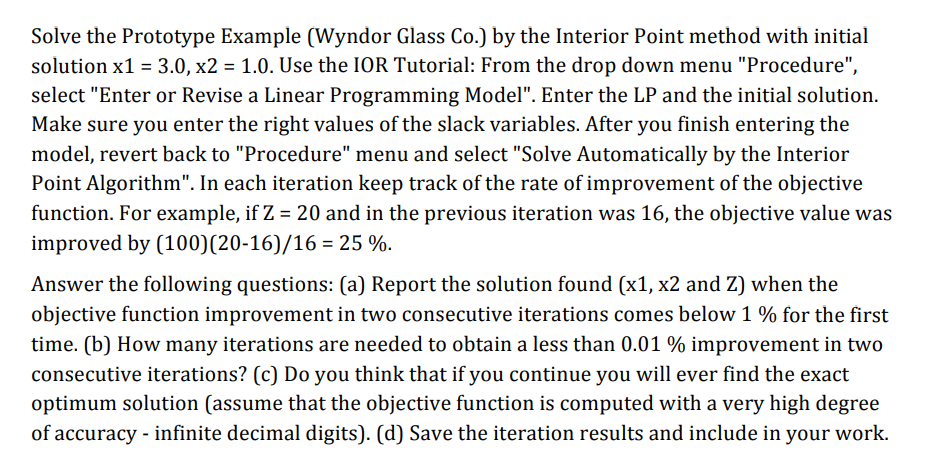
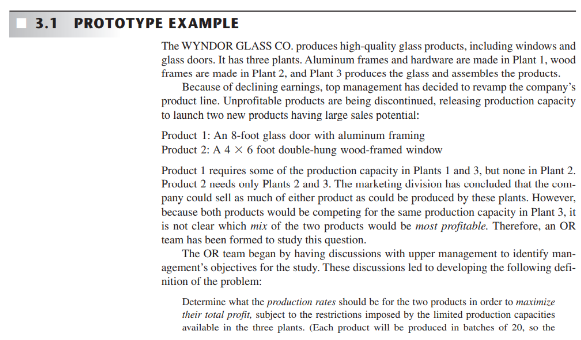
Solve the Prototype Example (Wyndor Glass Co.) by the Interior Point method with initial solution x1=3.0,x2=1.0. Use the IOR Tutorial: From the drop down menu "Procedure", select "Enter or Revise a Linear Programming Model". Enter the LP and the initial solution. Make sure you enter the right values of the slack variables. After you finish entering the model, revert back to "Procedure" menu and select "Solve Automatically by the Interior Point Algorithm". In each iteration keep track of the rate of improvement of the objective function. For example, if Z=20 and in the previous iteration was 16 , the objective value was improved by (100)(2016)/16=25%. Answer the following questions: (a) Report the solution found ( x1,x2 and Z ) when the objective function improvement in two consecutive iterations comes below 1% for the first time. (b) How many iterations are needed to obtain a less than 0.01% improvement in two consecutive iterations? (c) Do you think that if you continue you will ever find the exact optimum solution (assume that the objective function is computed with a very high degree of accuracy - infinite decimal digits). (d) Save the iteration results and include in your work. The WYNDOR GLASS CO. produces high-quality glass products, including windows and glass doors. It has three plants. Aluminum frames and hardware are made in Plant 1, wood frames are made in Plant 2, and Plant 3 produces the glass and assembles the products. Because of declining earnings, top management has decided to revamp the company's product line. Unprofitable products are being discontinued, releasing production capacity to launch two new products having large sales potential: Product 1: An 8-foot glass door with aluminum framing Product 2: A 46 foot double-hung wood-framed window Product 1 requires some of the production capacity in Plants 1 and 3, but none in Plant 2. Product 2 needs culy Plants 2 and 3. The markeling division has concluded that the company could sell as much of either product as could be produced by these plants. However, because both products would be competing for the same production capacity in Plant 3 , it is not clear which mix of the two products would be most profitable. Therefore, an OR team has been formed to study this question. The OR team began by having discussions with upper management to identify management's objectives for the study. These discussions led to developing the following definition of the problem: Determine what the production rates should be for the two products in order to maximize their total profit, subject to the restrictions imposed by the limited production capacities available in the three plants. (Each product will be produced in batches of 20 , so the

Step by Step Solution

There are 3 Steps involved in it

1 Expert Approved Answer
Step: 1 Unlock blur-text-image

Question Has Been Solved by an Expert!

Get step-by-step solutions from verified subject matter experts

Step: 2 Unlock
Step: 3 Unlock

Students Have Also Explored These Related General Management Questions!