







Question: Specific: Hands-On Task Reconsider the prototype example of the California Manufacturing company case study in section 7.1, page 904. Do the following: Study and understand
Specific:
Hands-On Task
Reconsider the prototype example of the California Manufacturing company case study in section 7.1, page 904. Do the following:
- Study and understand the case study (California Manufacturing company problem). Then refer to problem 7.1 on page 928 and formulate a BIP model in algebraic form for the problem.
- Download and open the Excel file named California Manufacturing Binary Integer Programming with SanDiego Template located under the Resources section on the Hands-On: Integer Linear Programming Assignment page.
- Modify the formulated mathematical model for the case study to that which you formulated for problem 7.2, page 928 as instructed in (b) (Hint: enter the data from the formulated BIP mathematical model into the appropriate Excel spreadsheet cell and make modifications where necessary).
- Obtain the BIP model optimal solution using Solver as explained in the Watch item,
- Answer these questions in a Word document and save your file as YourInitials-Wk6Hands-On:
- In two sentences, explain why there is a need to reformulate the original prototype model (on page 845) to that of Problem 7.2, page 928.
- Discuss the purpose of each variable in this newly formulated model.
- Draw a flowchart for how you used Excel Solver to obtain the optimal solution in (c).
- Upload the Excel and Word files
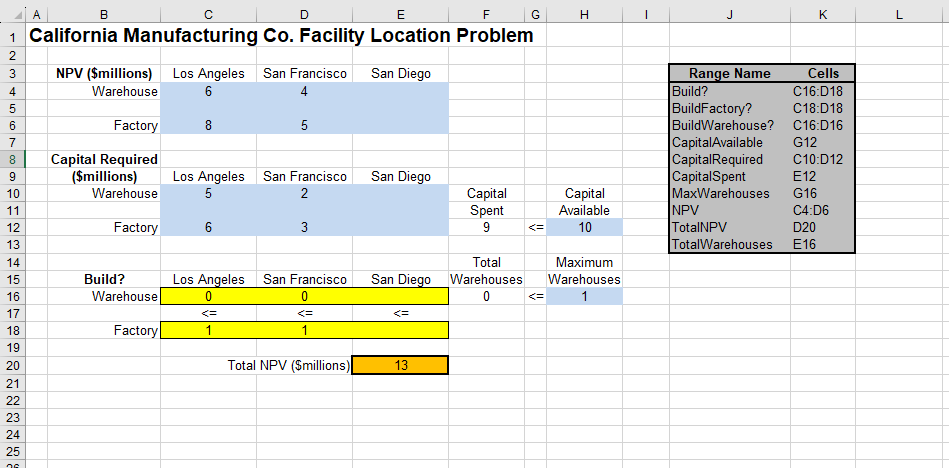
Reconsider the California Manufacturing Co. case study presented in Section 7.1.
The mayor of San Diego now has contacted the companys president, Armando Ortega, to try to persuade him to build a factory and perhaps a warehouse in that city. With the tax incentives being offered the company, Armandos staff estimates that the net present value of building a factory in San Diego would be $7 million and the amount of capital required to do this would be $4 million.
The net present value of building a warehouse there would be $5 million and the capital required would be $3 million.
(This option will only be considered if a factory also is being built there.) Armando has asked Steve Chan to revise his previous man-agement science study to incorporate these new alternatives into the overall problem.
The objective still is to find the feasible combination of investments that maximizes the total net present value, given that the amount of capital available for these invest-ments is $10 million. a.
Formulate a BIP model in algebraic form for this problem. b. Formulate and solve this model on a spreadsheet
Step by Step Solution
There are 3 Steps involved in it

Get step-by-step solutions from verified subject matter experts
 Study Help