







Question: Solve the question below giving explanations. Use the Edit menu in your browser to copy the 1000 numbers obtained in the coin tossing experiments. (d)

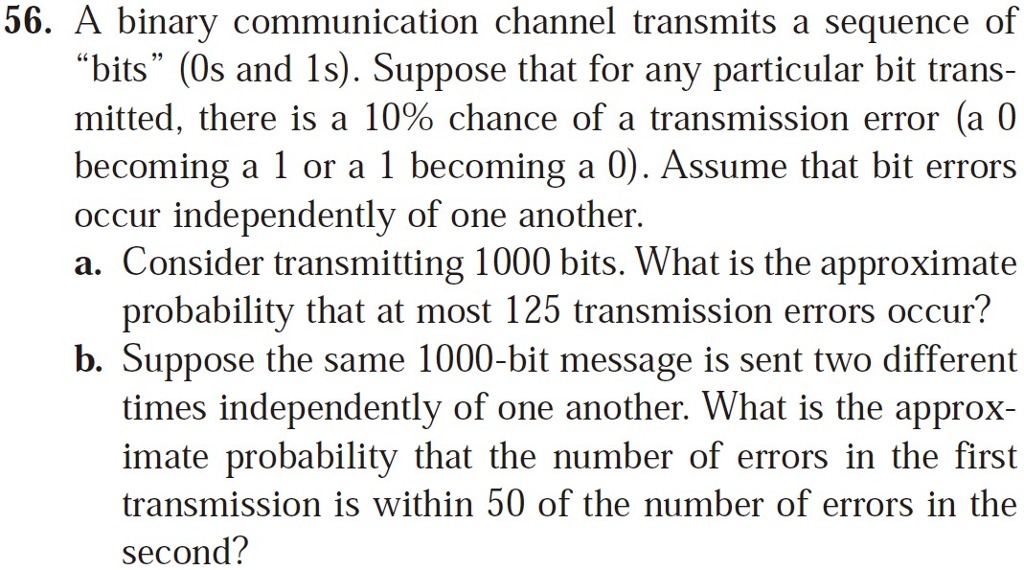
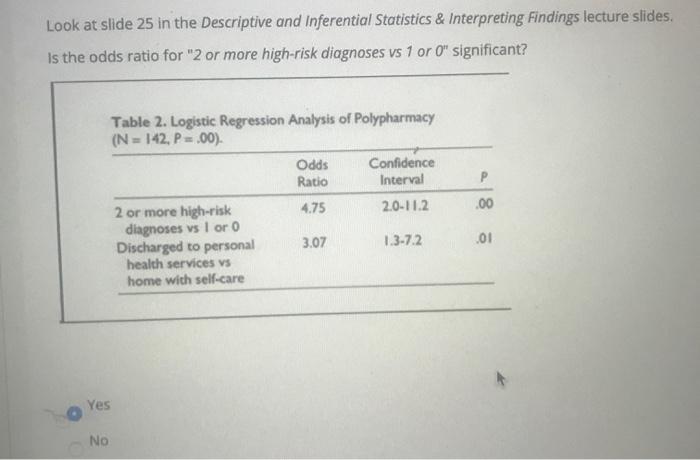
Solve the question below giving explanations.
Use the Edit menu in your browser to copy the 1000 numbers obtained
in the coin tossing experiments.
(d) Go back to LinuStats and choose the descriptive statistics page.
(e) Use the Edit menu in your browser to paste the 1000 numbers into the
data window.
(f) Choose a minimum value of 0, maximum value of 1, and window of
0.1
(g) Analyze the data by clicking the appropriate button.
(h) Copy the resulting relative frequency table and transform it into a cumulative distribution function
(i) Copy the Mean and SD (Standard Deviation) of the 1000 numbers.
Explain what this standard deviation means. I'll call these numbers
X and ?X
(j) Compare the obtained cumulative distribution function with that predicted by a Gaussian distribution with mean X and standard deviation
?X
What is less probable: 1) to get 80 or more tails out of tossing a fair coin 100
times, 2) to get 30 or more tails out of tossing a fair coin 50 times. NOTE:
Since n > 30 you can assume that the cumulative distribution of the mean
is approximately Gaussian.
4. An experimenter inserts intracellular electrodes on a large sample of randomly selected neurons in primary visual cortex (V1). Intracellular electrodes are designed to measure the response of single neurons. The researcher finds the average response of the neurons is 10 mVolts and the
standard deviation 1 mVolt. On a subsequent experiment the researcher
inserts extracellular electrodes on randomly selected location in V1. Extracellular electrodes compute the average response of a number of neurons
around the tip of the electrode. The researcher finds that when the electrode
is extracellular the average response is still 10 mVolts but the standard deviation goes down to 0.01 mVolts. Assume the neurons in V1 are independent
and have identical response distributions.
(a) Explain how the standard deviation of the mean of n independent random variables changes as the number of random variables increases.
(b) Estimate how many neurons are having an effect on the extracellular
electrode. Justify your response


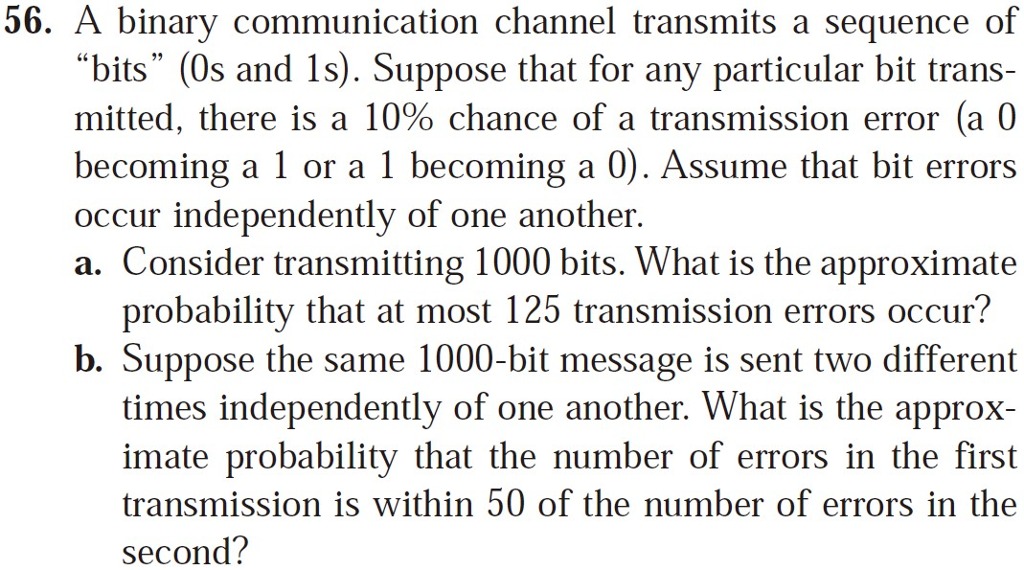
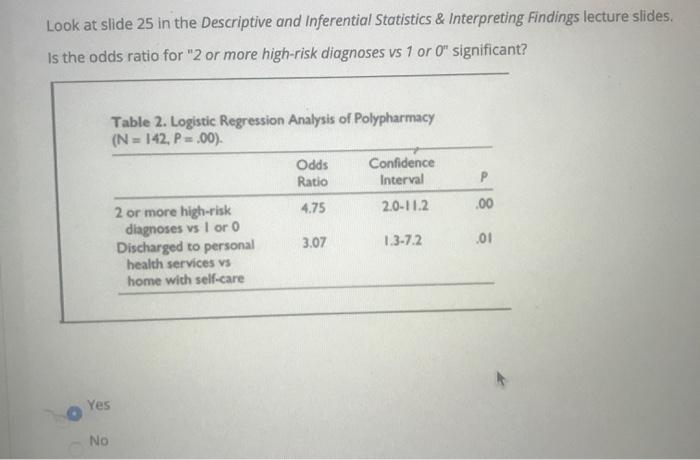
connect BUSINESS STATISTICS ctice: Connect Knowledge Check score this que
Step by Step Solution
There are 3 Steps involved in it

Get step-by-step solutions from verified subject matter experts
 Study Help