







Question: solve these USE the data set 3; a: T 2 5t] 15 1011] 30 4t] 1t} 7t] '20 {3} Plot the data. {h} Fit a
solve these
![solve these USE the data set 3; a: T 2 5t] 15](https://dsd5zvtm8ll6.cloudfront.net/si.experts.images/questions/2024/10/67070b9d9d376_97367070b9d91bc4.jpg)
![1011] 30 4t] 1t} 7t] '20 {3} Plot the data. {h} Fit](https://dsd5zvtm8ll6.cloudfront.net/si.experts.images/questions/2024/10/67070b9ddddd6_97367070b9dcd0d6.jpg)
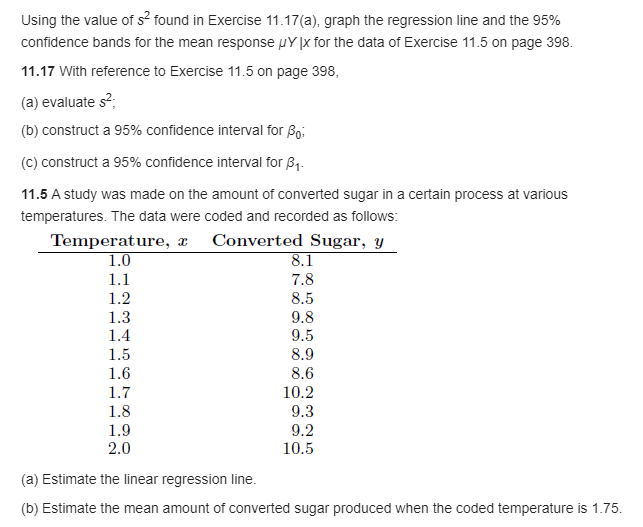
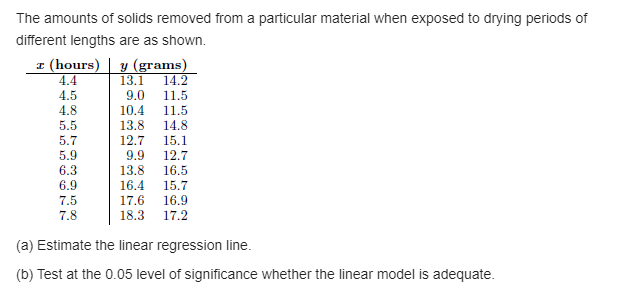
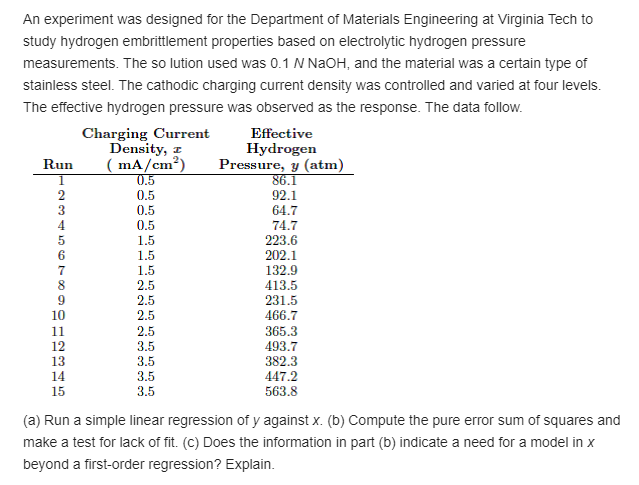

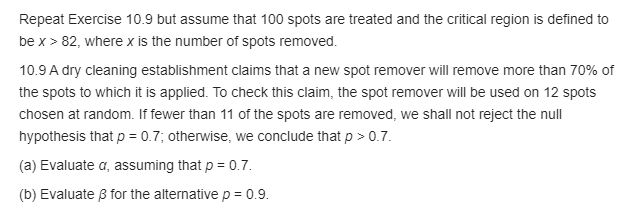
USE the data set 3; a: T 2 5t] 15 1011] 30 4t] 1t} 7t] '20 {3} Plot the data. {h} Fit a regression line through the origin. is} Plot the regression line on the graph with the data. {d} Give a general formula {in terms of the pi and the slope s1} for the esh'mator of 02. {e} owe a formula forVar (i ) r= 1, 2, . . . , n, for this case. if} Plot 95% condence limits for the mean response on the graph around the regression line. In Applied Spectroscopy, the infrared reflectance spectra properties of a viscous liquid used in the electronics industry as a lubricant were studied. The designed experiment consisted of the effect of band frequency x, and film thickness x2 on optical density y using a Perkin-Elmer Model 621 infrared spectrometer. (Source: Pacansky, J., England, C. D., and Wattman, R., 1986.) 0.231 740 1.10 0.107 740 0.62 0.053 740 0.31 0.129 805 1.10 0.069 805 0.62 0.030 805 0.31 1.005 980 1.10 0.559 980 0.62 0.321 980 0.31 2.948 1235 1.10 1.633 1235 0.62 0.934 1235 0.31 Estimate the multiple linear regression equation y = bo + bir1 + b2x2.Using the value ofs2 round in Exercise 11.1?[a}, graph the regression line and the 95% condence bands for the mean response p'r'pr for the data of Exercise 11.5 on page 355. 11.1?r With reference to Exercise 11.5 on page 398, {a} evaluate 52; {h} construct a 95% confidence interval for u; {c} construct a 95% condence interval for 151. 11.5 .lftstudy.r was made on the amount of converted sugar in a certain process at various temperatures. The data were coded and recorded as follows: Temperature, 3 Converted Sugar, 3; 1.9 8.1 1.1 18 1.2 8.5 1.3 9.8 1.4 9.5 1.5 8.9 1.8 8.5 1.? 19.2 1.8 9.3 1.9 9.2 2.9 19.5 {a} Estimate the linear regression line. {5} Estimate the mean amount of converted sugar produced when the coded temperature is 1.?5. The amounts of solids removed from a particular material when exposed to drying periods of different lengths are as shown. 2 [hours] 3; {grams} {a} Estimate the linear regression line. in) Test at the ops level of signicance whetherthe linear model is adequate. An experiment was designed for the Department of Materials Engineering at Virginia Tech to study hydrogen embriltlement properties based on electrolytic hydrogen pressure measurements. The so Iuljon used was [11 N NaDH. and the material was a certain type of stainless steel. The cathodic charging current density was controlled and varied at four levels. The effective hydrogen pressure was observed as the response. The data follow. Charging Curr-t. EfFective Density, :3. Hydrogen Run { rnAfcmE} Pressure, 1: [atm] 1 5.5 35.1 2 l[L5 92.1 3 115 54.'i'r 4 l[L5 34.7 5 1.5 223.5 5 1.5 252.1 \"J? 1.5 132.9 8 2.5 413.5 9 2.5 231.5 15 2.5 455.'ir 11 2.5 355.3 12 3.5 433.1r 13 3.5 332.3 14 3.5 44?.2 15 3.5 553.8 {a} Run a simple linear regression of y against 1.. {b} Compute the pure error sum of squares and make a test for laclt of lit. (c) Does the information in part (b} indicate a need for a model in x beyond a rstorder regression? Explain. \f\fRepeat Exercise 10.9 but assume that 1oo spots are treated and the critical region is dened to he x :=- 32, where x is the number of spots removed. 10.9 i'itdriir cleaning establishment claims that a new spot remover will remove more than TFG'K: of the spots to which it is applied. To check; this claim, the spot remover will he used on 12 spots chosen at random. If fewer than 11 of the spots are removed, we shall not reject the null hypothesis that p = (1?; otherwise, we conclude that p :-~ [l]. {a} Evaluate o, assuming that p = (1?. in} Evaluate p for the altemaijve p = as
Step by Step Solution
There are 3 Steps involved in it

Get step-by-step solutions from verified subject matter experts
 Study Help