







Question: solve this problem please 8. We completed Discussion 2 with the model rocket momentarily motionless - neither rising nor falling - at about 260 m
solve this problem please
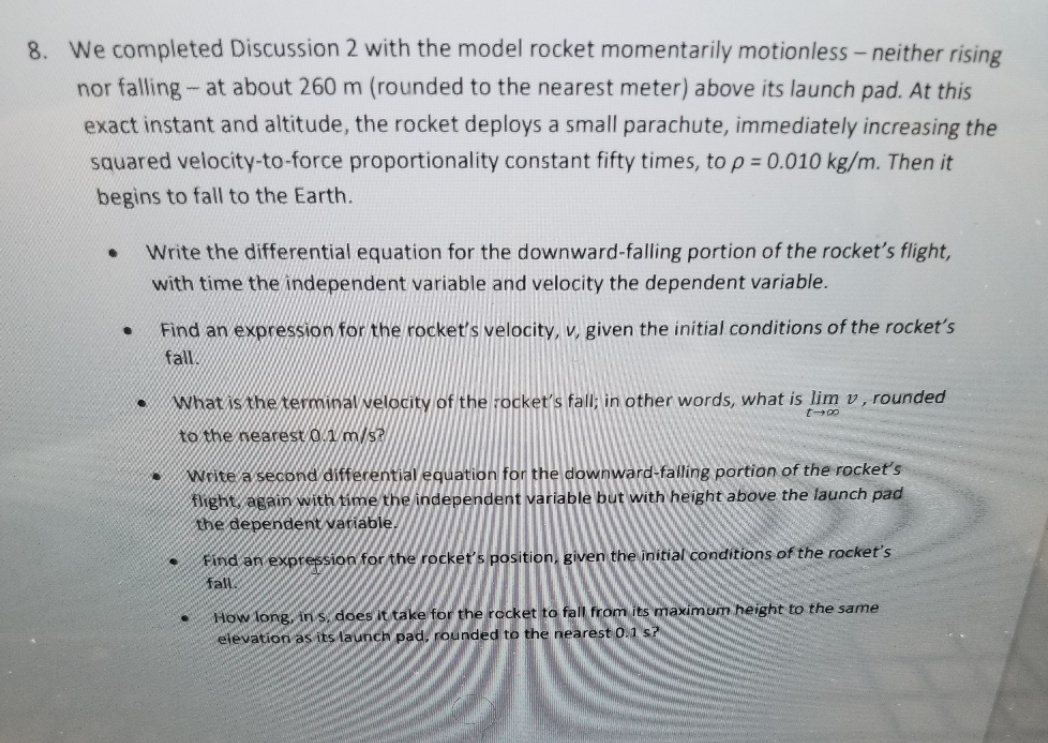
8. We completed Discussion 2 with the model rocket momentarily motionless - neither rising nor falling - at about 260 m (rounded to the nearest meter) above its launch pad. At this exact instant and altitude, the rocket deploys a small parachute, immediately increasing the squared velocity-to-force proportionality constant fifty times, to p = 0.010 kg/m. Then it begins to fall to the Earth. . Write the differential equation for the downward-falling portion of the rocket's flight, with time the independent variable and velocity the dependent variable. Find an expression for the rocket's velocity, v, given the initial conditions of the rocket's fall . What is the terminal velocity of the rocket's fall; in other words, what is lim v , rounded 1-00 to the nearest 0.1 m/s? . Write a second differential equation for the downward-falling portion of the rocket's flight, again with time the independent variable but with height above the launch pad the dependent variable. Find an expression for the rocket's position, given the initial conditions of the rocket's fall How long, in's. does it take for the rocket to fall from its maximum height to the same elevation as its launch pad, rounded to the nearest 0.1's
Step by Step Solution
There are 3 Steps involved in it

Get step-by-step solutions from verified subject matter experts
 Study Help