







Question: Solved questions: 1) How many days per week do the surgeons actually do surgeries? The surgeons perform surgery four days per week. Actual surgery time
Solved questions:
1) How many days per week do the surgeons actually do surgeries?
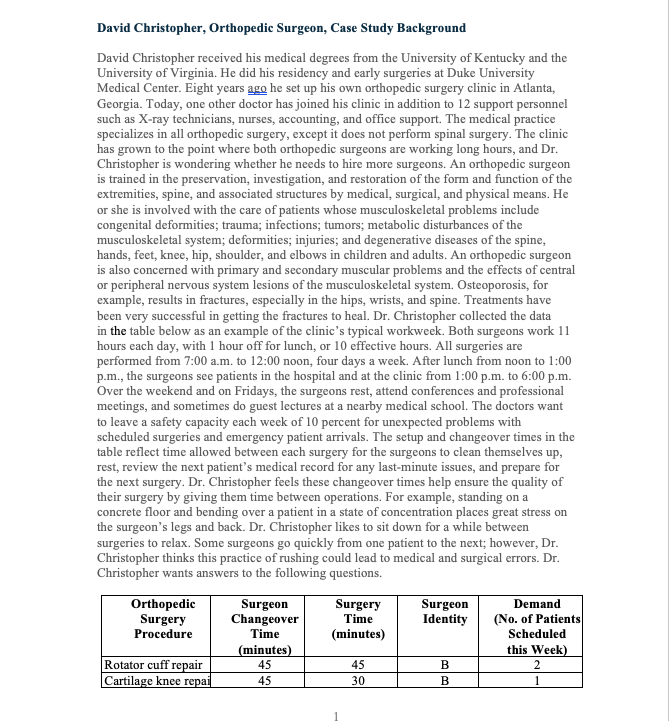
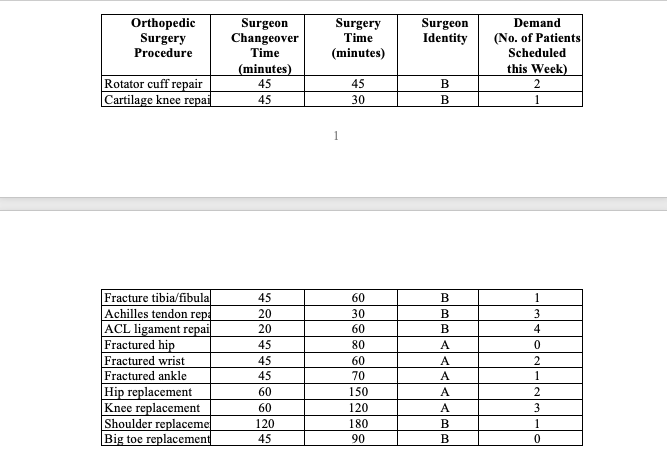
The surgeons perform surgery four days per week. Actual surgery time is 1,540 minutes in a week. If you take 1540/60= 25.67 hour per week. This results in 12.83 hours per week/per surgeon, which actually means they perform surgery 1.283 days per week.
2) How many hours per day do the surgeons allow for surgery, reduced of course for safety time?
The total surgery time can be proportioned as 1540:875. They perform surgery from 7:00 AM to 12:00PM which is five hours. But because they take safety precautions technically, they allow 3.18 hours for surgery. (Calculation): 5*(1540/(1540+875))= 3.18 hours
NEED ANSWERS TO THESE QUESTIONS HERE PLEASE:
3) Given the answers to the questions above, how many total hours per week does each surgeon individually plan for surgery?
4) Collectively then, how many hours per week are available for surgery between the two surgeons?
David Christopher, Orthopedic Surgeon, Case Study Background David Christopher received his medical degrees from the University of Kentucky and the University of Virginia. He did his residency and early surgeries at Duke University Medical Center. Eight years ago he set up his own orthopedic surgery clinic in Atlanta, Georgia. Today, one other doctor has joined his clinic in addition to 12 support personnel such as X-ray technicians, nurses, accounting, and office support. The medical practice specializes in all orthopedic surgery, except it does not perform spinal surgery. The clinic has grown to the point where both orthopedic surgeons are working long hours, and Dr. Christopher is wondering whether he needs to hire more surgeons. An orthopedic surgeon is trained in the preservation, investigation, and restoration of the form and function of the extremities, spine, and associated structures by medical, surgical, and physical means. He or she is involved with the care of patients whose musculoskeletal problems include congenital deformities; trauma; infections; tumors, metabolic disturbances of the musculoskeletal system; deformities; injuries, and degenerative diseases of the spine, hands, feet, knee, hip, shoulder, and elbows in children and adults. An orthopedic surgeon is also concerned with primary and secondary muscular problems and the effects of central or peripheral nervous system lesions of the musculoskeletal system. Osteoporosis, for example, results in fractures, especially in the hips, wrists, and spine. Treatments have been very successful in getting the fractures to heal. Dr. Christopher collected the data in the table below as an example of the clinic's typical workweek. Both surgeons work 11 hours each day, with 1 hour off for lunch, or 10 effective hours. All surgeries are performed from 7:00 a.m. to 12:00 noon, four days a week. After lunch from noon to 1:00 p.m., the surgeons see patients in the hospital and at the clinic from 1:00p.m. to 6:00p.m. Over the weekend and on Fridays, the surgeons rest, attend conferences and professional meetings, and sometimes do guest lectures at a nearby medical school. The doctors want to leave a safety capacity each week of 10 percent for unexpected problems with scheduled surgeries and emergency patient arrivals. The setup and changeover times in the table reflect time allowed between each surgery for the surgeons to clean themselves up, rest, review the next patient's medical record for any last-minute issues, and prepare for the next surgery. Dr. Christopher feels these changeover times help ensure the quality of their surgery by giving them time between operations. For example, standing on a concrete floor and bending over a patient in a state of concentration places great stress on the surgeon's legs and back. Dr. Christopher likes to sit down for a while between surgeries to relax. Some surgeons go quickly from one patient to the next; however, Dr. Christopher thinks this practice of rushing could lead to medical and surgical errors. Dr. Christopher wants answers to the following questions. Orthopedic Surgery Procedure Surgeon Changeover Time (minutes) 45 45 Surgery Time (minutes) Surgeon Identity Demand (No. of Patients Scheduled this Week) 2 Rotator cuff repair Cartilage knee repai 45 30 B B Orthopedic Surgery Procedure Surgery Time (minutes) Surgeon Identity Surgeon Changeover Time (minutes) 45 45 Demand (No. of Patients Scheduled this Week) 2 Rotator cuff repair Cartilage knee repail 45 30 B B 3 4 0 2 Fracture tibia/fibula Achilles tendon rep! ACL ligament repai Fractured hip Fractured wrist Fractured ankle Hip replacement Knee replacement Shoulder replaceme Big toe replacement 45 20 20 45 45 45 60 60 120 45 60 30 60 80 60 70 150 120 180 90 B B B A A A B B 2 3 0Step by Step Solution
There are 3 Steps involved in it

Get step-by-step solutions from verified subject matter experts
 Study Help